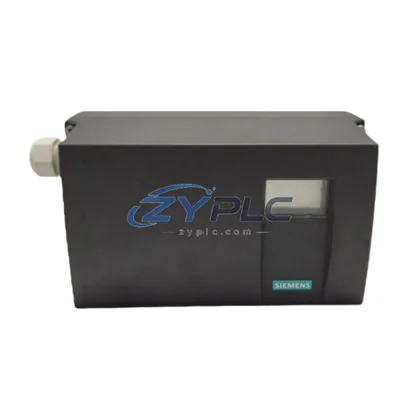
Siemens 6DR5013-0FN00-0AA3 Positioner for SIPART PS2
The Siemens 6DR5013-0FN00-0AA3 is an electropneumatic positioner engineered for seamless integration within the SIPART PS2 control system architecture. In modern industrial automation, a positioner is never a standalone device — it is a critical node within a layered control hierarchy that spans the control layer, I/O layer, field bus network, power distribution layer, human-machine interface, and final control elements. The 6DR5013-0FN00-0AA3 is designed to fulfill this role with precision, reliability, and long-term maintainability across demanding process environments.
Within a complete distributed control system (DCS) or PLC-based architecture, the 6DR5013-0FN00-0AA3 receives its setpoint signal from the control layer — typically a Siemens SIMATIC S7-300 or S7-400 CPU module — via a 4–20 mA analog output channel. The positioner translates this electrical signal into a precise pneumatic output, actuating control valves in process lines with high repeatability. This signal flow — from CPU to analog output module, through field wiring to the positioner, and finally to the pneumatic actuator — represents the fundamental execution path of any process control loop.
At the I/O layer, the 6DR5013-0FN00-0AA3 interfaces with SIMATIC ET 200 distributed I/O stations or directly with analog output modules such as the SM 332 or SM 331 series. These modules provide the conditioned 4–20 mA signal required for positioner operation, while simultaneously receiving feedback signals from the positioner’s integrated position sensor. This closed-loop feedback architecture ensures that valve position is continuously monitored and corrected, maintaining process stability even under variable supply pressure or mechanical load conditions.
Network communication within the system is handled at a higher layer. The 6DR5013-0FN00-0AA3 supports HART protocol overlay on the 4–20 mA signal, enabling asset management and diagnostic data to be transmitted to the control room without additional wiring. When integrated with a Siemens SIMATIC PDM (Process Device Manager) or connected via a HART multiplexer to a PROFIBUS PA segment, the positioner becomes a fully addressable field device within the plant asset management framework. This capability is essential for predictive maintenance strategies and reduces unplanned downtime in continuous process operations.
Power distribution to the positioner and its associated field instruments is managed through the plant’s 24 VDC power supply infrastructure. Siemens SITOP power supply modules, commonly deployed in the same control cabinet as the S7 CPU and I/O racks, provide stable, filtered DC power to the analog output modules and HART communication interfaces. The 6DR5013-0FN00-0AA3 itself is loop-powered, drawing its operating energy from the 4–20 mA signal loop, which simplifies field wiring and reduces the number of dedicated power conductors required in the cable tray.
At the human-machine interface layer, operators interact with the control loop through SIMATIC WinCC SCADA software or a SIMATIC HMI panel such as the TP700 or TP1200 Comfort series. These interfaces display real-time valve position, setpoint deviation, and positioner diagnostic status, allowing operators to identify valve stiction, actuator wear, or supply pressure anomalies before they escalate into process upsets. The integration of positioner diagnostics into the HMI layer is a key advantage of the SIPART PS2 platform and the 6DR5013-0FN00-0AA3 in particular.
Redundancy design is another critical consideration in high-availability process plants. The 6DR5013-0FN00-0AA3 can be deployed in architectures where the control signal is sourced from a redundant analog output module pair, ensuring that a single module failure does not interrupt valve control. In safety instrumented systems (SIS), the positioner may be paired with a solenoid valve and a partial stroke testing (PST) function to verify actuator operability without taking the valve offline. This approach is consistent with IEC 61511 requirements for safety loop integrity.
From a maintenance and lifecycle perspective, the 6DR5013-0FN00-0AA3 is designed for in-situ calibration and parameter adjustment using the SIMATIC PDM software or the local adjustment buttons on the positioner housing. Spare parts availability, firmware compatibility with existing SIPART PS2 installations, and the warranty terms confirmed during quotation provided with every unit from ZYPLC ensure that plant engineers can maintain system consistency without costly re-engineering. The positioner’s compact housing and standard mounting interface also simplify replacement in the field, minimizing valve downtime during scheduled maintenance windows.
Product Specification Table
| Parameter |
Specification |
| System Role |
Electropneumatic Positioner — Final Control Element Interface |
| SKU / Part Number |
6DR5013-0FN00-0AA3 |
| Brand / Series |
Siemens SIPART PS2 |
| Input Signal |
4–20 mA (2-wire, loop-powered) |
| HART Communication |
HART 5 / HART 7 overlay on 4–20 mA loop |
| Supply Pressure |
1.4 – 7 bar (20 – 101 psi) |
| Output Pressure |
0.2 – 6 bar (adjustable) |
| Actuator Compatibility |
Single-acting and double-acting pneumatic actuators |
| Position Feedback |
Integrated non-contact position sensor |
| Enclosure Rating |
IP66 / NEMA 4X |
| Ambient Temperature |
-40°C to +80°C |
| Explosion Protection |
ATEX / IECEx (Ex ia / Ex d) |
| Mounting Standard |
IEC 60534-6 (NAMUR) |
| Communication Protocol |
HART, PROFIBUS PA (variant-dependent) |
| Warranty |
warranty terms confirmed during quotation (ZYPLC) |
System Compatibility Notes
The 6DR5013-0FN00-0AA3 achieves its full potential when deployed as part of a coordinated control system rather than as an isolated field device. In a typical process plant control cabinet, the Siemens SIMATIC S7-400 CPU serves as the central processing unit, executing PID control algorithms and generating setpoint signals for all field positioners. The CPU communicates with distributed I/O via PROFIBUS DP, connecting to ET 200M remote I/O stations equipped with SM 332 analog output modules that drive the 4–20 mA signal to the 6DR5013-0FN00-0AA3.
Within the same control architecture, SIMATIC S7-300 CPUs may be deployed for local control loops in satellite control rooms, with the 6DR5013-0FN00-0AA3 serving as the field execution element for temperature, pressure, flow, or level control loops. The SITOP PSU100S 24 VDC power supply module provides stable power to the I/O rack, while the CP 343-1 communication processor manages Ethernet connectivity to the plant-wide SCADA network.
For asset management and diagnostics, the SIMATIC PDM software communicates with the 6DR5013-0FN00-0AA3 via the HART interface on the analog output module, retrieving positioner self-diagnostic data including travel accumulation, zero point deviation, and actuator response time. This data is archived in the plant asset management database and used to schedule predictive maintenance interventions. In plants using PROFIBUS PA, the positioner variant with PA communication can be connected directly to a DP/PA coupler, integrating the positioner into the PROFIBUS segment alongside pressure transmitters, flow meters, and temperature sensors.
Terminal modules such as the Siemens SIMATIC S7 SM 321 digital input module provide discrete feedback signals from limit switches mounted on the valve actuator, confirming open and closed positions independently of the positioner’s analog feedback. This dual-feedback architecture improves diagnostic confidence and supports safety interlock functions. In control cabinets with high channel density, the use of Weidmüller or Phoenix Contact terminal blocks alongside the Siemens I/O modules ensures organized, labeled wiring that simplifies commissioning and future modifications.
Industrial Application Notes
The 6DR5013-0FN00-0AA3 is deployed across a wide range of industrial sectors where precise valve positioning is critical to process quality, safety, and efficiency. In the oil and gas industry, the positioner controls flow control valves on wellhead manifolds, separator vessels, and pipeline pressure regulation stations, where its ATEX-certified explosion-proof housing ensures safe operation in Zone 1 and Zone 2 hazardous areas. The HART diagnostic capability allows remote monitoring of valve health from the central control room, reducing the need for field inspections in remote or hazardous locations.
In chemical and petrochemical plants, the 6DR5013-0FN00-0AA3 is used on reactor feed control valves, distillation column reflux valves, and heat exchanger bypass valves. The positioner’s high positioning accuracy and fast response time are essential for maintaining tight temperature and pressure control in exothermic reactions. Its wide ambient temperature range (-40°C to +80°C) makes it suitable for both outdoor installations in cold climates and hot process areas near furnaces or heat exchangers.
Water and wastewater treatment facilities deploy the 6DR5013-0FN00-0AA3 on aeration control valves, chemical dosing valves, and filter backwash control valves. The IP66 enclosure rating provides reliable protection against water ingress and washdown in wet process areas. Power generation plants use the positioner on turbine bypass valves, boiler feedwater control valves, and steam pressure reducing valves, where precise control is critical for grid stability and boiler protection.
In the mining and metallurgical industry, the 6DR5013-0FN00-0AA3 controls slurry flow valves, flotation cell aeration valves, and furnace atmosphere control valves. The positioner’s robust construction and wide supply pressure range accommodate the variable pneumatic supply conditions common in mining environments. Packaging and food processing lines use the positioner on filling valves, CIP (clean-in-place) valves, and product diverter valves, where hygienic design and repeatable positioning accuracy are essential for product quality and regulatory compliance.
Product Compatibility FAQ
Q1: Is the 6DR5013-0FN00-0AA3 compatible with existing SIPART PS2 installations using PROFIBUS PA communication?
A: The 6DR5013-0FN00-0AA3 is a HART-communication variant of the SIPART PS2 positioner family. For PROFIBUS PA integration, the corresponding PA variant (e.g., 6DR5013-0PN00-0AA3) should be selected. Both variants share the same mechanical housing, mounting interface, and pneumatic connections, allowing straightforward replacement within an existing SIPART PS2 installation. Consult the SIPART PS2 system manual (A5E00074631) for variant selection guidance and DP/PA coupler compatibility requirements.
Q2: What commissioning tools are required to configure and calibrate the 6DR5013-0FN00-0AA3 in a new installation?
A: The 6DR5013-0FN00-0AA3 supports both local commissioning via the integrated adjustment buttons and display, and remote commissioning via SIMATIC PDM software connected through a HART modem or HART-capable analog output module. The automatic initialization function (AUTO mode) allows the positioner to self-calibrate its travel range and zero point without manual adjustment, significantly reducing commissioning time. For large installations with multiple positioners, SIMATIC PDM’s batch commissioning function enables simultaneous configuration of multiple HART devices from a single engineering workstation.
Q3: What does the warranty terms confirmed during quotation cover, and how does ZYPLC support long-term spare parts availability for the 6DR5013-0FN00-0AA3?
A: Every 6DR5013-0FN00-0AA3 supplied by ZYPLC is covered by a warranty terms confirmed during quotation against manufacturing defects and functional failures under normal operating conditions. ZYPLC maintains dedicated inventory of SIPART PS2 positioners and associated spare parts, including pneumatic pilot valves, position sensor assemblies, and terminal board modules, to support rapid replacement in the event of field failures. For long-term maintenance planning, ZYPLC’s technical team can assist with lifecycle assessment, cross-reference to current production variants, and sourcing of discontinued Siemens positioner models to maintain system consistency across aging plant installations.