Triconex 4000098-510: Industrial Data Link for TMR Safety Network Architecture
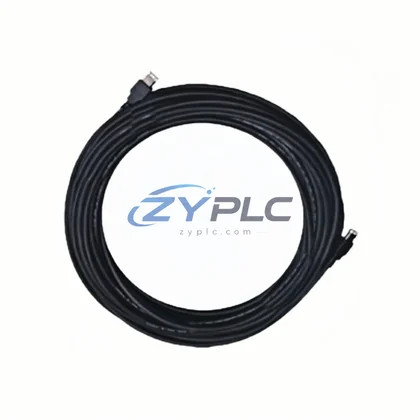
The Triconex 4000098-510 is a purpose-engineered TMR (Triple Modular Redundancy) safety communication cable assembly designed to serve as the critical physical data link within Tricon safety PLC architectures. In modern smart factory environments where process safety and real-time data integrity are non-negotiable, this cable assembly forms the backbone of fault-tolerant communication between the Tricon main chassis, I/O expansion modules, and the broader industrial automation network. Whether deployed in oil and gas, petrochemical, power generation, or advanced manufacturing, the 4000098-510 ensures that safety-critical signals traverse the network without interruption, latency, or data corruption.
At the heart of any TMR safety system lies the need for deterministic, redundant communication. The Triconex 4000098-510 fulfills this requirement by providing a shielded, high-integrity cable interface that supports the proprietary TriBus communication protocol used across the Tricon platform. This protocol enables the three independent processing legs of the TMR architecture to continuously cross-check data, vote on outputs, and maintain system availability even in the event of a single-channel fault. The result is a communication infrastructure that meets IEC 61508 SIL 3 requirements — the highest functional safety integrity level for industrial control systems.
Compatibility & Integration Notes
| Parameter |
Specification |
| SKU / Part Number |
4000098-510 |
| Brand |
Triconex |
| Series |
Tricon TMR Safety PLC |
| Communication Protocol |
TriBus (Proprietary TMR Safety Protocol) |
| Interface Type |
Cable Assembly / Backplane Communication Link |
| Transmission Capability |
High-speed deterministic data transfer between TMR processing legs |
| Network Compatibility |
Tricon v9/v10/v11 chassis, Tricon CX, TriStation 1131 engineering environment |
| System Application |
Safety Instrumented Systems (SIS), Emergency Shutdown (ESD), Fire & Gas (F&G), Burner Management (BMS) |
| Safety Standard |
IEC 61508 SIL 3, IEC 61511 |
| Warranty |
12 Months |
| Availability |
Confirmed via RFQ before quotation |
| Origin |
United States |
Connected Automation Data Flow
Understanding the role of the Triconex 4000098-510 requires tracing the full data flow from field device to control room. In a typical SIS architecture, field instruments — pressure transmitters, temperature sensors, flame detectors, and gas analyzers — generate analog and digital signals that are wired into Triconex Tricon I/O modules such as the Triconex 3703E Analog Input Module or the Triconex 3805E Digital Output Module. These I/O modules reside in the Tricon expansion chassis and communicate upstream to the main processor chassis via the TriBus backplane — the very link that the 4000098-510 cable assembly physically enables.
Within the main chassis, the Triconex 3008 Main Processor Module executes the safety logic in all three redundant legs simultaneously. The 4000098-510 ensures that inter-chassis communication between the main processor and remote I/O expansion frames remains synchronized and fault-tolerant. If one communication path degrades, the TMR voting mechanism continues to operate on the remaining two paths, maintaining SIL 3 integrity without process interruption.
At the network layer, the Tricon system connects to the plant DCS or SCADA platform via the Triconex 4351B Enhanced Intelligent Communication Module (EICM), which supports Modbus RTU, Modbus TCP/IP, and OPC DA/UA protocols. This gateway function allows real-time safety data — valve positions, trip statuses, process variables, and alarm states — to flow upward to Wonderware System Platform, Ignition SCADA by Inductive Automation, or Emerson DeltaV DCS historian and HMI layers. Operators at the control room HMI can monitor live process data, acknowledge alarms, and initiate controlled shutdowns, all while the 4000098-510 maintains the physical integrity of the underlying TMR data bus.
For remote diagnostic and asset management functions, the Tricon system may also interface with Triconex TriStation 1131 v4 engineering workstations over a dedicated maintenance network. This allows safety engineers to perform online program downloads, diagnostic reads, and forced I/O testing without interrupting the running safety application. The 4000098-510 cable assembly, by maintaining reliable inter-chassis communication, is a prerequisite for these advanced diagnostic capabilities.
In larger plant architectures, multiple Tricon systems may be networked together using Hirschmann MICE industrial Ethernet switches or Moxa EDS-510A managed switches to form a plant-wide safety network. The data originating from field sensors, processed by the Tricon TMR logic, and transmitted via the 4000098-510 cable link ultimately feeds into plant-level MES and ERP systems, enabling production transparency, regulatory compliance reporting, and predictive maintenance analytics.
Solving Data Isolation in Industrial Safety Sites
One of the most persistent challenges in industrial safety system integration is the isolation of safety data from the broader plant automation network. Legacy SIS installations often operate as standalone islands — their trip logs, diagnostic data, and process variables locked within proprietary safety controllers with no pathway to SCADA historians or enterprise reporting systems. The Triconex 4000098-510, as part of the Tricon communication infrastructure, directly addresses this challenge.
By maintaining a reliable, high-integrity TriBus link between the Tricon main processor and its I/O expansion modules, the 4000098-510 ensures that all safety-relevant data remains available for upstream transmission. When paired with the Triconex EICM communication module and standard industrial Ethernet infrastructure, safety data can be securely published to SCADA and DCS platforms in real time — eliminating the data silos that have historically prevented safety systems from contributing to plant-wide operational intelligence.
Protocol unification is another critical benefit. The Tricon platform, via its communication modules, supports simultaneous Modbus TCP/IP and OPC UA connectivity, allowing a single safety controller to serve both legacy DCS systems and modern IIoT data platforms. This means that a plant upgrading from a traditional DCS to a cloud-connected MES does not need to replace its safety infrastructure — the Tricon system, anchored by reliable cable assemblies like the 4000098-510, can adapt to new communication requirements without compromising SIL 3 integrity.
Remote monitoring and diagnostics are equally transformed. With the 4000098-510 ensuring stable inter-chassis communication, remote engineers can access live Tricon diagnostic data via TriStation 1131 over a VPN-secured maintenance network. Fault codes, module health indicators, and communication statistics can be reviewed without dispatching field personnel — reducing maintenance costs and accelerating fault resolution in remote or hazardous locations.
For plants pursuing digital transformation and production line transparency, the Triconex 4000098-510 is not merely a cable — it is the physical foundation upon which a fully connected, data-transparent safety architecture is built. Every alarm event, every trip record, and every process variable that flows through the Tricon system depends on the reliable communication link that this cable assembly provides.
Industrial Connectivity FAQ
Q1: Does the Triconex 4000098-510 support communication with third-party SCADA systems?
A: The 4000098-510 is a physical cable assembly that enables TriBus communication within the Tricon chassis architecture. When used in conjunction with the Triconex EICM or NCM communication modules, the Tricon system can interface with third-party SCADA platforms — including Wonderware, Ignition, and Emerson DeltaV — via Modbus TCP/IP and OPC UA protocols. The cable itself is protocol-agnostic at the field level, providing the physical data path that all higher-level communication depends upon.
Q2: What is the communication latency of the Tricon TMR TriBus network?
A: The Tricon TriBus communication architecture is designed for deterministic, low-latency data transfer between processing legs and I/O modules. Typical scan cycle times for Tricon v10/v11 systems range from 20 ms to 100 ms depending on program complexity and I/O count. The 4000098-510 cable assembly, as a passive physical component, introduces no additional latency and is rated for the full operational bandwidth of the TriBus interface.
Q3: Can the Triconex 4000098-510 be used in system expansion configurations?
A: Yes. The 4000098-510 is specifically designed to support Tricon chassis expansion, connecting the main processor chassis to remote I/O expansion frames. This makes it essential for large-scale SIS installations where I/O point counts exceed the capacity of a single chassis. Multiple expansion frames can be daisy-chained using the appropriate cable assemblies, allowing the Tricon system to scale to thousands of I/O points while maintaining TMR redundancy throughout.
Q4: What warranty and testing standards apply to the Triconex 4000098-510?
A: All Triconex 4000098-510 units supplied by ZYPLC are Warranty terms are confirmed during quotation. Each unit undergoes pre-shipment functional testing to verify connector integrity, shielding continuity, and signal transmission performance. Units are sourced from verified supply channels and are accompanied by documentation supporting traceability. For volume orders or urgent requirements, please contact our technical sales team directly.