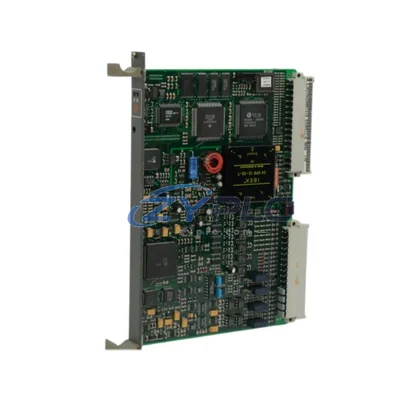
TRICONEX 4351A Industrial Network Interface for Tri-GP Systems: Bridging Safety Data Across the Industrial Data Link
In modern safety-critical manufacturing environments, the integrity of the industrial data link is not a luxury — it is a fundamental requirement. The TRICONEX 4351A Tri-GP Communication Module (TCM) is engineered to serve as the central network interface between the Triconex Triple Modular Redundant (TMR) Safety Instrumented System and the broader plant automation architecture. Whether connecting to a Distributed Control System (DCS), a SCADA platform, or an edge computing gateway, the 4351A ensures that safety-critical process data flows reliably, in real time, and without protocol barriers.
At ZYPLC, we maintain verified, tested inventory of the TRICONEX 4351A with a warranty and support terms confirmed before quote and global shipping capability. Every unit undergoes pre-shipment functional testing to confirm communication integrity before dispatch.
Compatibility & Integration Notes
| Parameter |
Specification |
| Part Number / SKU |
4351A |
| Brand |
TRICONEX (Schneider Electric) |
| Series |
Tri-GP (Tri-General Purpose) |
| Module Type |
Tri-GP Communication Module (TCM) |
| Supported Protocols |
Modbus RTU, Modbus TCP/IP, HART, OPC-UA, TriStation Protocol |
| Interface Types |
RS-232, RS-485, Ethernet (RJ45) |
| Network Compatibility |
DCS, SCADA, HMI, OPC Server, Safety PLC Networks |
| Transmission Capability |
Real-time bidirectional data exchange, deterministic latency |
| System Application |
SIS (Safety Instrumented System), ESD, F&G, Turbine Control |
| Architecture |
Triple Modular Redundant (TMR) — fault-tolerant design |
| Warranty |
12 Months — All units pre-shipment tested |
| Availability |
Confirmed via RFQ before quotation |
Connected Automation Data Flow
The TRICONEX 4351A TCM sits at the heart of a multi-layer industrial communication architecture. In a typical smart factory or process plant deployment, field-level instruments — including pressure transmitters, flow meters, and temperature sensors communicating over HART protocol — feed process values into the Triconex TMR safety controller. The 4351A acts as the protocol gateway, translating these field signals into structured data packets that can be consumed by higher-level systems.
Within the Triconex platform, the 4351A works in close coordination with the TRICONEX 3008 Main Processor Module, which executes the safety logic, and the TRICONEX 3700A Enhanced Communication Controller (ECC), which manages peer-to-peer communication between redundant controllers. The 4351A extends this communication reach outward — across the plant network — using Modbus TCP/IP to interface with DCS platforms such as the Honeywell Experion PKS or Emerson DeltaV SIS, enabling seamless data exchange between the safety layer and the process control layer.
On the SCADA side, the 4351A’s OPC-UA capability allows direct integration with supervisory platforms, enabling operators to monitor SIS status, valve positions, trip signals, and diagnostic alarms from a centralized HMI — such as a Wonderware InTouch or Ignition SCADA workstation — without requiring custom middleware. This dramatically reduces integration complexity and shortens commissioning timelines.
For remote I/O expansion, the 4351A communicates with TRICONEX 3703E Remote Output Module and TRICONEX 3604E Digital Input Module nodes distributed across the field, collecting discrete and analog signals from emergency shutdown valves, fire and gas detectors, and rotating machinery. These signals are aggregated, validated through the TMR voting logic, and transmitted upstream to the control room in real time.
In turbine control and compressor protection applications, the 4351A interfaces with Bently Nevada 3500 Series vibration monitoring systems via Modbus RTU, enabling the safety controller to receive machine health data and trigger protective shutdown sequences when vibration thresholds are exceeded. This cross-system data flow — from rotating equipment sensors through the 4351A to the safety PLC and onward to the SCADA historian — represents the complete industrial data chain that modern smart factories depend on.
Edge computing nodes, such as an industrial IoT gateway running on a DIN-rail mounted edge server, can subscribe to the 4351A’s OPC-UA data streams to perform local analytics, predictive maintenance calculations, and anomaly detection — all without burdening the safety controller with non-safety tasks. This architecture ensures that the SIS remains deterministic and IEC 61511-compliant while still contributing to the plant’s digital transformation objectives.
Solving Data Isolation in Industrial Sites
One of the most persistent challenges in brownfield industrial facilities is protocol fragmentation. Legacy safety systems often speak proprietary or serial protocols — Modbus RTU over RS-485, for example — while modern DCS and SCADA platforms expect Ethernet-based, OPC-UA or Modbus TCP/IP communication. Without a capable communication module like the TRICONEX 4351A, these systems operate as isolated data islands, preventing operators from achieving full production line transparency.
The 4351A directly addresses this by providing multi-protocol support within a single module. A plant that previously required a separate protocol converter between its Triconex SIS and its DCS can eliminate that intermediary device, reducing network latency, minimizing single points of failure, and simplifying the overall network topology. The result is a leaner, more reliable communication backbone.
Remote monitoring and diagnostics are equally transformed. With the 4351A in place, maintenance engineers can access real-time SIS diagnostics — module health, communication status, I/O fault flags — from a remote workstation or even a mobile HMI terminal, without requiring physical access to the safety controller cabinet. This capability is critical for offshore platforms, remote pipeline stations, and unmanned substations where on-site intervention is costly and time-consuming.
For facilities undergoing system expansion, the 4351A’s network architecture supports incremental scaling. New remote I/O nodes, additional field devices, or expanded SCADA data points can be integrated into the existing Triconex network without requiring a full system redesign. This modularity protects the capital investment in the existing safety infrastructure while enabling the plant to grow its automation footprint in line with production demands.
Production line transparency — the ability to see every process variable, every alarm state, and every device health indicator in a unified dashboard — is achievable when the 4351A bridges the gap between the safety layer and the information layer. Operators gain the situational awareness needed to make faster, better-informed decisions, while safety engineers retain full confidence in the integrity of the underlying SIS logic.
Industrial Connectivity FAQ
Q1: What communication protocols does the TRICONEX 4351A support, and is it compatible with modern DCS platforms?
The 4351A supports Modbus RTU, Modbus TCP/IP, HART, OPC-UA, and the native TriStation protocol. It is compatible with major DCS platforms including Honeywell Experion, Emerson DeltaV, ABB System 800xA, and Yokogawa CENTUM VP, as well as SCADA systems such as Ignition, Wonderware, and OSIsoft PI. Protocol bridging is handled natively within the module, eliminating the need for external converters in most integration scenarios.
Q2: How does the 4351A ensure network stability in a redundant TMR safety system?
The TRICONEX 4351A is designed for use within the Triple Modular Redundant (TMR) architecture, where three independent processing channels vote on every output. The communication module itself supports redundant network paths, ensuring that a single cable or port failure does not interrupt data flow. Watchdog timers and automatic failover mechanisms maintain communication continuity even during partial network faults, meeting the deterministic response requirements of IEC 61511 SIL-rated systems.
Q3: Can the TRICONEX 4351A be integrated into an existing SCADA or HMI system without custom programming?
Yes. The 4351A’s OPC-UA and Modbus TCP/IP interfaces are industry-standard and natively supported by all major SCADA and HMI platforms. In most cases, integration requires only the configuration of an OPC-UA server endpoint or a Modbus TCP connection within the SCADA software — no custom drivers or middleware are needed. This significantly reduces engineering hours during system commissioning and simplifies ongoing maintenance.
Q4: What warranty and pre-shipment testing does ZYPLC provide for the TRICONEX 4351A?
Every TRICONEX 4351A unit supplied by ZYPLC carries a warranty and support terms confirmed before quote covering hardware defects and communication failures. Prior to shipment, each module undergoes functional testing to verify protocol communication, I/O integrity, and module self-diagnostics. Units are shipped in anti-static packaging with full traceability documentation. Shipment timing is confirmed after RFQ review, testing, and export packing.