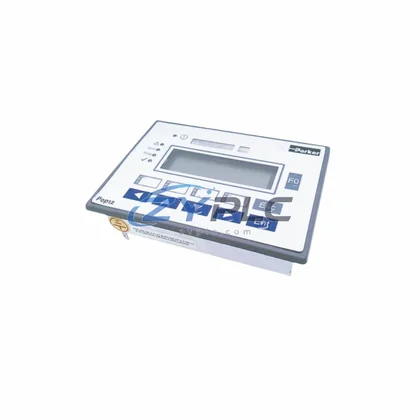
VICPAS VT320WA0000 HMI Keypad for VT320: Control System Integration and Upstream-Downstream Coordination
In modern industrial automation, the human-machine interface layer is not an isolated component — it is the critical junction between operator intent and machine execution. The VICPAS VT320WA0000 HMI membrane keypad is engineered specifically for deployment within the VT320 series operator panel architecture, serving as the primary tactile input interface that bridges the operator layer with the underlying control, I/O, and communication layers of a complete automation system. Whether integrated into a discrete manufacturing line, a process control cabinet, or a utility monitoring station, the VT320WA0000 delivers consistent signal response, long-cycle durability, and seamless system integration with the broader VT320 platform ecosystem.
Understanding the role of the VT320WA0000 requires viewing it within the full system hierarchy. At the control layer, a CPU module — such as a Siemens S7-300 series processor or an equivalent mid-range PLC — handles logic execution and communicates process states upward to the HMI. The VT320 operator panel receives this data and presents it visually to the operator. The VT320WA0000 membrane keypad then translates operator commands back into discrete input signals, completing the feedback loop between human decision-making and machine response. This bidirectional signal flow is fundamental to maintaining system responsiveness and reducing operator error in high-demand environments.
At the I/O layer, digital and analog input modules — including standard 16-channel DI modules and 8-channel DO relay output modules — process field signals from sensors, actuators, and transmitters. The HMI keypad’s role here is indirect but essential: operator commands entered via the VT320WA0000 trigger setpoint changes, mode switches, and alarm acknowledgments that propagate through the I/O layer to field devices. In systems where the VT320 panel is networked via PROFIBUS DP or MPI protocol, the keypad’s input latency must remain within acceptable bounds to ensure that control loop timing is not disrupted. The VT320WA0000 is designed to meet these timing requirements, supporting real-time operator interaction without introducing communication delays.
At the network and communication layer, the VT320 platform typically interfaces with industrial Ethernet switches, PROFINET controllers, or serial communication gateways. The membrane keypad itself does not participate in network communication, but its physical reliability directly affects the integrity of operator-initiated network commands — such as remote setpoint adjustments, batch recipe selections, or emergency stop confirmations. In redundant control architectures where a backup CPU or hot-standby PLC is active, the VT320WA0000 ensures that operator input remains available and consistent regardless of which controller is currently active, supporting seamless failover without requiring operator retraining or interface reconfiguration.
At the power layer, the VT320 operator panel is typically powered by a 24VDC regulated supply, often sourced from a DIN-rail mounted SITOP or equivalent industrial power supply unit. The membrane keypad draws minimal additional current, making it compatible with standard panel power budgets even in densely populated control cabinets. In systems where UPS modules provide backup power during grid interruptions, the low power consumption of the VT320WA0000 contributes to extended battery runtime, ensuring that operators retain HMI access during critical transition periods.
At the execution layer, the downstream effect of reliable keypad input is measurable in system uptime and process consistency. Servo drives, variable frequency drives (VFDs), pneumatic valve controllers, and motor starters all depend on accurate operator commands delivered through the HMI. A degraded or unresponsive membrane keypad introduces ambiguity into the command chain, potentially causing process deviations, false alarms, or unplanned shutdowns. The VT320WA0000 is manufactured to withstand the mechanical and environmental stresses typical of industrial panel installations, including vibration, thermal cycling, and repeated operator contact over multi-year service intervals.
Product Specification Table
| Parameter |
Specification |
| Part Number / SKU |
VT320WA0000 |
| Brand |
VICPAS |
| Compatible Series |
VT320 HMI Operator Panel Series |
| Component Type |
HMI Membrane Keypad (Replacement / Spare) |
| System Role |
Operator Input Interface — Human-Machine Interface Layer |
| Interface Compatibility |
VT320 Series Operator Panel Front Panel Assembly |
| Key Technology |
Membrane Switch Matrix with Tactile Feedback |
| Operating Voltage |
Passive (powered via host panel — typically 24VDC system) |
| Communication Role |
Discrete input signal generation to HMI controller |
| Protocol Compatibility |
Compatible with PROFIBUS DP, MPI, and PROFINET-enabled VT320 panels |
| Installation Environment |
Industrial control cabinet, panel-mount, IP-rated enclosure |
| Operating Temperature |
0°C to +55°C (typical industrial HMI range) |
| Origin |
China (CN) |
| Warranty |
— covers manufacturing defects and functional failure under normal operating conditions |
| system integration |
Full system integration with VT320 platform architecture; compatible with existing panel wiring harness and front-panel mounting frame |
System Compatibility Notes
The VT320WA0000 achieves its full value when considered as part of a coordinated control system rather than a standalone replacement part. In a typical VT320-based automation cell, the operator panel assembly — comprising the VT320 display unit, the VT320WA0000 membrane keypad, and the rear-panel communication interface — works in concert with a range of upstream and downstream components.
At the controller level, a Siemens S7-315-2DP CPU or S7-317-2DP serves as the central logic processor, executing ladder or structured text programs that govern machine behavior. The VT320 HMI panel communicates with this CPU via MPI or PROFIBUS DP, and operator commands entered through the VT320WA0000 keypad are interpreted by the HMI software and translated into PLC variable writes. In systems using Siemens ET200S distributed I/O or ET200M remote I/O stations, field signals are aggregated at the I/O layer and presented to the CPU, which then updates the HMI display — completing the real-time feedback loop that the operator interacts with via the membrane keypad.
Power distribution within the control cabinet is typically managed by a SITOP PSU100S 24VDC power supply or equivalent, which feeds both the VT320 panel and the associated PLC rack. In redundant power architectures, a SITOP UPS1600 or battery-backed DC UPS module ensures continuous HMI availability during power interruptions. Communication integrity is maintained through an industrial Ethernet switch (such as a Siemens SCALANCE X series) or a PROFIBUS repeater in legacy installations, ensuring that the VT320 panel maintains its network connection even under electrically noisy conditions.
For systems requiring expanded I/O capacity, SM321 digital input modules and SM322 digital output modules mounted on S7-300 racks extend the control system’s field connectivity without requiring changes to the HMI configuration. Terminal modules such as Weidmüller or Phoenix Contact DIN-rail terminal blocks provide the field wiring interface, while 24VDC relay output modules drive contactors, solenoid valves, and indicator lamps based on PLC logic outputs. The VT320WA0000 keypad’s role in this architecture is to provide the operator with a reliable, tactile means of interacting with all of these downstream systems through a single, familiar interface.
Industrial Application Notes
The VICPAS VT320WA0000 membrane keypad finds application across a broad range of industrial sectors where the VT320 operator panel platform is deployed.
In discrete manufacturing environments — including automotive assembly, electronics production, and metal fabrication — the VT320 panel is commonly used as the primary operator interface for CNC machine tools, robotic welding cells, and conveyor control stations. The VT320WA0000 keypad provides operators with direct access to cycle start, emergency stop, mode selection, and parameter entry functions, all of which are critical to maintaining production throughput and quality consistency.
In power generation and electrical utility applications, VT320-based HMI panels are installed in switchgear rooms, transformer substations, and generator control panels. The membrane keypad must withstand elevated ambient temperatures, electromagnetic interference, and infrequent but high-consequence operator interactions. The VT320WA0000’s robust membrane construction ensures reliable key registration even after extended periods of standby, making it suitable for emergency control scenarios where operator confidence in the interface is paramount.
In petrochemical and process industries, the VT320 platform is used in conjunction with distributed control systems (DCS) and safety instrumented systems (SIS) to provide local operator access at field panels and junction boxes. The VT320WA0000 keypad supports operator interactions such as manual override commands, setpoint adjustments, and alarm acknowledgments in environments where network connectivity to the central control room may be intermittent.
In water treatment and municipal utility facilities, VT320 panels control pump stations, chemical dosing systems, and filtration processes. The membrane keypad’s sealed construction resists moisture ingress and chemical contamination, supporting reliable operation in the humid, chemically active environments typical of water treatment infrastructure.
In mining, metallurgy, and heavy industry, the VT320WA0000 is deployed in conveyor drive control panels, crusher control stations, and smelting process interfaces. The keypad’s mechanical durability under vibration and thermal stress is a key selection criterion in these applications, where panel replacement downtime directly impacts production output.
Product Compatibility FAQ
Q1: Is the VT320WA0000 compatible with all variants of the VT320 operator panel, and does it require any firmware or configuration changes after installation?
The VT320WA0000 is designed as a direct replacement membrane keypad for the VT320 series operator panel. It is compatible with the standard VT320 front-panel assembly and connects via the existing internal ribbon cable or membrane connector without requiring firmware updates or HMI project reconfiguration. After physical installation, the keypad functions identically to the original factory-installed unit, preserving all existing key assignments, function mappings, and operator screen navigation sequences. No additional commissioning steps are required beyond standard panel reassembly and functional verification.
Q2: How does the VT320WA0000 support long-term maintenance planning in systems with extended service life requirements?
Membrane keypads are a high-wear component in operator panel assemblies, subject to mechanical fatigue from repeated key actuation over multi-year service intervals. Maintaining a stock of VT320WA0000 units as part of a planned spare parts inventory allows maintenance teams to perform rapid keypad replacement during scheduled downtime windows, avoiding unplanned production interruptions caused by keypad failure. The provided with each VT320WA0000 unit covers manufacturing defects and functional failures under normal operating conditions, providing procurement assurance for initial deployment. For systems with 5–10 year service horizons, we recommend establishing a minimum RFQ-based spare coverage for 2–3 units per installed VT320 panel to support lifecycle maintenance without lead-time dependency.
Q3: What should engineers verify when integrating the VT320WA0000 into an existing VT320 panel within a redundant or safety-critical control architecture?
In redundant control architectures — such as those using hot-standby PLC pairs or dual-channel safety PLCs — the HMI panel and its keypad are typically connected to the primary controller, with failover logic managed at the PLC level. When replacing the VT320WA0000 in such systems, engineers should verify that the panel is in a safe state (manual mode or process hold) before disassembly, and confirm that the backup controller has assumed control if the primary is taken offline for maintenance. After keypad replacement, a full functional test of all key inputs should be performed against the HMI project’s defined key map, including function keys, navigation keys, and any custom-programmed soft keys. This verification step ensures that the replacement keypad is correctly registered by the HMI controller and that no input channels have been inadvertently remapped or disabled during the replacement procedure.