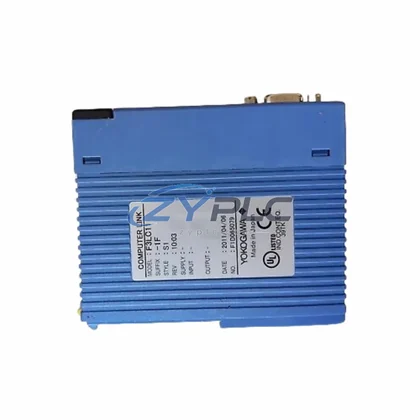
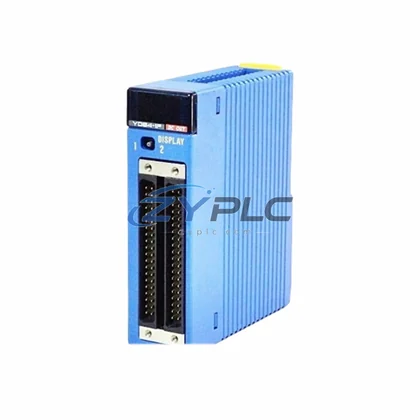
In modern manufacturing environments where every watt of consumed energy and every millisecond of cycle time directly impacts profitability, the Yokogawa F3YD32-1A digital output module delivers the precision control infrastructure that energy-conscious production lines demand. As a 32-point transistor-type digital output module engineered for the Yokogawa FA-M3 programmable automation controller platform, the F3YD32-1A serves as a critical execution layer between the controller’s logic decisions and the physical actuators, solenoids, relays, and drives that govern real production equipment.
Unlike generic output modules that simply switch signals, the F3YD32-1A is designed to minimize parasitic energy losses at the I/O boundary. Its transistor output architecture eliminates the mechanical wear and coil-drive losses associated with relay-based alternatives, reducing both heat generation and standby power draw across the output bank. In high-density automation cells where dozens of output points cycle continuously across shifts, this efficiency advantage compounds into measurable reductions in panel cooling load and overall facility energy consumption.
Product Specification Table
| Parameter |
Specification / Value |
| SKU / Model |
F3YD32-1A |
| Brand |
Yokogawa |
| Series |
FA-M3 |
| Output Points |
32-point transistor output |
| Output Type |
Transistor (NPN sink type) |
| Rated Load Voltage |
12–24 VDC |
| Max Load Current per Point |
0.5 A |
| Operating Temperature |
0°C to 55°C |
| Compatible Platform |
Yokogawa FA-M3 (F3BU□□-□N base units) |
| Application Environment |
Industrial automation, process control, discrete manufacturing |
| Energy Efficiency Value |
Transistor output eliminates relay coil losses; low ON-state voltage drop reduces heat dissipation |
| Warranty |
warranty terms confirmed during quotation — tested and verified before shipment |
System Compatibility and Application
The F3YD32-1A does not operate in isolation — its energy efficiency contribution is fully realized when integrated within a well-architected FA-M3 automation system. At the controller level, the Yokogawa F3RP61-2L sequence CPU module orchestrates all logic execution, managing scan cycles with deterministic timing that prevents unnecessary output toggling and the associated switching losses. Paired with the F3PU20-0S power supply module, the FA-M3 rack maintains stable, regulated DC power delivery to all I/O modules including the F3YD32-1A, ensuring that voltage fluctuations do not cause spurious output activations that waste actuator energy.
On the input side, the Yokogawa F3XD64-3N 64-point digital input module captures field sensor states — proximity switches, limit switches, photoelectric sensors — feeding real-time equipment status back to the CPU. This closed-loop awareness allows the controller to deactivate output channels on the F3YD32-1A precisely when actuators are not needed, rather than holding outputs energized during idle machine states. The result is a measurable reduction in solenoid valve and relay coil energization time across a production shift.
For analog process variables such as motor speed references, pressure setpoints, and flow control signals, the F3AD08-0V analog input module and F3DA04-6V analog output module work in tandem with the digital output layer. Variable frequency drives (VFDs) receiving analog speed commands from the F3DA04-6V can be enabled or disabled via discrete signals from the F3YD32-1A, creating a coordinated drive control architecture where motors ramp down during low-demand periods rather than running at full speed continuously. This integration between analog drive control and digital output switching is one of the most impactful maintenance planning strategies available in FA-M3-based systems.
Network-level condition monitoring is enabled through the F3NC96-0N Ethernet communication module, which connects the FA-M3 system to SCADA platforms, maintenance planning systems (EMS), and cloud-based monitoring dashboards. By exposing output channel states, cycle counts, and actuator activation durations as network-accessible data, plant engineers can identify which output points are driving the highest energy loads and optimize control logic accordingly. The F3XW64-3P mixed I/O module further extends the system’s monitoring reach in space-constrained panels where both input and output density must be maximized without expanding the rack footprint.
For motion-intensive applications, the FA-M3 platform supports servo drive integration through dedicated motion modules. When the F3YD32-1A handles auxiliary digital outputs — brake release signals, servo enable commands, axis home signals — in coordination with Yokogawa or third-party servo amplifiers, the overall motion system achieves tighter synchronization between mechanical movement and energy delivery. Servo axes that receive precise enable/disable commands from the F3YD32-1A avoid unnecessary holding torque during idle dwell periods, reducing both motor heating and drive energy consumption.
The base unit F3BU13-0N provides the physical backplane into which the F3YD32-1A and companion modules are installed, with the bus architecture ensuring low-latency, high-bandwidth communication between the CPU and all I/O modules. This tight integration eliminates the communication overhead and latency penalties that can cause control systems to over-energize outputs as a safety margin against delayed feedback.
Maintenance and Replacement Notes
In automotive component assembly lines, the F3YD32-1A manages the digital output signals for pneumatic cylinder solenoids, conveyor clutch controls, and fixture clamping actuators. By implementing output deactivation sequences during pallet transfer gaps and tool change intervals — logic executed by the FA-M3 CPU based on line encoder and sensor feedback — plants have documented reductions in compressed air consumption of 15–25%, since solenoid valves are no longer held open during non-productive machine states. Compressed air generation is one of the largest energy consumers in discrete manufacturing, and precise digital output control is the primary lever for reducing it.
In food and beverage processing facilities, the F3YD32-1A controls conveyor drive enable signals, filling station actuators, and packaging machine outputs. Integration with the FA-M3’s high-speed counter inputs allows the system to synchronize output activation with product flow rates, eliminating the over-run periods where actuators continue cycling after product has cleared a station. This synchronization reduces both mechanical wear and the energy consumed by actuators operating against no load.
Predictive maintenance workflows benefit directly from the F3YD32-1A’s transistor output architecture. Because transistor outputs have no moving parts and generate diagnostic data through the FA-M3’s self-diagnostic functions, maintenance teams can monitor output channel health without physical inspection. Abnormal load current conditions — indicating a failing solenoid coil or a short-circuit actuator — can be detected and alarmed before they cause unplanned downtime. Planned maintenance windows are shorter and more targeted, reducing the unplanned downtime associated with full-line shutdowns for single-component failures.
All units supplied by ZYPLC undergo functional output testing across all 32 channels prior to shipment, with load verification confirming that each transistor output switches correctly under rated current conditions. This pre-shipment testing protocol ensures that the F3YD32-1A arrives ready for immediate installation, eliminating the commissioning delays and repeated power cycling that consume engineering time and energy during system startup. Every unit is backed by a warranty terms confirmed during quotation, with availability subject to RFQ confirmation for same-week dispatch to support urgent production line repair and replacement requirements.
Product Sourcing FAQ
Q1: How does the F3YD32-1A contribute to measurable operational stability compared to relay output modules?
The F3YD32-1A uses transistor switching rather than electromechanical relays, eliminating relay coil power draw (typically 50–200 mW per coil) across all 32 output points. In applications where outputs are frequently toggled, the absence of coil inrush current and the lower ON-state voltage drop of transistor outputs reduce both steady-state and switching energy losses. Additionally, transistor outputs respond faster, enabling tighter control logic that reduces actuator over-run time.
Q2: Is the F3YD32-1A compatible with third-party VFDs and servo drives for motor maintenance planning?
Yes. The F3YD32-1A provides standard 12–24 VDC transistor output signals compatible with the digital input interfaces of most industrial VFDs and servo amplifiers. It can deliver run/stop commands, direction signals, and fault reset outputs to drives from major manufacturers. When used in conjunction with the FA-M3’s analog output modules for speed reference signals, the F3YD32-1A completes the digital control layer of a full drive management architecture.
Q3: What is the recommended replacement or upgrade path if the F3YD32-1A is used in an aging FA-M3 system?
The F3YD32-1A is a current-production Yokogawa FA-M3 module and is directly compatible with all FA-M3 base units and CPU generations. For systems requiring higher output density, the FA-M3 platform offers 64-point output modules that can consolidate two F3YD32-1A slots into one, freeing rack space for additional communication or motion modules. ZYPLC maintains inventory of both current and legacy FA-M3 I/O modules to support phased upgrades without full system replacement.
Q4: What testing and warranty coverage does ZYPLC provide for the F3YD32-1A?
Every F3YD32-1A unit shipped by ZYPLC is functionally tested across all 32 output channels under rated load conditions before dispatch. Testing confirms correct switching behavior, output voltage levels, and isolation integrity. Units are supplied with a warranty terms confirmed during quotation covering manufacturing defects and functional failures under normal operating conditions. ZYPLC’s technical team provides pre-sales compatibility verification and post-sales application support to ensure correct system integration.