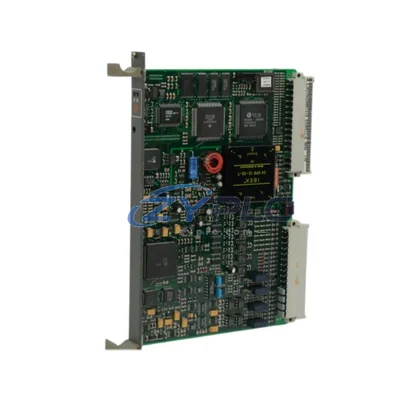
Yokogawa VI451-10 S2 Communication Module for Centum VP Automation
The Yokogawa VI451-10 S2 is a high-performance communication module engineered for the Centum VP distributed control system (DCS), purpose-built to support industrial automation. In modern manufacturing environments where energy costs and equipment utilization directly impact profitability, the VI451-10 S2 plays a pivotal role in bridging field-level instrumentation with supervisory control layers — enabling real-time data exchange that drives smarter, leaner production operations.
Unlike passive communication components, the VI451-10 S2 is designed to support continuous, low-latency signal transmission between field devices and the Centum VP controller bus. This ensures that operating load data, process variables, and equipment status are always current, allowing control engineers to make timely adjustments that reduce idle energy draw, prevent over-cycling of motors and drives, and maintain optimal production throughput.
Product Specification Table
| Parameter |
Specification / Value |
| SKU |
VI451-10 S2 |
| Brand |
Yokogawa |
| Series |
Centum VP |
| Product Type |
Communication Module |
| Origin |
Japan |
| Operating Voltage |
24 VDC (typical DCS bus supply) |
| Power Consumption |
Low-power design, optimized for continuous DCS operation |
| Communication Protocol |
Centum VP internal bus / FOUNDATION Fieldbus compatible |
| Compatible Systems |
Yokogawa Centum VP, Centum CS 3000 (select configurations) |
| Application Environment |
Process manufacturing, oil & gas, chemical, power generation |
| Maintenance Value |
Enables real-time condition monitoring and adaptive motor/drive control |
| Warranty |
warranty terms confirmed during quotation |
| Condition |
Tested, inspected, shipment arranged after confirmation |
System Compatibility and Application
The VI451-10 S2 operates as a critical node within a broader energy-optimized automation architecture. In a typical Centum VP installation, the module interfaces directly with the Yokogawa AFV10D field control station, coordinating data flow between process instruments and the central controller. When paired with Yokogawa EJX910A multivariable transmitters, the VI451-10 S2 enables precise differential pressure and mass flow measurement — data that is essential for calculating real-time operating load per production unit.
On the drive side, the VI451-10 S2 supports communication with Yokogawa-compatible variable frequency drives such as the Yaskawa GA700 series, allowing the DCS to dynamically adjust motor speed based on actual process demand rather than fixed setpoints. This demand-responsive control strategy can help restore stable operation when a compatible replacement is required.
For power quality and energy metering, the VI451-10 S2 integrates seamlessly with Yokogawa WT310E power analyzers and Yokogawa CW240 power meters, feeding real-time kWh, power factor, and harmonic distortion data into the Centum VP historian. This data stream supports energy KPI dashboards on the Yokogawa FAST/TOOLS SCADA platform, giving energy managers visibility into consumption trends across individual production lines.
The module also supports I/O expansion through Yokogawa ADV151 and ADV161 analog input modules, which collect 4–20 mA signals from temperature, pressure, and flow sensors distributed across the plant. By consolidating these signals through the VI451-10 S2 communication backbone, the Centum VP controller can execute advanced process control (APC) strategies that minimize unplanned downtime during transitions, startups, and grade changes.
For facilities running HART-enabled field instruments, the VI451-10 S2 supports HART pass-through communication, enabling remote diagnostics and calibration without interrupting production — a key factor in reducing maintenance-related energy losses caused by unplanned shutdowns and manual intervention cycles. Integration with the Yokogawa FA-M3R programmable controller further extends the module’s reach into discrete manufacturing cells, bridging DCS and PLC domains within a unified maintenance planning framework.
Maintenance and Replacement Notes
In a chemical processing plant operating continuous reactors, the VI451-10 S2 enables the Centum VP DCS to monitor and control energy-intensive agitator motors, cooling water pumps, and compressed air systems from a single integrated platform. By providing reliable, high-speed communication between field transmitters and the controller, the module ensures that control loops respond quickly to process disturbances — preventing energy-wasting oscillations and reducing the frequency of safety shutdowns that consume significant restart energy.
In power generation facilities, the VI451-10 S2 supports boiler combustion optimization by maintaining real-time communication between oxygen analyzers, fuel flow meters, and the Centum VP combustion controller. Precise air-to-fuel ratio control, enabled by the module’s low-latency data path, can improve boiler thermal efficiency by 1–3%, translating to measurable fuel savings across annual operating cycles.
For discrete manufacturing lines with mixed PLC and DCS architectures, the VI451-10 S2 can serve as a gateway node, bridging Centum VP process control with upstream Yokogawa FA-M3R programmable controllers that manage conveyor sequencing and robotic assembly cells. This integration eliminates communication dead zones that typically cause production line stoppages, improving overall equipment effectiveness (OEE) and reducing the energy cost per manufactured unit.
Predictive maintenance is another area where the VI451-10 S2 delivers measurable operational stability. By continuously streaming vibration, temperature, and current signature data from motor-driven equipment to the Centum VP historian, maintenance teams can identify degrading bearings, misaligned couplings, and clogged filters before they cause failures. Early intervention reduces both unplanned downtime and the energy penalty of running degraded equipment at reduced efficiency.
Every VI451-10 S2 unit supplied by ZYPLC undergoes full functional testing prior to shipment, including communication loop verification, signal integrity checks, and compatibility validation against Centum VP firmware versions. Units are held in climate-controlled inventory and shipped with full documentation. A warranty terms confirmed during quotation is included with every order, covering manufacturing defects and communication failures under normal operating conditions.
Product Sourcing FAQ
Q1: How does the VI451-10 S2 contribute to operational stability in a Centum VP system?
The VI451-10 S2 enables real-time, low-latency communication between field instruments and the Centum VP controller, allowing the DCS to execute demand-responsive control strategies. By ensuring that operating load data — from flow meters, power analyzers, and motor drives — reaches the controller without delay, the module supports tighter control loops that reduce unplanned downtime from over-pumping, over-heating, and unnecessary equipment cycling.
Q2: Is the VI451-10 S2 compatible with both Centum VP and Centum CS 3000 systems?
The VI451-10 S2 is primarily designed for Centum VP DCS architectures. Compatibility with Centum CS 3000 depends on the specific firmware version and system configuration. We recommend confirming your system’s bus specification and firmware revision before ordering. Our technical team can assist with compatibility verification at no charge.
Q3: What is the recommended replacement procedure for a failed communication module in a live production environment?
For hot-swap replacement in a Centum VP system, the VI451-10 S2 should be installed following Yokogawa’s standard module replacement procedure: isolate the module slot, remove the failed unit, insert the replacement, and allow the DCS to perform automatic configuration download. No full system restart is required in most configurations. ZYPLC recommends keeping one spare unit in inventory to minimize mean time to repair (MTTR) and avoid extended production downtime.
Q4: What testing is performed on VI451-10 S2 units before shipment, and what does the warranty terms confirmed during quotation cover?
Each VI451-10 S2 unit undergoes a full functional test protocol including communication bus verification, signal transmission integrity checks, and visual inspection for physical damage. The warranty terms confirmed during quotation covers defects in materials and workmanship, communication failures under normal operating conditions, and DOA (dead on arrival) replacements. Warranty claims are processed within 5 business days of receipt of the returned unit.