
ZYPLC Blog
990 Series Vibration Transmitters: Replacement Evidence for the Field
A vibration transmitter is often treated as a simple signal converter until a compressor, fan, pump, or motor loses its trend and alarm path. The replacement decision depends on the sensor chain, power, output type, mounting, range, calibration, and control-system input. A transmitter that produces a signal is not necessarily producing the right signal. ZYPLC […]
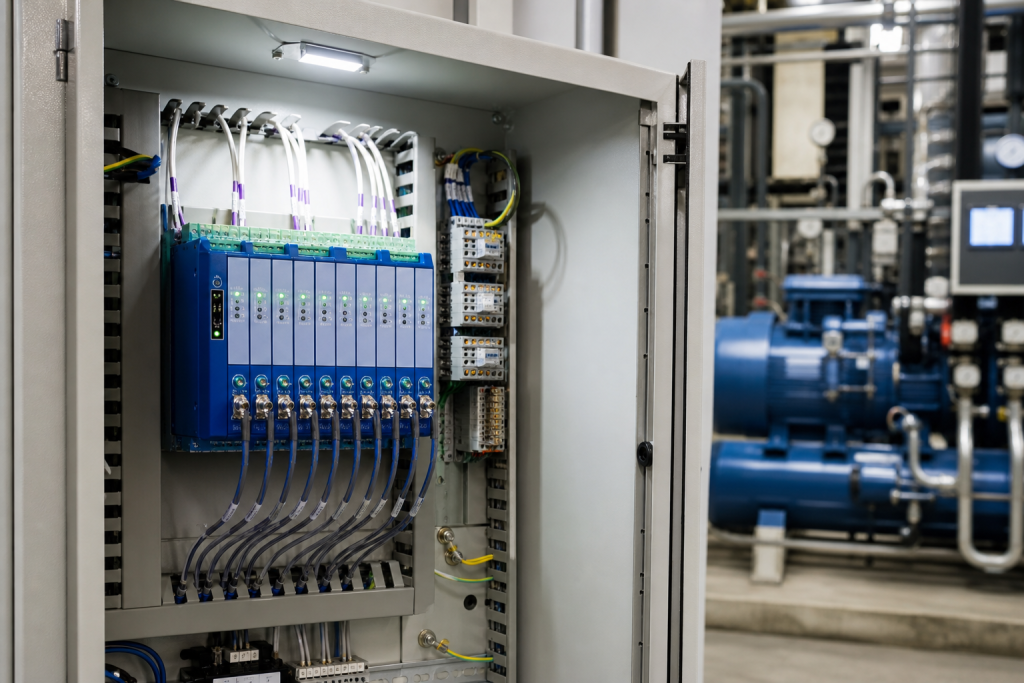
A vibration transmitter is often treated as a simple signal converter until a compressor, fan, pump, or motor loses its trend and alarm path. The replacement decision depends on the sensor chain, power, output type, mounting, range, calibration, and control-system input. A transmitter that produces a signal is not necessarily producing the right signal.
ZYPLC readers need a field-ready way to source condition-monitoring transmitters without confusing a 990-series transmitter with a probe, proximitor, or monitor card. The model record should explain what the device measures and where that measurement is used.
Separate transmitter from sensor and monitor
Record the transmitter model, sensor type, input, power supply, output, alarm or relay behavior, mounting, environmental rating, and receiving channel. Identify whether the signal is used for trending, alarm, trip, or maintenance only.
The live 990-10-50-01 vibration transmitter reference is a catalog match to use in the RFQ. The related 330750-40-05 vibration sensor reference also shows why the sensor and transmitter should not be mixed in one vague request.
Photograph the transmitter label, sensor cable, terminals, power wiring, output loop, mounting, and the cabinet or junction-box context. Add the control-system input and scaling if the plant record allows it.
Preserve scaling and calibration evidence
Before replacing the transmitter, confirm range, units, scaling, damping, output behavior, alarm limits, and calibration interval. A replacement with different scaling can create a quiet but serious trend error.
Record sensor type, cable length, connector, power, and output. If the transmitter drives a trip or alarm, state that role and the required functional test.
Ask suppliers to separate exact match, substitute, repair option, and calibration evidence. A low-cost unit without calibration or configuration information may not be field-ready.
Acceptance should prove the signal
After replacement, check power, sensor input, output loop, scaling, trend, alarms, timestamps, and any approved trip or interlock behavior. Compare the result with a known reference where plant procedure permits.
Record whether the item was visually inspected, bench-tested, calibrated, or field-accepted. These are different confidence levels.
Keep transmitter label, sensor pairing, calibration record, settings, and final test evidence together. The next sourcing request should start with the measured function, not only the old product title.
Build the RFQ around the installed function
A useful spare request begins with the installed function, not only a familiar brand name. State what the device does, where it sits, what it connects to, and what failure would stop or blind the process. Then add the exact label, revision, connector view, power information, accessory scope, condition requirement, destination, and required date. This gives procurement and engineering the same starting point.
Separate an exact replacement from a possible substitute, repair exchange, bench item, and migration candidate. These options may all be commercially useful, but they do not carry the same approval burden. An exact spare may support a short outage window. A substitute may need wiring changes, parameter review, software work, or a production trial before it can be counted as recovery stock.
The product references in this article are live catalog examples, not permission to skip engineering checks. Compare the product page with the installed label and the plant record. If a suffix, connector, voltage, protocol, firmware family, or mechanical interface differs, keep the item conditional until the responsible engineer closes that gap.
Receiving inspection should repeat the evidence used for the RFQ. Photograph the received label, packaging, connectors, terminals, mounting features, and included accessories. Record what was checked and what remains unknown. A clean-looking item is not automatically a field-ready spare, and an item that powers up is not automatically accepted by the control or protection function.
Keep the approved catalog and RFQ reference with the maintenance record, but do not let a catalog title replace the installed evidence. The useful record is the combination of model, function, interface, condition, test requirement, and decision owner.
Review the spare before the maintenance window, not only after a failure. Confirm that the item is still physically present, that packaging and accessories are intact, that the backup or test procedure is available, and that the responsible engineer is still named.
When a substitute is considered, write down the exact gap it is intended to close and the evidence needed to approve it. This may include a drawing comparison, firmware review, bench test, dimensional check, protection test, communication test, or production trial.
The final decision should be visible to stores, procurement, maintenance, and operations. Use plain status labels such as exact replacement, approved substitute, repair exchange, bench-only, or engineering review required.
FAQ
What should match on a 990 transmitter spare?
Match transmitter model, sensor input, power, output, range, scaling, mounting, environment, and alarm or trip role.
Can a vibration sensor replace a transmitter?
No. They perform different functions in the measurement chain and must be identified separately.
What photos help with the RFQ?
Send transmitter label, sensor and cable, terminals, power, output loop, mounting, and receiving-channel context.
What proves field acceptance?
Power, sensor input, output, scaling, trends, alarms, and any required trip or interlock checks must be documented.
Send ZYPLC the 990 transmitter label, sensor pairing, cable and terminal photos, scaling information, and deadline. We can help prepare a field-ready condition-monitoring RFQ.
A useful record also states what the supplier cannot determine from a catalog page. Unknown firmware, missing drawings, unclear terminal scope, incomplete accessories, and untested condition should be written as open items so the quote remains honest and the plant has a short list of questions to close before the equipment is needed.
Use the same evidence at receiving that was used during selection. Compare the actual label and interface with the approved request, then save received-item photos with the work order. This helps maintenance, procurement, and stores learn from every replacement instead of starting the next RFQ from a blank screen.
© 2026 ZYPLC. All rights reserved. Official Website: https://zyplc.com Inquiry: sales@zyplc.com | WhatsApp/Tel: +86 18359293191
Continue reading
Related sourcing guides
 Aug 5, 2026
Bently Nevada 990 Spares: Transmitter Evidence Before a Pump Train Restart
When a pump or fan train returns after maintenance, vibration evidence is often the difference between confidence and guesswork. A Bently Nevada 990 transmitter spare must preserve range, probe-chain behavior, wiring, alarm meaning, and baseline comparison. Otherwise the machine may restart with a working transmitter and an untrusted signal. ZYPLC readers need a practical record […]
 Jul 20, 2026
Bently Nevada Velocity Sensors: When a Probe Is Not the Right Spare
A velocity sensor and a proximity probe may both appear in a vibration spare list, but they serve different measurement chains. Choosing the wrong one can leave a monitor without the expected input, range, mounting, or output behavior. The model-checking question is not “does it measure vibration?” but “what signal does this machine channel require?” […]