
ZYPLC Blog
How To Triage A Mixed Automation Spare List By Lead Time
A ZYPLC guide for ranking PLC, DCS, HMI, drives, robotics, and sensor spares by downtime risk and sourcing difficulty.
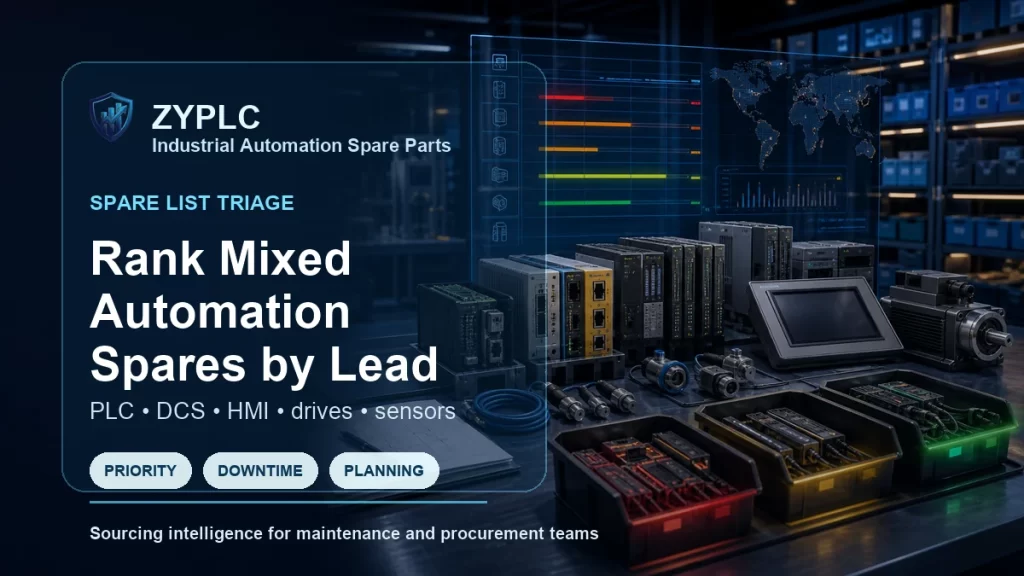
A mixed automation spare list can look organized in a spreadsheet and still be weak in practice. The problem is not usually the number of parts. It is priority. A plant may list PLC CPUs, HMI panels, drive boards, encoder cables, robot teach pendants, I/O cards, and sensors in one file, but not every item carries the same downtime risk or sourcing difficulty.
ZYPLC recommends treating the list as a lead-time triage tool. The goal is to separate emergency spares from convenient stock, and to do that before a line is already down. A buyer who knows which parts are critical, obsolete, exact-match only, or acceptable for engineering review can get a faster and cleaner response from suppliers.
Sort By Production Impact First
The first question is simple: what happens if this part fails today? A PLC CPU that stops a bottling line, a drive module on the main conveyor, or an HMI used for recipe selection should rank above a sensor that can be sourced locally. This does not mean smaller parts are unimportant. It means the spare strategy should reflect production impact instead of catalog order.
For each item, mark the affected machine, whether a bypass exists, and whether the plant has a tested spare. If the answer is “unknown,” treat that uncertainty as a risk. Unknown installed-base details are one of the main reasons urgent RFQs take longer than expected.
Then Add Sourcing Difficulty
Once impact is clear, look at availability. Some modern HMI panels and drives are easy to quote but difficult to ship quickly in specific configurations. Older PLC and DCS modules may be easy to identify but hard to find in acceptable condition. Robotics components may need exact revision checks because a visually similar spare can behave differently in a live cell.
A useful triage label might be: green for common items, yellow for uncertain lead time, and red for obsolete or shutdown-critical items. The red group is where buyers should prepare photos, full labels, condition requirements, and destination details in advance.
Exact Match Or Reviewable Alternative?
Not every spare needs the same matching rule. A safety-related controller or communication module may require an exact part number. A non-critical panel accessory may allow a compatible replacement. The RFQ should say which path is acceptable. If the supplier must guess, they may either over-limit the search or quote an option the engineering team later rejects.
For global sourcing, clarity saves days. Include the full model, brand, quantity, acceptable condition, target delivery date, and whether alternatives are allowed. For drives, include power rating and application context. For HMI panels, include screen size, communication interface, and installed software constraints when known.
FAQ
How often should a spare-parts list be reviewed?
For critical production equipment, review it at least before planned shutdowns and after major line changes. Obsolete items should be checked more often because availability can change quickly.
Should every item on the list be purchased immediately?
No. The point of triage is to identify which items justify stock, which need a sourcing plan, and which can remain quote-on-demand.
What makes an RFQ faster for a mixed spare list?
Group items by urgency, provide complete model numbers and photos, state condition requirements, and identify whether alternatives are acceptable.
Have a mixed automation spare list? Send ZYPLC the file with urgency notes and destination details. The team can help separate emergency spares from normal replenishment items.
© 2026 ZYPLC. Official Website: https://zyplc.com Inquiry: use the ZYPLC contact or quote request page.
Continue reading
Related sourcing guides
 Jul 5, 2026
Obsolete Spare Kit Lead Times: What to Check Before the Shutdown Window
Recent CISA ICS advisories are a useful trigger for a practical obsolete spare kit review, even when the named product is not installed at your site. Advisories force maintenance and procurement teams to ask whether installed hardware, shelf spares, backups, accessories, and approval rules are ready before the next outage. For ZYPLC Sourcing Team, the […]
 Jul 3, 2026
Remote Antenna Field Kits: Lead-Time Lessons from the iDirect Advisory
The July 2, 2026 iDirect iQ-Series advisory is a useful reminder that remote communication repairs are often lead-time problems before they are technical problems. A satellite terminal, antenna feed, power supply, or surge device may be small compared with a PLC rack, but a missing part can leave a remote site blind. ZYPLC buyers are […]
 Jun 29, 2026
Spare Lead Time Planning After ICS Advisories: Build the Kit Before the Window
The latest CISA industrial control advisories are useful for a reason beyond cybersecurity. They show how quickly a plant can move from “we should review this” to “we need a maintenance window and a usable spare.” When the affected asset is a controller, relay, gateway, server, or engineering tool, lead time planning becomes part of […]