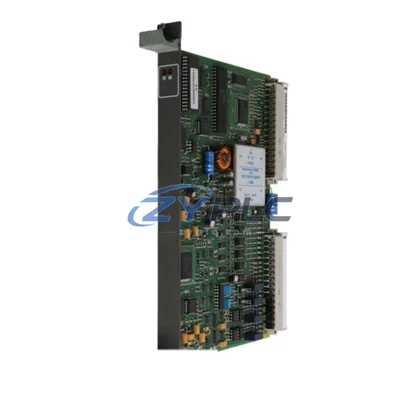
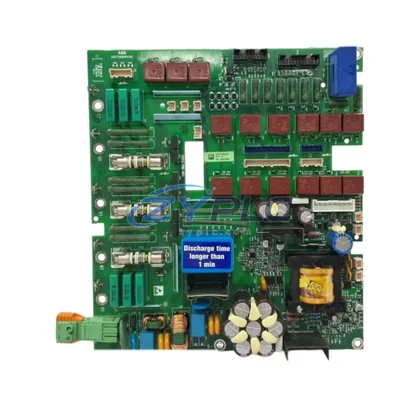
AB 1336-MCB-SP1 Control Board for 1336 Plus Automation
The Allen-Bradley 1336-MCB-SP1 (Part No. 74100-071-51) is the main control board engineered for the 1336 Plus series AC variable frequency drive (VFD). As the central intelligence of the drive system, this board governs PWM switching logic, motor flux vector calculations, and real-time feedback loops that directly determine how efficiently electrical energy is converted into mechanical output. In energy-intensive production environments — from continuous process lines to high-cycle discrete manufacturing — the performance of this single board can determine whether a facility meets its energy reduction targets or continues to bleed operating-hours through uncontrolled motor operation.
At ZYPLC, every 1336-MCB-SP1 unit is sourced from verified supply channels, subjected to pre-shipment functional testing, and backed by a warranty terms confirmed during quotation. Stock is maintained on-hand for rapid dispatch, minimizing the downtime window when a drive fault grounds a critical production asset.
Product Specification Table
| Parameter |
Specification / Value |
| Part Number |
1336-MCB-SP1 (74100-071-51) |
| Compatible Drive Series |
Allen-Bradley 1336 Plus AC VFD |
| Board Function |
Main Control Board — PWM, Vector Control, I/O Interface |
| Drive Efficiency Contribution |
Enables closed-loop vector control for >95% drive efficiency |
| Power Range Supported |
0.37 kW – 448 kW (drive-dependent) |
| Compatible Control Voltage |
24 VDC logic supply |
| Communication Interface |
DPI / SCANport (1336 Plus native) |
| Compatible Systems |
Rockwell Automation ControlLogix, SLC 500, PLC-5 platforms |
| Application Environment |
Industrial — HVAC, Pumps, Compressors, Conveyors, Mixers |
| Energy Saving Value |
Eliminates uncontrolled motor starts; enables speed-matched load control |
| Origin |
United States |
| Warranty |
warranty terms confirmed during quotation (ZYPLC) |
| Stock Status |
RFQ Available — Pre-shipment Tested |
System Compatibility and Application
The 1336-MCB-SP1 does not operate in isolation — it is the command center of a broader maintenance-focused drive architecture. In a properly configured 1336 Plus system, this control board interfaces directly with the 1336-MOD-L2E gateway module to enable EtherNet/IP communication, allowing the drive to participate in plant-wide condition monitoring networks managed by a ControlLogix L7x controller running RSLogix 5000 / Studio 5000 Logix Designer.
On the motor side, the board’s vector control algorithms work in tandem with the 1336 Plus power structure and its associated 1336-PB power board to deliver precise torque and speed regulation. This precision eliminates the unplanned downtime associated with over-speeding motors or running them at fixed frequency when variable load demands could be met at lower speeds. When paired with a PowerFlex 755 drive on adjacent lines — sharing the same ControlLogix backplane — engineers can implement coordinated energy load-shedding strategies across multiple motor circuits simultaneously.
For energy data acquisition, the 1336-MCB-SP1’s SCANport interface supports connection to 1203-USB SCANport communication adapters and 1336-GM1 operator interface modules, enabling real-time monitoring of drive output frequency, motor current draw, DC bus voltage, and fault history. This data feeds into energy dashboards built on FactoryTalk View SE SCADA platforms, where production engineers can correlate motor load with line throughput KPIs.
On the I/O side, the control board integrates with 1756-IB16 digital input modules and 1756-OF8 analog output modules in the ControlLogix chassis to receive process feedback signals — flow rates, pressure transducer outputs, conveyor load cells — and translate them into dynamic speed reference commands. This closed-loop architecture is what separates energy-optimized variable speed operation from simple on/off motor control.
For facilities running distributed control architectures, the 1336 Plus with this control board can be networked via 1336-GM6 DeviceNet communication cards, integrating the drive into a DeviceNet segment alongside 1769-SDN scanner modules and CompactLogix controllers. This topology is common in bottling, packaging, and material handling lines where dozens of drives must be coordinated from a single control node with minimal wiring overhead.
Maintenance and Replacement Notes
In real production environments, motor systems account for 60–70% of total industrial electricity consumption. The Allen-Bradley 1336-MCB-SP1 directly addresses this by enabling the 1336 Plus drive to implement affinity law-based speed control: reducing motor speed by just 20% cuts power consumption by nearly 50%, because power scales with the cube of speed in centrifugal load applications such as pumps, fans, and blowers.
When this control board fails or degrades, the drive typically defaults to a fault state, forcing the motor to either stop entirely or — in legacy bypass configurations — run at full fixed speed. Both outcomes are costly: a stopped motor halts production throughput, while a motor running at full speed on a partial load wastes energy proportional to the load gap. Replacing a faulty 1336-MCB-SP1 restores closed-loop vector control, returning the drive to its designed operating efficiency curve and eliminating the energy penalty of uncontrolled operation.
Beyond operational stability, the control board’s fault detection and diagnostic capabilities reduce unplanned downtime. The board continuously monitors output current, DC bus voltage, heatsink temperature, and ground fault conditions. Early fault annunciation — surfaced through the 1336-GM1 operator interface or upstream to FactoryTalk Diagnostics — allows maintenance teams to schedule corrective action during planned stops rather than reacting to catastrophic failures mid-shift. This predictive maintenance posture reduces mean time to repair (MTTR) and extends the service life of the broader drive system, including the power semiconductors, gate driver boards, and motor windings that degrade fastest under thermal stress from undetected fault conditions.
In conveyor and material handling applications, the board’s speed reference ramp control eliminates mechanical shock loads during motor starts, reducing wear on gearboxes, couplings, and belt drives. Smoother acceleration and deceleration profiles also reduce peak demand charges on the facility’s utility bill — a direct financial benefit that compounds across every motor start cycle over the equipment’s operational life.
ZYPLC maintains ready stock of the 1336-MCB-SP1 specifically to support rapid-response maintenance scenarios. Every unit shipped has been functionally tested prior to dispatch, and the included warranty terms confirmed during quotation covers operational defects discovered after installation. For facilities managing lean spare parts inventories, this warranty coverage reduces the risk of carrying a non-functional spare that only reveals its fault condition during an emergency replacement.
Product Sourcing FAQ
Q1: How does replacing the 1336-MCB-SP1 improve energy efficiency on my production line?
A faulty or degraded control board forces the 1336 Plus drive out of closed-loop vector control mode, causing the motor to run inefficiently or at fixed speed. Replacing the board restores precise speed and torque regulation, allowing the drive to match motor output exactly to load demand — eliminating the unplanned downtime of over-speed operation and reducing peak current draw during acceleration cycles.
Q2: Is the 1336-MCB-SP1 compatible with my existing ControlLogix or SLC 500 control system?
Yes. The 1336 Plus drive communicates natively with Rockwell Automation control platforms including ControlLogix, SLC 500, and PLC-5 via SCANport and optional communication adapters such as the 1336-MOD-L2E (EtherNet/IP) or 1336-GM6 (DeviceNet). The control board itself is the interface hub for all drive-to-controller communication, so a correctly installed 1336-MCB-SP1 restores full network integration without requiring changes to the upstream control program.
Q3: What is the recommended replacement process, and how do I verify the board is functioning correctly after installation?
After installation, power up the drive and monitor the operator interface (1336-GM1 or equivalent) for fault codes. Verify that the drive accepts a speed reference command and ramps the motor smoothly to setpoint. Check output current balance across all three phases and confirm DC bus voltage is within specification. ZYPLC pre-tests every 1336-MCB-SP1 before shipment, but a post-installation functional check under load conditions is always recommended before returning the line to production.
Q4: What does the warranty terms confirmed during quotation cover, and what is the process if a warranty claim is needed?
The warranty terms confirmed during quotation provided by ZYPLC covers operational defects in the 1336-MCB-SP1 board under normal industrial operating conditions. If a fault is identified within the warranty period, contact ZYPLC directly to initiate a return and replacement process. Warranty claims are handled promptly to minimize production impact. Units damaged by incorrect installation, overvoltage events, or environmental conditions outside the drive’s rated specifications are evaluated on a case-by-case basis.