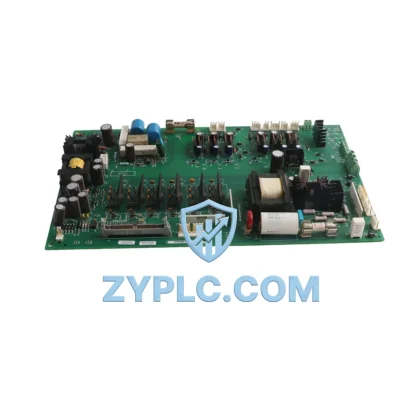
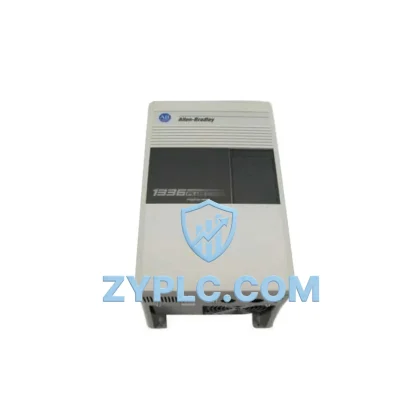
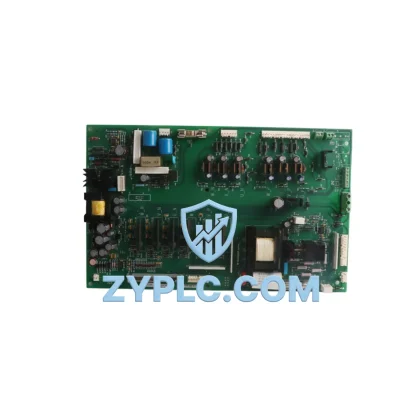
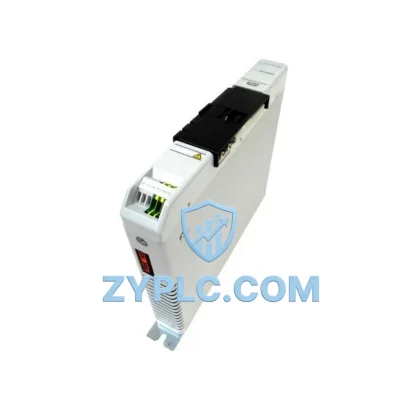
ABB 3HAC057544-003 System-Ready Servo Motor for IRB7600 Architecture: Control System Architecture and Upstream-Downstream Coordination
The ABB 3HAC057544-003 is a precision servo motor engineered specifically for deployment within the IRB7600 robotic control architecture. Rather than functioning as a standalone drive component, this motor is designed to operate as an integrated node within a layered automation system — coordinating seamlessly across the control layer, I/O layer, network layer, power layer, human-machine interface layer, and execution layer. Understanding its role within the full system architecture is essential for engineers responsible for commissioning, maintenance, and long-term operational continuity in high-demand industrial environments.
In modern industrial robotics and process automation, the servo motor is not merely an actuator — it is a precision feedback element that closes the loop between the controller’s motion commands and the physical execution of those commands. The 3HAC057544-003 fulfills this role within the IRB7600 platform, a heavy-duty six-axis industrial robot widely deployed in automotive body-in-white assembly, foundry handling, machine tending, and large-part palletizing. Its integration into the system architecture demands compatibility not only at the mechanical and electrical interface level, but also at the communication and control protocol level, ensuring that encoder feedback, torque limits, and velocity profiles are correctly interpreted by the upstream IRC5 controller.
Architecture Specification Table
| Parameter |
Specification |
| Part Number / SKU |
3HAC057544-003 |
| Brand |
ABB Robotics |
| Compatible Robot Series |
IRB7600 |
| System Role |
Axis Servo Drive Motor (Execution Layer) |
| Motor Type |
AC Brushless Servo Motor with Integrated Encoder |
| Controller Compatibility |
IRC5 Single Cabinet / IRC5 Compact / IRC5 Panel Mounted |
| Drive Unit Interface |
ABB Drive Unit DSQC667 / DSQC668 compatible |
| Feedback Type |
Resolver / Absolute Encoder (axis-dependent) |
| Electrical Supply |
Three-phase AC, matched to IRC5 drive output stage |
| Insulation Class |
Class F (155°C) |
| Protection Rating |
IP67 (axis-dependent installation) |
| Operating Temperature |
0°C to +50°C ambient |
| Mounting Interface |
IRB7600 axis flange, OEM-matched bolt pattern |
| Communication Layer |
Integrated with IRC5 motion control via SERCOS / proprietary ABB bus |
| Origin |
Sweden (ABB Robotics Manufacturing) |
| Warranty |
12-Month Warranty — covers manufacturing defects and functional failure under normal operating conditions |
Coordinated Control System Design
The 3HAC057544-003 servo motor achieves its full performance potential only when correctly integrated within the complete IRB7600 control architecture. At the control layer, the IRC5 controller — specifically the DSQC1000 main computer board — generates motion trajectories and distributes axis commands through the internal drive bus. These commands are received by the axis drive units, typically the DSQC667 or DSQC668 drive modules housed within the IRC5 cabinet, which convert digital motion commands into the precise voltage and current waveforms required to drive the 3HAC057544-003 motor windings.
At the power layer, the IRC5 power supply unit — such as the DSQC609 rectifier and capacitor module — conditions incoming three-phase mains power and provides the DC bus voltage from which the drive units synthesize the motor’s AC drive signal. Voltage stability at this layer directly affects torque ripple and positioning accuracy at the execution layer where the 3HAC057544-003 operates. Engineers should verify that the power supply module is rated for the full continuous and peak current demands of all active axes simultaneously, particularly in high-inertia applications typical of the IRB7600’s 500 kg payload class.
At the I/O layer, the DSQC652 digital I/O module and DSQC651 analog I/O module provide the signal infrastructure for external interlocks, safety relays, and process feedback signals that coordinate the robot’s motion with peripheral equipment such as welding controllers, conveyor encoders, and vision systems. These I/O signals are processed by the IRC5 controller and can influence the motion profile executed by the 3HAC057544-003 in real time — for example, decelerating the axis in response to a safety zone signal or synchronizing motion to an external encoder pulse.
At the network layer, the IRC5 controller communicates with plant-level SCADA systems, PLCs, and MES platforms via fieldbus interfaces including PROFIBUS-DP, DeviceNet, EtherNet/IP, and PROFINET, typically implemented through the DSQC688 fieldbus adapter. This network connectivity allows the robot’s motion — and by extension the 3HAC057544-003’s operational state — to be coordinated with upstream production scheduling and downstream quality inspection systems without manual intervention.
At the human-machine interface layer, the FlexPendant (IRC5 teach pendant, part number 3HAC028357-001) provides the primary operator interface for jogging individual axes, executing motion programs, and monitoring axis status including motor temperature, torque utilization, and encoder health. Maintenance engineers rely on the FlexPendant’s axis diagnostic screens to identify early signs of servo degradation before they result in unplanned downtime. The 3HAC057544-003’s encoder feedback data is continuously available through this interface, supporting predictive maintenance workflows.
At the execution layer, the 3HAC057544-003 motor works in conjunction with the IRB7600’s mechanical transmission — gearboxes, harmonic drives, and wrist assemblies — to convert electrical torque commands into precise mechanical motion. The motor’s encoder provides position and velocity feedback that closes the servo loop within the IRC5 drive unit at update rates typically exceeding 1 kHz, ensuring sub-millimeter repeatability across the robot’s full working envelope. Correct backlash compensation parameters, stored in the IRC5 system parameters, must be calibrated to match the specific mechanical characteristics of the axis in which the 3HAC057544-003 is installed.
Application in Layered Automation Systems
Automotive Manufacturing: In automotive body-in-white assembly lines, the IRB7600 equipped with the 3HAC057544-003 servo motor performs heavy spot welding, material handling, and press-tending operations. The motor’s high torque density and precise velocity control enable the robot to handle large stamped steel panels with the repeatability required for dimensional quality in door, hood, and roof assembly. Integration with Fronius or Lincoln Electric welding controllers via the IRC5 I/O layer allows weld current and gun force to be coordinated with robot motion in a single synchronized sequence.
Foundry and Metal Casting: In foundry environments, the IRB7600 handles molten metal ladles, die-cast parts, and sand cores in high-temperature, high-vibration conditions. The 3HAC057544-003’s IP67 protection and Class F insulation make it suitable for these demanding environments. The IRC5 controller’s temperature monitoring functions track motor winding temperature in real time, triggering protective derating before thermal damage can occur.
Petrochemical and Process Industries: In petrochemical plants, large-payload robots equipped with the IRB7600 platform perform valve manipulation, pipe handling, and inspection tasks in hazardous areas. The system’s PROFIBUS or PROFINET connectivity allows the robot to receive process setpoints from the plant DCS, enabling fully automated operation without operator intervention during continuous production runs.
Palletizing and Logistics: In high-throughput palletizing applications, the IRB7600’s speed and payload capacity — enabled by the 3HAC057544-003’s torque output — allow it to handle full pallet layers of bagged goods, boxed products, or drums at cycle rates that exceed what smaller robots can achieve. The IRC5 controller’s conveyor tracking function, implemented via the DSQC377B conveyor encoder interface, synchronizes the robot’s pick motion with moving conveyor lines without stopping the line.
Architecture Engineering FAQ
Q1: Is the 3HAC057544-003 compatible with all IRC5 cabinet variants, and are there any drive unit substitution constraints?
The 3HAC057544-003 is designed for use within the IRB7600 platform and is compatible with the IRC5 Single Cabinet and IRC5 Panel Mounted controller variants. The motor must be paired with the correct axis drive unit — typically the DSQC667 or DSQC668 — as specified in the IRB7600 product manual for the relevant axis position. Substituting drive units from other IRC5 configurations without verifying current rating and firmware compatibility may result in axis faults or reduced performance. Always cross-reference the robot’s system parameters file (SYS.CFG) to confirm the motor-drive pairing before commissioning.
Q2: What commissioning steps are required after replacing the 3HAC057544-003 in an existing IRB7600 installation?
After mechanical installation and electrical reconnection, the following commissioning steps are required: (1) Perform a revolution counter update for the affected axis using the FlexPendant to re-establish the absolute position reference. (2) Verify motor calibration offsets in the IRC5 system parameters against the values recorded during original factory calibration. (3) Run a low-speed axis jog test to confirm correct direction of rotation and absence of mechanical binding. (4) Execute a full-speed test cycle under no-load conditions before returning the robot to production. (5) Monitor axis torque and temperature via the IRC5 diagnostic interface during the first production shift to confirm stable operation.
Q3: What does the 12-Month Warranty cover, and how does it support long-term maintenance planning?
The 12-Month Warranty covers manufacturing defects and functional failures arising under normal operating conditions within twelve months of the shipment date. It does not cover damage resulting from incorrect installation, operation outside specified electrical or environmental parameters, or unauthorized modification. For maintenance planning purposes, the 12-month coverage period aligns with typical annual preventive maintenance intervals in automotive and process industry facilities, allowing engineers to schedule servo motor inspections and replacements as part of planned shutdown windows rather than responding reactively to unplanned failures. Spare motor inventory held under this warranty provides a cost-effective buffer against production disruption in high-utilization robot installations.
© 2026 ZYPLC. All rights reserved.
Original Source: https://zyplc.com
Contact: +86 19859288691 | [email protected]