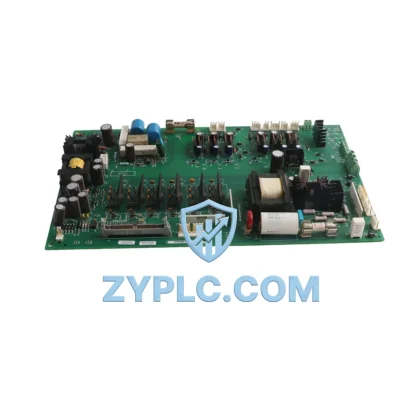
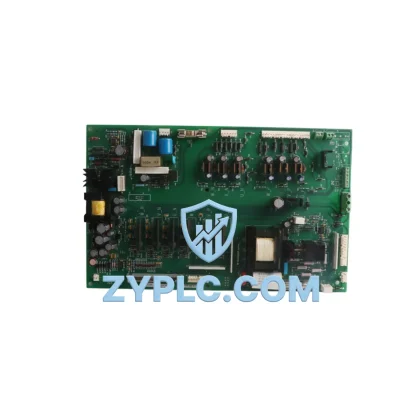
ABB AGBB-01C REV.B System-Ready Gate Driver for ACS Series Architecture
The ABB AGBB-01C REV.B is a precision-engineered gate driver module designed to operate as a critical switching interface within the power conversion layer of ABB ACS Series variable frequency drive systems. Rather than functioning as a standalone component, the AGBB-01C REV.B is architecturally positioned between the control intelligence layer and the IGBT power stack, translating low-level switching commands into the high-current gate pulses required to drive insulated-gate bipolar transistors with the timing accuracy and electrical isolation demanded by modern industrial automation environments.
In a fully integrated ACS Series drive architecture, the AGBB-01C REV.B works in close coordination with the AINT-02C or AINT-14C inverter interface boards, which relay modulation signals from the RMIO-11C or RMIO-12C main control boards. The gate driver module receives these signals and conditions them for direct application to the IGBT module gate terminals, ensuring precise turn-on and turn-off transitions that minimize switching losses and protect the power semiconductors from overvoltage transients. This contextual integration is fundamental to maintaining system efficiency, thermal stability, and long-term drive reliability across demanding duty cycles.
From a system architecture perspective, the AGBB-01C REV.B contributes to both the redundancy and the maintainability of the overall drive platform. In multi-drive cabinet installations — such as those found in steel rolling mills, cement kilns, water treatment pump stations, and offshore platform motor control centers — the ability to replace a gate driver module independently of the IGBT stack or the main control board significantly reduces mean time to repair. Engineers can swap the AGBB-01C REV.B without disturbing the APOW-01C or APOW-02C power supply modules, the IOEC-04 I/O extension cards, or the panel-mounted CDP312R control panel, preserving system continuity and minimizing production downtime.
The module’s electrical design incorporates galvanic isolation between the logic-side signal input and the gate-side output, a feature that protects the upstream control circuitry from the high-voltage transients inherent in the DC bus environment of ACS800 and ACS880 series drives. This isolation architecture also supports the fault detection and diagnostic feedback loops that the RMIO control board uses to monitor IGBT health, enabling predictive maintenance strategies that align with Industry 4.0 asset management frameworks.
In layered automation systems, the AGBB-01C REV.B sits at the intersection of the power electronics layer and the control signal layer. Above it, the PROFIBUS DP or Modbus RTU fieldbus network carries process setpoints from the DCS or SCADA system down to the drive’s control board. Below it, the IGBT module converts DC bus energy into the variable-frequency, variable-voltage output that drives the motor load. The gate driver module is the critical translation point in this hierarchy — any degradation in its switching performance propagates immediately into motor current waveform quality, torque ripple, and ultimately into process output consistency.
For system integrators specifying spare parts strategies for long-lifecycle installations, the AGBB-01C REV.B represents a high-priority stocking item. Its failure mode — typically manifesting as asymmetric phase output, overcurrent trips, or IGBT desaturation faults — can halt production lines with no warning. Maintaining at least one spare module per drive cabinet, alongside companion items such as the AINT-02C interface board and the APOW-01C power supply, is standard practice in industries where unplanned downtime carries significant financial or safety consequences.
Architecture Specification Table
| Parameter |
Specification |
| System Role |
IGBT Gate Driver Module – Power Conversion Layer |
| Compatible Platform |
ABB ACS Series (ACS800, ACS880, ACS600) |
| SKU / Part Number |
AGBB-01C REV.B |
| Brand / Manufacturer |
ABB (Switzerland) |
| Module Function |
Gate signal conditioning and IGBT switching interface |
| Isolation Type |
Galvanic isolation, logic-to-gate |
| Signal Interface |
Compatible with AINT-02C / AINT-14C inverter interface boards |
| Communication Layer |
Interfaces with RMIO-11C / RMIO-12C control boards via inverter board |
| Installation Environment |
Drive cabinet, DIN rail or direct board mount |
| Operating Temperature |
0°C to +55°C (standard industrial cabinet environment) |
| Warranty |
12-Month Warranty – covered from date of shipment |
| Availability |
In stock – global shipping supported |
Coordinated Control System Design
The AGBB-01C REV.B achieves its full performance potential only when integrated within a correctly specified ACS Series drive system. The following components represent the typical architectural context in which this gate driver module operates:
The RMIO-11C and RMIO-12C main control boards serve as the intelligence layer of the ACS800 drive, executing the DTC (Direct Torque Control) algorithm and generating the PWM switching commands that ultimately reach the AGBB-01C REV.B via the inverter interface board. The AINT-02C inverter interface board acts as the signal routing layer between the control board and the gate driver, carrying fiber-optic or direct electrical signals depending on the drive variant. The APOW-01C and APOW-02C auxiliary power supply modules provide the regulated low-voltage rails that power the control and gate driver electronics, and their stability directly affects the switching consistency of the AGBB-01C REV.B.
At the I/O layer, the IOEC-04 I/O extension card expands the drive’s digital and analog I/O capacity, enabling integration with process sensors, limit switches, and actuator feedback signals that inform the control board’s torque and speed regulation loops. The CDP312R control panel provides the human-machine interface layer for local parameter configuration, fault diagnostics, and drive commissioning — a tool that engineers use alongside the gate driver replacement procedure to verify switching performance after module exchange.
In redundant drive architectures, the RDCU-02C drive control unit provides a separate control platform that can be used in master-follower configurations, where multiple AGBB-01C REV.B modules across parallel inverter sections must switch in precise synchronization to share load current equally. The AGPS-11C gate driver power supply module is another closely related component, providing the isolated gate power rails that the AGBB-01C REV.B requires for its output stage operation in certain ACS800 hardware variants.
Application in Layered Automation Systems
The AGBB-01C REV.B is deployed across a wide range of heavy industrial and process automation environments where ABB ACS Series drives form the backbone of motor control infrastructure.
In steel and metals processing, ACS880 and ACS800 drives equipped with AGBB-01C REV.B gate driver modules control the main mill motors, coiler drives, and cooling fan systems that operate continuously under high thermal and mechanical stress. The gate driver’s precise switching characteristics are essential for maintaining the torque linearity required in tension-controlled rolling applications.
In water and wastewater treatment, large pump and blower drives in municipal treatment plants rely on ACS Series drives for energy-efficient variable-speed operation. The AGBB-01C REV.B supports the long mean-time-between-failure requirements of these installations, where drives may operate for years between scheduled maintenance windows.
In oil, gas, and petrochemical facilities, ACS800 drives in hazardous area motor control centers use gate driver modules as part of their functional safety architecture, where the isolation and fault feedback capabilities of the AGBB-01C REV.B contribute to SIL-rated drive system designs.
In mining and mineral processing, conveyor drives, crusher motors, and ventilation fan systems in underground and surface operations depend on the robustness of the ACS Series drive platform. The ability to replace the AGBB-01C REV.B quickly during a scheduled maintenance window — without requiring full drive replacement — is a key operational advantage in remote or access-restricted mining environments.
In packaging and discrete manufacturing lines, ACS Series drives with AGBB-01C REV.B modules provide the dynamic torque response required for servo-like positioning and speed synchronization across multi-axis conveyor and processing systems.
Architecture Engineering FAQ
Q1: Is the AGBB-01C REV.B compatible with both ACS800 and ACS880 drive platforms?
The AGBB-01C REV.B is primarily associated with the ACS800 series drive architecture. Compatibility with ACS880 hardware variants depends on the specific inverter section design and the associated AINT interface board revision. Engineers should verify the hardware compatibility matrix in the ACS800 hardware manual or contact ZYPLC technical support to confirm cross-compatibility before installation. In mixed-fleet environments, maintaining platform-specific spare modules is recommended to avoid commissioning delays.
Q2: What diagnostic steps should be followed when replacing the AGBB-01C REV.B in a live production environment?
Prior to module replacement, the drive should be powered down and the DC bus fully discharged — typically confirmed by measuring bus voltage below 50V DC. The RMIO control board fault log should be reviewed via the CDP312R panel to confirm that the fault signature (IGBT desaturation, overcurrent, or asymmetric phase output) is consistent with gate driver failure rather than IGBT module or interface board failure. After installing the replacement AGBB-01C REV.B, a no-load test run should be performed to verify symmetric phase output before reconnecting the motor load. The 12-Month Warranty covers the replacement module from the date of shipment.
Q3: How does the 12-Month Warranty apply to the AGBB-01C REV.B, and what does it cover?
The 12-Month Warranty provided by ZYPLC covers manufacturing defects and premature failure of the AGBB-01C REV.B under normal operating conditions consistent with ABB’s published environmental and electrical specifications. The warranty period begins from the date of shipment. Failures resulting from incorrect installation, operation outside specified parameters, or physical damage are not covered. ZYPLC’s technical team provides pre-sales compatibility verification and post-sales installation support to help customers achieve correct contextual integration and maximize module service life.
© 2026 ZYPLC. All rights reserved.
Original Source: https://zyplc.com
Contact: +86 19859288691 | [email protected]