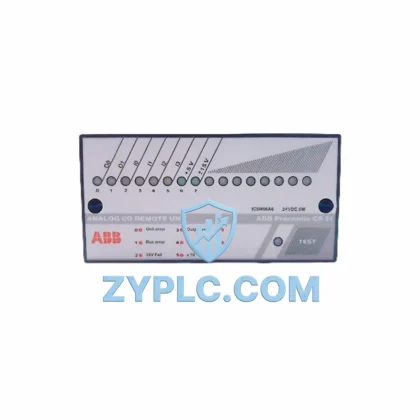
ABB AO920N 3KDE175533L9200 Analog Output for S900
The ABB AO920N 3KDE175533L9200 is a high-precision isolated analog output module purpose-built for deployment within the ABB S900 distributed control system (DCS) architecture. Designed to operate as a critical signal-conditioning and actuation interface at the I/O layer, this module bridges the gap between the control layer and field-level actuators — including control valves, variable frequency drives, and positioners — across demanding industrial environments. Its role within a layered automation system is not merely functional; it is architectural. By delivering stable, galvanically isolated 4–20 mA or 0–10 V output signals, the AO920N ensures that command signals from the CPU layer reach field devices with full fidelity, regardless of electrical noise, ground potential differences, or cable length constraints.
In a complete S900 DCS deployment, the AO920N operates in close coordination with the S900 system controller, the CI920S communication interface module, and the power supply modules such as the PS920 or PS921. The module slots into the S900 I/O station backplane, sharing a common communication bus with digital input modules (DI920), digital output modules (DO920), and analog input modules (AI920N) — forming a cohesive, high-density I/O cluster that supports both simplex and redundant configurations. This modular architecture allows engineers to scale the I/O count without redesigning the control cabinet, making the AO920N a long-term investment in system expandability.
From a system architecture perspective, the AO920N participates in the signal flow from the process controller down to the execution layer. The CPU issues setpoint commands via the fieldbus backbone — typically PROFIBUS DP or the proprietary S900 communication protocol — which are received by the CI920S interface and distributed to the AO920N for conversion into precise analog output signals. This tight integration between the communication layer and the I/O layer ensures deterministic response times, which is essential in closed-loop control applications such as flow regulation, pressure control, and temperature management in process industries.
Redundancy is a core design consideration in high-availability installations. The AO920N supports hot-standby redundancy configurations when paired with a redundant CI920S communication interface and a redundant power supply arrangement. In such setups, a secondary AO920N module can be configured to shadow the primary, enabling bumpless transfer in the event of a module failure. This capability is particularly valued in continuous process industries — petrochemical plants, power generation facilities, and water treatment stations — where unplanned downtime carries significant operational and safety consequences.
Installation and commissioning of the AO920N follow standard S900 engineering workflows. The module is configured via ABB’s engineering tools, where channel assignments, output ranges, fault behavior, and diagnostic reporting are defined. Each channel can be individually parameterized, allowing mixed output configurations within a single module. Diagnostic data — including wire-break detection, output saturation alerts, and communication health — is reported back to the control system in real time, enabling predictive maintenance strategies and reducing unplanned intervention cycles.
For long-term maintenance and spare parts management, the AO920N’s standardized form factor and backward compatibility within the S900 platform simplify inventory planning. A single spare module can serve as a replacement across multiple I/O stations, reducing the total number of spare parts required in a plant’s maintenance inventory. Combined with ZYPLC’s 12-Month Warranty and global logistics capability, procurement teams can source replacement modules with confidence, knowing that quality assurance and post-sale support are built into every transaction.
Product Specification Table
| System Role |
Analog Output I/O Module — S900 DCS I/O Layer |
| Full Part Number |
AO920N 3KDE175533L9200 |
| Brand / Platform |
ABB / S900 Distributed Control System |
| Output Channels |
8 channels (isolated), individually configurable |
| Output Signal Range |
4–20 mA / 0–20 mA / 0–10 V (per channel) |
| Galvanic Isolation |
Channel-to-channel and channel-to-bus isolation |
| Communication Interface |
S900 internal I/O bus via CI920S interface module |
| Fieldbus Compatibility |
PROFIBUS DP (via CI920S), S900 proprietary bus |
| Power Supply |
Supplied via S900 backplane (PS920 / PS921) |
| Mounting |
S900 I/O station backplane, DIN rail compatible enclosure |
| Operating Temperature |
-20°C to +60°C |
| Protection Rating |
IP20 (module), suitable for control cabinet installation |
| Diagnostics |
Wire-break detection, output saturation, communication fault reporting |
| Redundancy Support |
Hot-standby redundancy with redundant CI920S configuration |
| system integration |
Full system integration within S900 DCS architecture |
| Warranty |
12-Month Warranty — ZYPLC Quality Assurance |
System Compatibility Notes
The AO920N 3KDE175533L9200 achieves its full potential when deployed as part of a coordinated S900 control system architecture. At the control layer, the S900 system controller — such as the AC900F process controller — executes the control logic and generates analog setpoint commands for field actuators. These commands are transmitted via the CI920S communication interface module, which manages the I/O bus and coordinates data exchange between the controller and all connected I/O modules, including the AO920N.
At the power layer, the PS920 or PS921 power supply modules provide regulated DC power to the I/O station backplane, ensuring that all modules — including the AO920N — operate within their specified electrical parameters even under varying load conditions. For high-availability installations, a redundant power supply configuration eliminates the power supply as a single point of failure.
On the input side, the AI920N analog input module works in tandem with the AO920N to form a complete analog I/O pair — receiving process variable feedback from field transmitters while the AO920N delivers corrective output signals to actuators. Digital I/O modules such as the DI920 and DO920 complement the analog layer by handling discrete signals for valve position feedback, motor run/stop commands, and alarm outputs.
At the human-machine interface layer, ABB’s CP600 or CP635 HMI panels provide operators with real-time visibility into analog output values, channel diagnostics, and system health. Terminal modules and marshalling components within the control cabinet — including ABB’s TB820 terminal base units — provide the physical wiring interface between the AO920N’s output channels and field cable terminations, simplifying installation and enabling module replacement without disturbing field wiring.
Industrial Application Notes
The ABB AO920N 3KDE175533L9200 is deployed across a broad spectrum of process and discrete manufacturing industries where precise analog output control is essential to operational performance and safety.
In petrochemical and refinery applications, the AO920N drives control valve positioners that regulate flow rates of hydrocarbons, steam, and process gases. Its galvanic isolation is critical in these environments, where ground loops and electrical interference from high-power equipment can corrupt signal integrity. The module’s diagnostic capabilities support functional safety requirements by providing real-time fault detection at the I/O level.
In power generation facilities — including thermal, hydroelectric, and combined-cycle plants — the AO920N participates in turbine control, boiler feedwater regulation, and generator excitation systems. Its compatibility with redundant S900 architectures ensures that control continuity is maintained even during module maintenance or unexpected failures.
In water and wastewater treatment plants, the AO920N controls pump speed references via variable frequency drives (VFDs), chemical dosing pump rates, and aeration blower outputs. Its wide operating temperature range and robust construction make it suitable for installation in both climate-controlled control rooms and field-mounted enclosures.
In mining and metallurgical operations, the module manages analog outputs for conveyor speed control, crusher feed rate regulation, and flotation cell level control. The ability to configure individual channels independently allows a single AO920N to serve multiple control loops within a single I/O station, maximizing cabinet density and minimizing hardware costs.
In packaging and discrete manufacturing lines, the AO920N provides precise speed and torque references to servo drives and VFDs, enabling synchronized multi-axis motion control within a DCS-managed production environment.
Product Compatibility FAQ
Q1: Is the AO920N 3KDE175533L9200 compatible with both simplex and redundant S900 DCS configurations?
Yes. The AO920N is fully compatible with both simplex and redundant S900 system architectures. In redundant configurations, it operates alongside a redundant CI920S communication interface and a secondary power supply arrangement. The module supports hot-standby redundancy, enabling bumpless transfer to the backup module in the event of a primary module failure — a critical requirement for continuous process applications where control interruption is not acceptable.
Q2: Can the AO920N be replaced in the field without interrupting the entire I/O station?
In most S900 configurations, the AO920N supports hot-swap replacement when the system is configured for redundant operation. In simplex configurations, module replacement requires a brief suspension of the affected output channels. The use of ABB TB820 terminal base units ensures that field wiring remains undisturbed during module exchange, significantly reducing the time and risk associated with maintenance interventions. ZYPLC’s 12-Month Warranty covers the replacement module, providing additional assurance for maintenance planning.
Q3: What engineering tools are required to configure and commission the AO920N within an S900 DCS?
The AO920N is configured using ABB’s standard S900 engineering environment, which includes the Control Builder F or equivalent DCS engineering tool. Channel parameters — including output range, fault behavior, wire-break response, and diagnostic reporting — are defined at the engineering station and downloaded to the CI920S interface, which distributes configuration data to the AO920N via the I/O bus. No additional hardware tools are required for standard commissioning. ZYPLC provides technical support for integration and commissioning queries as part of the 12-Month Warranty service commitment.
© 2026 ZYPLC. All rights reserved.
Original Source: https://zyplc.com
Contact: +86 19859288691 | plc.sales@zyplc.com