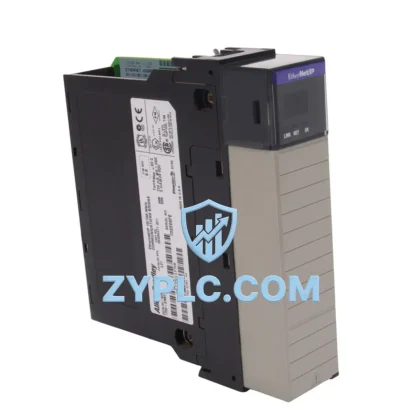
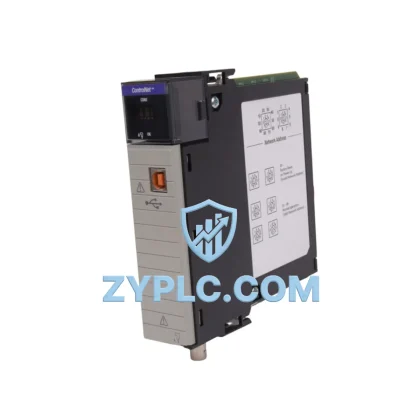
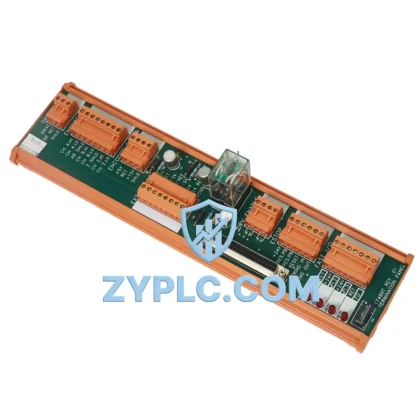
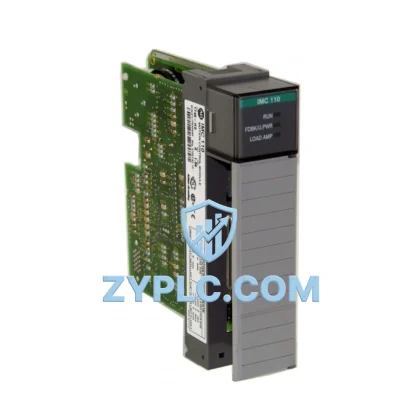
ABB APBU-44CE System-Ready Branching Unit for AC500 Architecture: Control System Coordination Across Every Layer
The ABB APBU-44CE is a dedicated branching unit engineered for deployment within the ABB AC500 modular PLC platform, specifically designed to extend and distribute the S500 I/O bus across multiple field device clusters in complex industrial control architectures. Rather than functioning as a standalone component, the APBU-44CE serves as a structural node within a layered automation system — connecting the control layer, I/O distribution layer, and field execution layer into a coherent, maintainable, and scalable whole. Its role is to preserve signal integrity, reduce wiring complexity, and enable modular expansion without compromising system determinism or communication reliability.
In modern industrial environments — whether in power generation, petrochemical processing, water treatment, or advanced manufacturing — control system architects face the dual challenge of maximizing I/O density while maintaining the flexibility to expand, reconfigure, or service individual segments without system-wide disruption. The APBU-44CE addresses this challenge directly by acting as a passive yet precision-engineered bus splitter that allows the S500 I/O bus to branch into parallel sub-segments, each independently addressable and maintainable. This architecture supports hot-swap capability at the module level, reduces mean time to repair (MTTR), and simplifies commissioning across geographically distributed cabinet installations.
Architecture Specification Table
| Parameter |
Specification |
| Model |
APBU-44CE |
| Brand |
ABB |
| Series |
AC500 / S500 I/O |
| System Role |
S500 I/O Bus Branching Unit |
| Bus Ports |
4 × S500 I/O bus outputs (CE-type connectors) |
| Communication Protocol |
S500 proprietary I/O bus (CS31 compatible architecture) |
| Supply Voltage |
24 V DC (bus-powered via S500 backplane) |
| Operating Temperature |
-25°C to +60°C |
| Protection Rating |
IP20 |
| Mounting |
DIN rail, compatible with AC500 S500 I/O terminal base |
| Country of Origin |
Germany |
| Certifications |
CE, UL (series-level) |
| Warranty |
12-Month Warranty |
| Contextual Integration |
Fully compatible with AC500 PM5xx / PM5xx-ETH CPU families and S500 I/O modules |
Coordinated Control System Design
The APBU-44CE achieves its full value when integrated as part of a complete ABB AC500 control system architecture. At the control layer, ABB AC500 CPUs such as the PM554-T-ETH, PM564-T-ETH, or PM591-ETH serve as the processing core, executing ladder logic, function block diagrams, or structured text programs while managing real-time communication with all downstream I/O nodes. The APBU-44CE connects directly to the S500 I/O bus emanating from these CPUs, enabling the bus to branch into up to four independent sub-segments — each capable of hosting a full complement of S500 digital and analog I/O modules.
At the I/O layer, modules such as the DC532 (digital input), DC522 (digital output), AX522 (analog I/O), and DA501 (analog output) are distributed across the branched bus segments. Each segment operates with full electrical isolation from the others, ensuring that a fault or maintenance event on one branch does not propagate to adjacent I/O clusters. This design is particularly valuable in redundant or safety-critical architectures where segment-level isolation is a functional requirement.
At the power layer, the ABB CP-E 24/5.0 or equivalent 24 V DC power supply units provide stable bus power to each branched segment. Proper power budgeting across branches — accounting for the cumulative current draw of all connected I/O modules — is essential during system design, and the APBU-44CE’s passive architecture ensures minimal additional power consumption at the branching node itself.
At the network and communication layer, the AC500 platform supports integration with PROFIBUS DP, PROFINET, Modbus TCP, and EtherNet/IP via dedicated communication modules such as the CM572-DP (PROFIBUS master) or CM589-PNIO (PROFINET adapter). The APBU-44CE’s role in maintaining S500 bus integrity ensures that upstream communication modules receive consistent, low-latency I/O data regardless of the physical distribution of field devices across cabinet sections.
At the human-machine interface layer, ABB CP600 series HMI panels or third-party SCADA systems connected via OPC-UA or Modbus TCP provide operators with real-time visibility into the distributed I/O architecture. The logical transparency of the APBU-44CE — which does not require separate configuration or addressing — simplifies HMI tag mapping and reduces engineering time during commissioning.
At the execution layer, field devices including variable frequency drives, solenoid valve banks, motor starters, and instrumentation transmitters connect to the S500 I/O modules distributed across the branched bus segments. The APBU-44CE ensures that signal routing from these field devices to the CPU remains deterministic and electrically stable, supporting precise closed-loop control in demanding process environments.
Application in Layered Automation Systems
Manufacturing and Assembly Lines: In automotive or electronics manufacturing, the APBU-44CE enables a single AC500 CPU to manage distributed I/O across multiple machine stations on a production line. Each branch serves a distinct workstation — welding, inspection, conveying, or packaging — while the CPU maintains unified program execution and data logging. This reduces the number of CPUs required per line and simplifies network topology.
Power Generation and Substation Automation: In power plant auxiliary systems or substation control panels, the APBU-44CE supports the distribution of I/O signals across physically separated switchgear cubicles. The branched architecture allows maintenance personnel to isolate and service individual cubicle I/O segments without interrupting the broader protection and control system — a critical requirement in live substation environments.
Petrochemical and Refinery Process Control: In continuous process plants, the APBU-44CE supports the deployment of S500 I/O modules across hazardous area boundaries (with appropriate barriers) and non-hazardous control rooms. The branching architecture accommodates the physical separation between field junction boxes and central marshalling cabinets, reducing cable runs and simplifying loop documentation.
Water and Wastewater Treatment: Municipal water treatment facilities benefit from the APBU-44CE’s ability to extend the S500 I/O bus across pump stations, chemical dosing skids, and filtration banks — all controlled from a central AC500 CPU. The modular branch architecture supports phased expansion as treatment capacity grows, without requiring CPU replacement or bus reconfiguration.
Mining and Metallurgy: In ore processing or smelting operations, the APBU-44CE supports robust I/O distribution in high-vibration, high-temperature environments. Its DIN rail mounting and CE-certified design ensure reliable operation in industrial enclosures subject to mechanical stress and electromagnetic interference from large motor drives and arc furnaces.
Architecture Engineering FAQ
Q1: How many S500 I/O modules can be connected per branch of the APBU-44CE, and does branching affect bus scan time?
Each branch of the APBU-44CE supports the standard S500 I/O bus module count as defined by the connected AC500 CPU’s I/O capacity specification — typically up to 10 S500 I/O modules per sub-segment depending on the CPU model and power budget. Branching via the APBU-44CE does not introduce additional bus scan time overhead, as the unit is a passive electrical splitter rather than an active bus master or repeater. Total system scan time is determined by the CPU’s cycle time configuration and the aggregate I/O module count across all branches.
Q2: Is the APBU-44CE compatible with both AC500 V2 and AC500-eCo CPU families, and can it be used in redundant CPU architectures?
The APBU-44CE is designed for the S500 I/O bus and is compatible with AC500 V2 CPU families including the PM5xx and PM5xx-ETH series. Compatibility with AC500-eCo CPUs should be verified against the specific eCo CPU’s I/O bus specification, as the eCo platform uses a simplified I/O architecture. In redundant CPU configurations using ABB’s AC500 redundancy modules, the APBU-44CE can be deployed on the shared I/O bus segment, provided the redundancy architecture is configured for shared I/O access — consult the AC500 system redundancy application note for detailed wiring and configuration guidance.
Q3: What does the 12-Month Warranty cover for the APBU-44CE, and what support is available for long-term maintenance and spare parts supply?
The 12-Month Warranty covers manufacturing defects, electrical failures under normal operating conditions, and component-level faults identified during the warranty period. Warranty claims are processed through ZYPLC’s technical support team, with replacement units dispatched from in-stock inventory to minimize system downtime. For long-term maintenance planning, ZYPLC maintains a dedicated inventory of APBU-44CE units and compatible S500 I/O modules to support multi-year service contracts and emergency spare parts requirements. Engineers are encouraged to contact our technical team for system-level compatibility assessments and lifecycle planning support.
© 2026 ZYPLC. All rights reserved.
Original Source: https://zyplc.com
Contact: +86 19859288691 | [email protected]