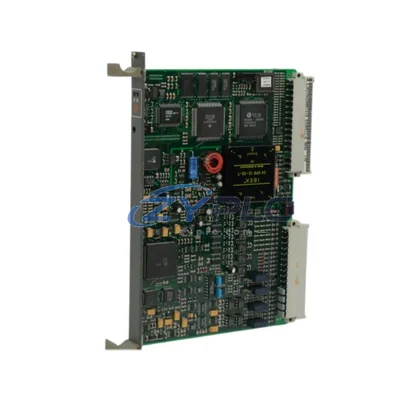
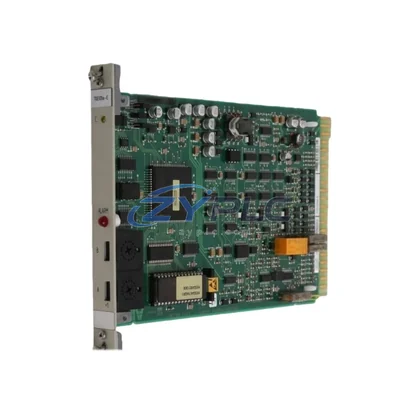
The ABB CAI10 is a high-precision 4-channel analog input module engineered for the AC500 S500 distributed I/O platform. Designed to serve as a critical data acquisition node in modern industrial automation architectures, the CAI10 bridges the gap between field-level sensors and upper-level control systems — enabling seamless signal capture, real-time data transmission, and intelligent process monitoring across the entire automation chain.
In smart factory environments, the integrity of analog signal acquisition directly determines the quality of process control decisions. The CAI10 supports multiple input signal types including 0–20 mA, 4–20 mA, and ±10 V, making it universally compatible with a wide range of industrial sensors such as pressure transmitters, temperature transducers, flow meters, and level sensors deployed on the production floor. Each channel is independently configurable, allowing engineers to mix signal types within a single module and reduce wiring complexity across multi-sensor installations.
The CAI10 integrates natively into the ABB AC500 PLC ecosystem. When paired with an AC500 CPU — such as the PM554, PM564, or PM595 series — the module communicates over the S-Bus backplane with deterministic cycle times, ensuring that analog process values are delivered to the controller with minimal latency. This tight integration supports closed-loop control strategies where real-time feedback from field instruments must be processed and acted upon within milliseconds.
Beyond local PLC integration, the CAI10 plays a pivotal role in broader industrial network architectures. The AC500 platform supports a wide range of industrial communication protocols including PROFIBUS DP, PROFINET, Modbus TCP, EtherNet/IP, and CANopen. Through the AC500 CPU’s communication interfaces or dedicated gateway modules such as the CI502-PNIO or CI504-PNIO PROFINET adapters, analog data captured by the CAI10 can be transmitted upstream to SCADA systems, MES platforms, and cloud-based analytics engines. This enables plant operators to monitor analog process variables in real time from centralized control rooms or remote HMI terminals.
In distributed automation topologies, the CAI10 is frequently deployed alongside remote I/O expansion modules such as the TU515 or TU516 terminal units, which provide the physical mounting and field wiring interface for the S500 I/O modules. This modular architecture allows engineers to position analog input nodes close to the field instruments, reducing signal cable runs and minimizing the risk of noise-induced measurement errors — a critical consideration in electrically noisy industrial environments such as motor drive panels, welding stations, and high-voltage switchgear rooms.
The CAI10’s data output feeds directly into the AC500 controller’s process image, where it can be consumed by structured control programs written in IEC 61131-3 languages including Ladder Diagram, Function Block Diagram, and Structured Text. Engineers can implement advanced signal conditioning, scaling, filtering, and alarm threshold logic within the PLC program, transforming raw analog counts into meaningful engineering units that drive process decisions and trigger alarm notifications to operator HMI panels such as the ABB CP600 series or third-party SCADA clients connected via OPC UA.
For facilities pursuing Industry 4.0 and digital twin initiatives, the analog data streams captured by the CAI10 can be routed through edge computing gateways — such as the ABB Edge Controller or compatible third-party edge devices — enabling local data preprocessing, anomaly detection, and predictive maintenance analytics without relying on cloud round-trip latency. This edge-to-cloud architecture ensures that critical process data remains available even during network interruptions, supporting high-availability production environments.
Every ABB CAI10 module supplied by ZYPLC undergoes pre-shipment functional verification to confirm channel accuracy, signal range compliance, and backplane communication integrity. Modules are sourced through verified industrial supply channels and are accompanied by a warranty and support terms confirmed before quote covering manufacturing defects and functional failures under normal operating conditions. Our technical team provides RFQ response within 24 hours and supports customers with compatibility verification, system configuration guidance, and cross-reference assistance for legacy ABB I/O platforms.
Compatibility & Integration Notes
| Parameter |
Specification |
| Module Type |
4-Channel Analog Input Module |
| Compatible Platform |
ABB AC500 S500 Distributed I/O |
| Input Signal Types |
0–20 mA, 4–20 mA, ±10 V (per channel, configurable) |
| Communication Interface |
S-Bus Backplane (AC500 internal bus) |
| Supported Protocols |
PROFIBUS DP, PROFINET, Modbus TCP, EtherNet/IP, CANopen (via AC500 CPU) |
| Network Compatibility |
SCADA, MES, OPC UA, DCS integration via AC500 gateway modules |
| Resolution |
12-bit analog-to-digital conversion |
| System Application |
Process monitoring, closed-loop control, remote I/O, smart factory data acquisition |
| Mounting |
S500 I/O terminal units (TU515, TU516) |
| Origin |
Germany |
| Warranty |
12 Months (manufacturing defects and functional failures) |
Connected Automation Data Flow
In a typical smart factory deployment, the ABB CAI10 sits at the front end of the industrial data chain. Field instruments — including 4–20 mA pressure transmitters, PT100 temperature sensors connected via analog signal conditioners, and ultrasonic level transmitters — feed their process signals directly into the CAI10’s input channels. The module digitizes these signals and passes the values across the S500 backplane to the AC500 PLC CPU, such as the PM564-T or PM595-4ETH-F, where the data enters the controller’s cyclic process image.
From the AC500 CPU, process data flows outward through multiple communication pathways. A CI502-PNIO PROFINET communication interface module enables the AC500 to participate in a PROFINET IO network, connecting the controller to higher-level SCADA servers running platforms such as ABB System 800xA or Wonderware InTouch. Simultaneously, Modbus TCP connectivity allows the AC500 to share analog process values with energy management systems, third-party HMI panels, and data historians. In facilities using CANopen for drive coordination, the AC500 can exchange setpoints and feedback values with ABB ACS880 variable frequency drives, enabling coordinated motor speed control based on analog process feedback captured by the CAI10.
For remote monitoring and diagnostics, the AC500’s built-in Ethernet port connects to plant-wide industrial Ethernet switches — such as ABB’s EL series or compatible managed switches from the automation network infrastructure — routing process data to remote engineering workstations and mobile operator interfaces. Edge computing nodes installed at the panel level can subscribe to OPC UA data feeds from the AC500, enabling local analytics and alarm processing without burdening the central SCADA server. Digital output modules such as the CDO16 can be triggered by alarm conditions derived from CAI10 analog threshold violations, activating warning lights, sirens, or interlock relays on the production floor.
Solving Data Isolation in Industrial Sites
One of the most persistent challenges in industrial automation is the fragmentation of process data across incompatible systems and protocols. Legacy installations often feature a mix of 4–20 mA analog loops, PROFIBUS DP networks, serial Modbus RTU devices, and newer Ethernet-based systems — each operating as an isolated data island with no visibility into the others. The ABB CAI10, deployed within the AC500 S500 I/O architecture, directly addresses this challenge by providing a standardized, high-accuracy analog acquisition layer that feeds into the AC500’s multi-protocol communication stack.
By consolidating analog field signals into the AC500 platform, plant engineers gain a single, unified data source that can simultaneously serve PROFINET-based SCADA systems, Modbus TCP energy monitors, OPC UA data historians, and EtherNet/IP production management platforms. This eliminates the need for standalone signal converters, protocol translators, and data concentrators that introduce additional failure points and maintenance overhead. The result is a transparent, end-to-end data pipeline from sensor to enterprise system — enabling real-time production visibility, accurate KPI reporting, and data-driven maintenance scheduling.
Remote diagnostics capabilities built into the AC500 platform allow maintenance engineers to interrogate module status, channel health, and communication statistics from any networked workstation, reducing the need for on-site troubleshooting visits and minimizing production downtime. As production requirements evolve, the S500 I/O system’s modular architecture supports seamless expansion — additional CAI10 modules, digital I/O modules, or specialty function modules can be added to the I/O rack without disrupting existing wiring or reprogramming the base controller configuration.
Industrial Connectivity FAQ
Q1: What communication protocols does the ABB CAI10 support for SCADA and HMI integration?
The CAI10 itself communicates over the S500 S-Bus backplane to the AC500 CPU. The AC500 CPU then exposes analog data to upper-level systems via PROFIBUS DP, PROFINET IO, Modbus TCP, EtherNet/IP, or CANopen, depending on the communication modules installed. This makes the CAI10 compatible with virtually all major industrial SCADA, DCS, and HMI platforms.
Q2: How does the CAI10 ensure network stability and data integrity in electrically noisy environments?
The CAI10 features galvanic isolation on its analog input channels, protecting measurement accuracy against ground loops and common-mode interference. The S-Bus backplane communication is deterministic and immune to Ethernet network congestion, ensuring that analog values are delivered to the AC500 CPU on every controller scan cycle without packet loss or jitter.
Q3: Can the CAI10 be expanded or integrated into larger distributed I/O systems?
Yes. The S500 I/O platform supports up to 10 I/O modules per local bus segment, and multiple segments can be connected via the AC500’s remote I/O capabilities or PROFIBUS DP/PROFINET extensions. This allows engineers to build scalable distributed I/O architectures spanning large production facilities, with CAI10 modules positioned at optimal locations relative to field instruments.
Q4: What does the warranty and support terms confirmed before quote cover, and what is the pre-shipment testing process?
Every CAI10 module supplied by ZYPLC is functionally tested prior to shipment, verifying channel accuracy across all supported signal ranges and confirming backplane communication integrity. The warranty and support terms confirmed before quote covers manufacturing defects and functional failures under normal operating conditions. Our technical support team is available to assist with installation, configuration, and troubleshooting throughout the warranty period.