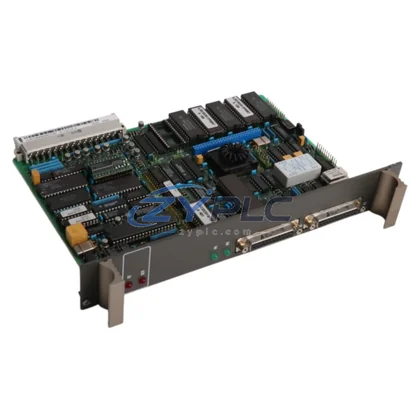
ABB DSQC104 Resolver Board for S4 Automation
The ABB DSQC104 is a precision resolver feedback board engineered for ABB S4 and S4C series robot controllers. In modern industrial environments where energy efficiency and uptime directly impact profitability, the DSQC104 plays a critical role in closing the servo control loop with minimal signal loss and maximum positional accuracy. By delivering clean, high-resolution resolver feedback to the robot’s motion controller, it enables tighter torque regulation, reduces motor hunting, and eliminates unnecessary energy draw caused by imprecise positioning cycles.
Factories running ABB IRB 1400, IRB 2400, or IRB 6400 series robots depend on accurate resolver data to maintain consistent production line rhythm. When resolver feedback degrades — due to board failure, signal noise, or aging components — servo drives compensate by drawing excess current, increasing thermal load and accelerating wear on motor windings. Replacing a faulty resolver board with a verified DSQC104 immediately restores loop stability, reduces reactive power consumption, and brings cycle times back to specification.
Product Specification Table
| Parameter |
Specification / Value |
| SKU |
DSQC104 |
| Brand |
ABB |
| Series |
S4 / S4C Robot Controller |
| Product Type |
Resolver Feedback Board |
| Compatible Systems |
ABB S4, S4C; IRB 1400, IRB 2400, IRB 6400 |
| Application Environment |
Industrial Robot Automation, Servo Drive Systems |
| Power Consumption |
Low-draw signal processing; reduces servo overcurrent events |
| Operating Efficiency |
High-resolution resolver decoding; minimizes positional error |
| Energy Saving Value |
Eliminates excess motor current from feedback instability |
| Origin |
Sweden (ABB) |
| Warranty |
warranty terms confirmed during quotation |
| Lead Time |
Ships within 1–3 business days |
| Condition |
New / Tested Refurbished Available |
System Compatibility and Application
The DSQC104 does not operate in isolation — it is one node in a tightly integrated industrial automation system. In a typical ABB S4C cell, the DSQC345 main computer board orchestrates all motion commands, relying on resolver data from the DSQC104 to calculate real-time joint positions. Alongside it, the DSQC346 serial measurement board aggregates axis feedback signals before passing them upstream, ensuring that each servo axis receives synchronized, low-latency position data.
On the drive side, the DSQC508 drive unit translates motion commands into precise voltage and current waveforms delivered to each robot axis motor. When resolver feedback is accurate, the drive operates within its optimal efficiency band — avoiding the excess switching losses that occur when the control loop is forced to correct for positional drift. The DSQC374 I/O board manages digital and analog signals between the robot controller and peripheral equipment such as conveyors, grippers, and safety interlocks, ensuring that the entire production cell responds to energy state changes in real time.
For facilities integrating ABB robots into broader MES or SCADA environments, the DSQC532 fieldbus adapter enables communication over PROFIBUS or DeviceNet, allowing energy consumption data from the robot controller to be logged and analyzed at the plant level. Paired with a CP600 series HMI panel, operators can monitor servo load trends, identify axes running above baseline current draw, and schedule predictive maintenance before a resolver fault causes unplanned downtime.
In multi-robot cells, the DSQC609 power distribution board ensures that each controller receives stable, conditioned DC power — a prerequisite for consistent resolver signal quality. Voltage fluctuations at the board level introduce noise into the resolver feedback path, causing the servo drive to misinterpret position data and draw compensatory current. Maintaining clean power delivery through a verified DSQC609 directly supports the energy efficiency gains enabled by a properly functioning DSQC104.
Where motion profiling demands the highest precision — such as in arc welding or precision assembly — the DSQC626 axis computer board works in conjunction with the resolver board to execute interpolated multi-axis trajectories with sub-millimeter repeatability. Smooth, optimized motion paths reduce peak current demand per cycle, lowering both energy consumption and mechanical stress on gearboxes and bearings.
Maintenance and Replacement Notes
In automotive body-in-white lines, stamping transfer systems, and electronics assembly cells, robot uptime and energy efficiency are directly linked. A single resolver board failure on an ABB IRB 2400 can halt an entire welding station, triggering idle energy consumption across upstream and downstream equipment while maintenance teams diagnose the fault. Stocking verified DSQC104 boards as part of a planned spare parts inventory eliminates this diagnostic delay — maintenance technicians can swap the board, restore resolver feedback, and return the robot to production within minutes rather than hours.
Beyond emergency replacement, the DSQC104 supports a proactive maintenance planning strategy. By monitoring servo axis current trends through the robot controller’s diagnostic interface, engineers can identify axes where resolver signal degradation is causing the drive to work harder than necessary. Replacing a marginal DSQC104 before it fails completely prevents the gradual energy creep that occurs as feedback quality deteriorates — a pattern that often goes unnoticed until a hard fault triggers a line stoppage.
In facilities running multiple shifts, the cumulative operational stability from maintaining clean resolver feedback across all robot axes can be significant. Each axis operating with accurate position feedback runs its motion profile at the programmed efficiency point, avoiding the excess acceleration and deceleration that results from positional uncertainty. Across a cell of six to twelve robots, this translates to measurable reductions in peak demand charges and overall kWh consumption per production shift.
All DSQC104 units supplied by ZYPLC undergo functional testing prior to shipment, verifying resolver signal integrity, board communication with the S4C controller backplane, and thermal performance under load. This pre-shipment validation ensures that replacement boards restore full energy efficiency from the first production cycle after installation, with no burn-in period required.
Product Sourcing FAQ
Q1: How does a faulty DSQC104 affect energy consumption in an ABB S4 robot?
A degraded resolver board introduces positional feedback errors that force the servo drive to apply corrective current continuously. This increases motor heat generation, raises per-cycle energy consumption, and accelerates wear on drive components. Replacing the DSQC104 restores accurate feedback and returns the drive to its designed efficiency operating point.
Q2: Is the DSQC104 compatible with both S4 and S4C controller variants?
Yes. The DSQC104 is designed for use across the ABB S4 and S4C controller families, supporting robot models including the IRB 1400, IRB 2400, and IRB 6400 series. Always verify the controller firmware version and backplane configuration against the board revision before installation.
Q3: What is the recommended replacement interval for the DSQC104 in high-duty-cycle applications?
In continuous three-shift operations, resolver boards should be inspected as part of annual preventive maintenance. Signs of impending failure include intermittent axis faults, increased servo current draw on specific axes, and position repeatability degradation. Proactive replacement based on condition monitoring is more cost-effective than reactive replacement after a production stoppage.
Q4: What warranty and testing does ZYPLC provide with the DSQC104?
Every DSQC104 supplied by ZYPLC is covered by a warranty terms confirmed during quotation and undergoes pre-shipment functional testing to verify resolver signal output, backplane communication, and thermal stability. Units are shipped within 1–3 business days. For technical support or compatibility verification, contact our team directly.