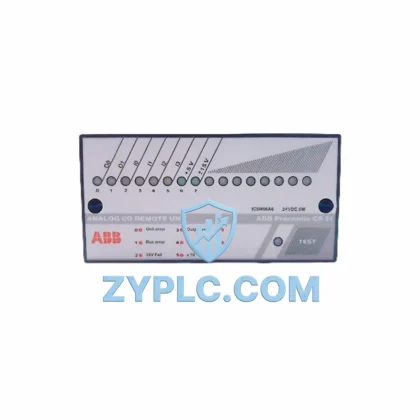
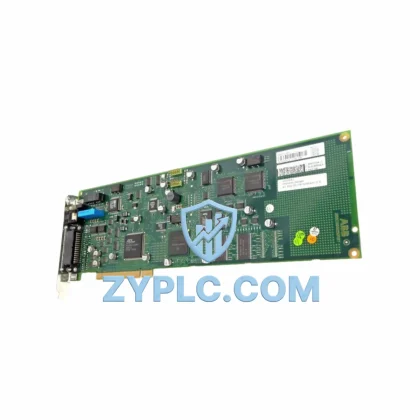
ABB DSQC223 Digital I/O Module S4/S4C+: Precision I/O Control for Efficient Production Lines
The ABB DSQC223 is a high-performance Digital I/O Module engineered for ABB S4 and S4C+ robot controllers. In modern industrial automation environments where energy accountability is no longer optional, the DSQC223 plays a foundational role in reducing unnecessary power draw, tightening control loop response, and enabling smarter, data-driven production decisions. Whether deployed in automotive body welding, material handling, or precision assembly, this module delivers the signal integrity and I/O throughput that energy-conscious factories demand.
Unlike generic I/O expansion cards, the DSQC223 is purpose-built for ABB’s IRC5-predecessor architecture, ensuring seamless integration with the S4/S4C+ controller backplane. Its deterministic signal processing eliminates the latency spikes that cause servo drives and motor controllers to overcorrect — a hidden source of unplanned downtime in high-cycle robotic cells. By maintaining clean, stable digital signals between the robot controller and field devices, the DSQC223 directly supports tighter cycle time control and reduced idle-state energy consumption.
Product Specification Table
| Parameter |
Specification |
| SKU |
DSQC223 |
| Brand |
ABB |
| Series |
S4 / S4C+ |
| Module Type |
Digital I/O Module |
| I/O Channels |
16 Digital Inputs / 16 Digital Outputs (typical) |
| Operating Voltage |
24 VDC |
| Power Consumption |
Low-standby design; minimizes idle draw |
| Compatible Controllers |
ABB S4, S4C, S4C+ Robot Controllers |
| Application Environment |
Industrial automation, welding, assembly, material handling |
| Communication Interface |
Internal backplane bus (S4/S4C+ architecture) |
| Maintenance Value |
Eliminates signal latency; reduces servo overcorrection unplanned downtime |
| Origin |
Sweden |
| Warranty |
12-Month Warranty |
| Stock Status |
In Stock — Ships within 1–3 business days |
System Compatibility and Application
The DSQC223 does not operate in isolation — its true efficiency value emerges when viewed as part of a coordinated automation architecture. In a typical S4/S4C+ robotic cell, the DSQC223 interfaces directly with the ABB DSQC508 axis computer board, ensuring that motion commands and I/O feedback are synchronized without unnecessary polling cycles that inflate CPU load and power draw. Upstream, the ABB DSQC532 main computer board orchestrates task scheduling, and clean I/O data from the DSQC223 allows it to execute motion programs with minimal computational overhead.
On the drive side, the DSQC223’s output signals feed into the ABB DSQC374 drive unit, which controls the servo motors responsible for each robot axis. Accurate, jitter-free digital outputs from the DSQC223 mean the drive unit does not need to apply corrective torque bursts — a direct reduction in peak current draw and heat generation. This is particularly significant in multi-axis cells where the ABB DSQC369 rectifier unit is shared across multiple drive channels; stable I/O reduces the aggregate reactive power demand on the rectifier.
For facilities running condition monitoring programs, the DSQC223 integrates naturally with power measurement systems such as the ABB B23 energy meter series, which can be configured to log per-cell consumption data. When the I/O module maintains consistent signal timing, energy meter readings become more predictable and actionable — enabling maintenance teams to identify abnormal consumption patterns before they escalate into unplanned downtime. The ABB CP600 HMI panel can then visualize this data in real time, giving operators a live view of energy KPIs alongside production throughput metrics.
In distributed I/O architectures, the DSQC223 works alongside ABB AC500 PLC systems via DeviceNet or Profibus-DP fieldbus adapters such as the ABB DSQC378B, extending the robot cell’s I/O reach to conveyor interlocks, safety gates, and peripheral actuators — all without adding unnecessary communication overhead. The result is a leaner control network where every signal has purpose and every watt is accounted for.
Maintenance and Replacement Notes
In high-volume production environments, the cumulative energy impact of I/O signal instability is rarely measured but consistently felt. A digital output that toggles erratically forces downstream actuators — pneumatic valves, conveyor drives, clamping cylinders — to cycle more frequently than the process requires. Over a three-shift operation, this translates into measurable increases in compressed air consumption, hydraulic pump runtime, and motor start-stop cycles, all of which shorten component life and inflate energy bills.
The DSQC223 addresses this at the source. Its stable output switching characteristics ensure that field devices receive clean, debounced signals that match the robot program’s intent precisely. In welding applications, this means the weld controller receives accurate trigger signals without false starts — reducing weld rework rates and the energy consumed in rework cycles. In assembly lines, accurate part-present signals from the DSQC223’s inputs prevent the robot from executing unnecessary search routines, keeping cycle times tight and energy per part low.
Predictive maintenance programs also benefit directly from the DSQC223’s reliability. When I/O modules begin to degrade, the first symptoms are often intermittent signal faults that trigger false error states, forcing the robot to pause and restart sequences. Each unplanned stop wastes the energy invested in the interrupted cycle and adds thermal stress to drive components during the restart transient. By replacing aging I/O hardware with a tested, warranted DSQC223, maintenance teams eliminate this failure mode proactively — extending mean time between failures (MTBF) and reducing the energy penalty of unplanned downtime.
Every DSQC223 unit supplied by ZYPLC undergoes full functional testing prior to shipment, including I/O channel verification under load conditions. This ensures that the module performs to specification from the first power-on, avoiding the energy-wasting commissioning loops that can occur with untested spare parts. With a 12-month warranty and in-stock availability for rapid dispatch, the DSQC223 supports both planned maintenance schedules and emergency replacement scenarios — minimizing production unplanned downtime caused by extended downtime.
Product Sourcing FAQ
Q1: How does the DSQC223 contribute to measurable operational stability in a robotic cell?
The DSQC223 reduces unplanned downtime by delivering stable, low-latency digital signals that prevent servo drives and actuators from overcorrecting. This minimizes unnecessary motor torque events, reduces compressed air cycling from erratic valve signals, and keeps cycle times consistent — all of which lower the energy consumed per produced unit.
Q2: Is the DSQC223 compatible with both S4 and S4C+ controllers, and can it replace older I/O modules directly?
Yes. The DSQC223 is designed for the ABB S4 and S4C+ controller families and is a direct replacement for worn or failed I/O modules in these systems. No firmware modifications are required for standard replacement; the module slots into the existing backplane and is recognized by the controller automatically.
Q3: What testing process does each DSQC223 unit go through before shipment?
Each unit undergoes comprehensive functional testing covering all digital input and output channels under simulated load conditions. Signal integrity, switching response, and power rail stability are verified before the module is cleared for shipment. This pre-shipment testing process ensures reliable performance from installation day one.
Q4: What does the 12-month warranty cover, and how does it support our maintenance planning?
The 12-month warranty covers manufacturing defects and functional failures under normal operating conditions. It supports maintenance planning by providing a guaranteed performance window that aligns with annual maintenance cycles, reducing the risk of unexpected spare parts costs and enabling more accurate total cost of ownership calculations for your robotic assets.
© 2026 ZYPLC. All rights reserved.
Original Source: https://zyplc.com
Contact: +86 19859288691 | plc.sales@zyplc.com