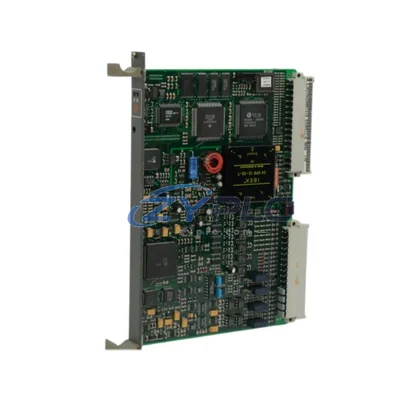
ABB DSQC431 3HAC036260-001: Industrial Data Link for IRC5C Smart Factory Networks
The ABB DSQC431 (3HAC036260-001) is a dedicated DeviceNet Communication Gateway engineered for ABB IRC5C robot controllers. Designed to bridge field-level devices and upper-level control systems, this module enables seamless protocol conversion, real-time data exchange, and deterministic network communication across complex industrial automation architectures. Whether integrating robotic cells into a broader SCADA environment or extending DeviceNet connectivity to remote I/O stations, the DSQC431 delivers the network stability and data transparency that modern smart factories demand.
In today’s industrial landscape, connectivity is the backbone of operational efficiency. The DSQC431 serves as the critical communication node between the IRC5C robot controller and the plant-wide DeviceNet fieldbus, ensuring that every signal — from torque feedback and position data to alarm states and cycle counts — flows reliably from the robot arm to the supervisory layer. This uninterrupted data pipeline supports real-time monitoring, predictive maintenance, and remote diagnostics without introducing latency or packet loss into the control loop.
Compatibility & Integration Notes
| Parameter |
Specification |
| SKU |
DSQC431 / 3HAC036260-001 |
| Brand |
ABB Robotics |
| Compatible Controller |
IRC5C (Compact IRC5) |
| Communication Protocol |
DeviceNet (CAN-based, ISO 11898) |
| Interface Type |
DeviceNet Gateway / Communication Board |
| Transmission Capability |
Up to 500 kbps; deterministic, real-time fieldbus |
| Network Compatibility |
DeviceNet Master/Slave topology; compatible with Allen-Bradley, Omron, and Siemens DeviceNet networks |
| System Application |
Robot cell integration, SCADA/HMI connectivity, remote I/O, PLC-to-robot communication |
| Product Type |
Communication Gateway |
| Origin |
Sweden |
| Warranty |
Warranty and support terms confirmed before quote — Tested & Verified Before Shipment |
Connected Automation Data Flow
In a typical smart factory deployment, the DSQC431 sits at the heart of the robot cell’s communication architecture. The IRC5C controller — running ABB’s RobotWare operating system — interfaces with the DSQC431 to expose robot I/O, motion status, and program states onto the DeviceNet fieldbus. From there, a DeviceNet scanner module installed in a Rockwell Automation ControlLogix or CompactLogix PLC polls the DSQC431 as a DeviceNet slave, aggregating robot data alongside signals from Banner Engineering photoelectric sensors, Balluff RFID readers, and SMC pneumatic valve islands connected on the same network segment.
The PLC forwards consolidated process data upstream via EtherNet/IP to a Wonderware System Platform SCADA or Ignition by Inductive Automation HMI/SCADA server, where operators monitor robot cycle times, weld counts, and fault codes in real time. Simultaneously, an ABB DSQC688 EtherNet/IP Communication Board — often deployed alongside the DSQC431 in multi-protocol IRC5C cabinets — handles higher-level MES data exchange, while the DSQC431 manages deterministic fieldbus I/O at the device layer.
For remote I/O expansion, Turck BL20 or BL67 DeviceNet remote I/O modules extend digital and analog signal collection from end-of-arm tooling, conveyor sensors, and safety light curtains back to the IRC5C through the DSQC431 gateway. This architecture eliminates point-to-point wiring runs and centralizes diagnostics — technicians can interrogate node health, check bus-off counters, and verify MAC ID assignments directly from the SCADA workstation without entering the robot cell.
In welding and material handling applications, the DSQC431 also coordinates with ABB DSQC652 Digital I/O Boards and DSQC643 Analog I/O Boards within the IRC5C cabinet, ensuring that external DeviceNet commands from the PLC are correctly mapped to internal robot I/O signals. Cognex In-Sight vision systems connected via DeviceNet trigger inspection routines and pass/fail results back through the DSQC431 to the robot controller, enabling inline quality control without additional communication hardware.
For drive-level integration, ABB ACS880 variable frequency drives equipped with DeviceNet adapter modules receive speed references and return actual speed, current, and fault status through the same DeviceNet segment managed by the DSQC431, giving the SCADA system a unified view of both robot motion and drive performance across the production line.
Solving Data Isolation in Industrial Sites
One of the most persistent challenges in legacy and hybrid industrial environments is data isolation — robot controllers, PLCs, drives, and sensors each speaking different protocols, with no unified path for data to reach the supervisory layer. The DSQC431 directly addresses this by acting as the DeviceNet gateway for the IRC5C, translating the robot’s internal communication into a standardized fieldbus format that any DeviceNet-capable PLC or scanner can consume.
Protocol unification: Sites running mixed Allen-Bradley, Omron, or Siemens DeviceNet infrastructure can integrate ABB IRC5C robots without custom middleware or OPC server workarounds. The DSQC431 presents the robot as a standard DeviceNet node, fully compatible with existing network configurations.
Eliminating production line blind spots: Without a communication gateway, robot fault codes, cycle data, and I/O states remain locked inside the IRC5C cabinet. The DSQC431 exposes this data to the plant network, enabling SCADA dashboards to display robot KPIs alongside conveyor throughput, press cycle counts, and quality inspection results — giving production managers complete line transparency.
Remote monitoring and diagnostics: With the DSQC431 in place, maintenance engineers can remotely query DeviceNet node status, identify communication errors, and diagnose bus faults from the control room or via VPN-connected laptops — reducing mean time to repair (MTTR) and minimizing unplanned downtime.
System scalability: As production lines expand, additional DeviceNet nodes — remote I/O modules, vision systems, barcode readers, or additional robot cells — can be added to the network without modifying the IRC5C’s internal configuration. The DSQC431 supports the full DeviceNet node address range, accommodating network growth without hardware replacement.
Inventory and supply assurance: ZYPLC maintains RFQ-confirmed availability of the ABB DSQC431 (3HAC036260-001), with each unit function-tested prior to shipment. Fast global delivery via DHL/FedEx ensures minimal lead times for MRO replacement and project commissioning requirements.
Industrial Connectivity FAQ
Q1: Does the DSQC431 introduce communication latency that could affect robot cycle times?
The DSQC431 operates on the DeviceNet fieldbus at up to 500 kbps with deterministic, cyclic polling. Communication latency is typically sub-millisecond for I/O data exchange, well within the timing tolerances of standard robot cell operations. For time-critical applications, network segment load and node count should be optimized during commissioning.
Q2: Is the DSQC431 compatible with DeviceNet networks from other vendors such as Rockwell Automation or Omron?
Yes. The DSQC431 conforms to the ODVA DeviceNet specification, making it interoperable with DeviceNet scanners and masters from Rockwell Automation (1756-DNB, 1769-SDN), Omron (DRM21), and other ODVA-compliant vendors. MAC ID and baud rate are configurable to match existing network parameters.
Q3: How is network stability ensured in high-EMI robot welding environments?
DeviceNet uses differential signaling on a shielded twisted-pair trunk, providing inherent noise immunity in high-EMI environments such as arc welding cells. Proper cable termination (120Ω at both ends), grounding, and physical separation from power cables are recommended. The DSQC431 includes onboard diagnostics for bus-off detection and error frame counting to support proactive network health monitoring.
Q4: What does the warranty and support terms confirmed before quote cover, and how is pre-shipment testing conducted?
Every DSQC431 unit supplied by ZYPLC undergoes functional verification testing — including DeviceNet communication initialization, I/O mapping validation, and firmware version confirmation — before dispatch. The warranty and support terms confirmed before quote covers hardware defects and communication failures under normal operating conditions. Expedited replacement support is available for critical production environments.
—