ABB DSQC431 3HAC17345-1: Industrial Data Link for IRC5 Robotic Systems
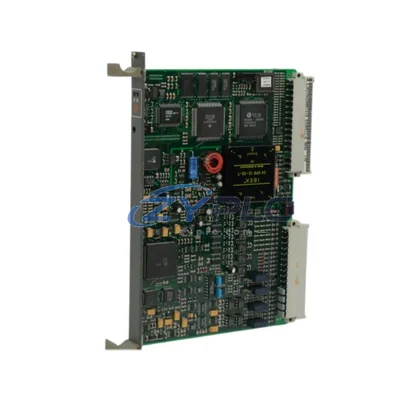
The ABB DSQC431 (part number 3HAC17345-1, also cross-referenced as 3HAB3309-1, 3HAC024138-001, and 3HAC045759-001) is a dedicated External Axis Board engineered for the ABB IRC5 robot controller platform. Designed to extend servo axis control beyond the standard six-axis configuration, this board enables seamless integration of positioners, track motions, and auxiliary servo drives into a unified robotic workcell. In modern smart factory environments, where data continuity from field device to enterprise system is non-negotiable, the DSQC431 serves as a critical node in the industrial data chain — bridging mechanical motion, real-time control signals, and network-level communication across the entire automation architecture.
From signal acquisition at the servo encoder level to synchronized motion feedback transmitted through the IRC5 controller backplane, the DSQC431 ensures that every axis position, velocity command, and fault status is captured, processed, and made available to upstream systems including ABB RobotStudio, SCADA platforms, and MES layers. Its role in the data flow is not passive — it actively participates in the closed-loop control cycle, feeding real-time axis data into the IRC5’s motion coordination engine while simultaneously making that data accessible for remote diagnostics and production monitoring.
Compatibility & Integration Notes
| Attribute |
Specification |
| Part Number |
3HAC17345-1 (DSQC431) |
| Cross References |
3HAB3309-1 / 3HAC024138-001 / 3HAC045759-001 |
| Compatible Platform |
ABB IRC5 Robot Controller Series |
| Function |
External Axis Servo Control Board |
| Interface Type |
IRC5 Controller Backplane Bus |
| Protocol Support |
ABB Axis Communication Protocol, DeviceNet (via IRC5 options), PROFIBUS DP (via IRC5 options) |
| Network Compatibility |
IRC5 Single / Dual Cabinet, IRC5 Panel Mounted Controller |
| System Application |
Positioner Control, Track Motion, Servo Axis Extension, Robotic Workcell Integration |
| SCADA / HMI Integration |
Via IRC5 OPC-UA Server, ABB Ability™ Connected Services |
| Transmission Capability |
Real-time axis position, velocity, torque feedback; fault status reporting |
| Origin |
Sweden (ABB Robotics) |
| Warranty |
Warranty and support terms confirmed before quote |
| Availability |
Confirmed via RFQ before quotation |
Connected Automation Data Flow
In a fully integrated IRC5 robotic workcell, the DSQC431 External Axis Board sits at the intersection of mechanical motion and digital data. The data flow begins at the servo motor encoder — whether on a ABB IRBP positioner or a linear track unit — where position pulses are captured and transmitted to the DSQC431 over the IRC5 backplane. The board processes these signals in real time, synchronizing external axis motion with the primary six-axis robot arm managed by the ABB DSQC652 (3HAC025917-001) Ethernet/IP communication board.
Upstream, the IRC5 controller — equipped with the ABB DSQC1000 main computer unit — aggregates all axis data and exposes it via the integrated OPC-UA server to SCADA systems such as Ignition by Inductive Automation or Wonderware System Platform. HMI panels connected via PROFIBUS DP or EtherNet/IP — including ABB CP600 series operator panels — display live axis positions, program states, and alarm conditions sourced directly from the DSQC431’s feedback loop.
For remote I/O expansion within the workcell, the IRC5 platform supports ABB DSQC328A (3HAC17326-1) I/O units, which relay digital and analog signals from safety mats, proximity sensors, and pneumatic valve banks back through the controller network. The DSQC431 coordinates with these I/O nodes to ensure that external axis motion is interlocked with peripheral device states — preventing servo movement when safety zones are breached or tooling is not confirmed in position.
At the drive level, ABB MicroFlex e190 or compatible servo drives receive motion references from the IRC5 drive system, with the DSQC431 providing the axis definition and parameter set that governs acceleration ramps, torque limits, and position windows. This tight integration between the axis board, drive system, and controller ensures deterministic motion performance across all coordinated axes.
For plants running mixed automation architectures, the IRC5’s optional DSQC688 (3HAC026253-001) PROFIBUS master board enables the DSQC431-equipped controller to communicate with third-party PLCs — such as Siemens S7-1500 or Allen-Bradley ControlLogix — over PROFIBUS DP, allowing the robotic workcell to participate in plant-wide production scheduling and quality data collection managed by the factory SCADA layer.
Solving Data Isolation in Industrial Sites
One of the most persistent challenges in industrial automation is the fragmentation of data across incompatible control platforms. A robotic workcell running an ABB IRC5 controller may share a production line with conveyors managed by a Siemens S7-300 PLC, vision systems communicating over GigE Vision, and quality inspection stations reporting via Modbus TCP. Without a coherent data integration strategy, each subsystem operates as an isolated island — generating valuable process data that never reaches the MES or ERP layer.
The ABB DSQC431 addresses the axis-level component of this challenge by ensuring that external servo axes are fully visible within the IRC5 control architecture. When combined with the IRC5’s network communication options — including EtherNet/IP, PROFINET, and DeviceNet adapters — the DSQC431-equipped controller can publish real-time axis data to plant-wide networks, enabling SCADA systems to monitor positioner angles, track positions, and servo fault codes alongside robot program states and cycle times.
For remote diagnostics, the ABB Ability™ Connected Services platform leverages the IRC5’s OPC-UA interface to stream controller health data — including DSQC431 axis board status — to cloud-based monitoring dashboards. Maintenance engineers can identify axis calibration drift, encoder signal degradation, or servo overload conditions before they result in unplanned downtime, reducing mean time to repair (MTTR) and improving overall equipment effectiveness (OEE).
Production line transparency is further enhanced by integrating the IRC5 workcell with MES platforms that consume OPC-UA data from the controller. Cycle time per part, axis utilization rates, and fault frequency data sourced from the DSQC431 feedback loop can be correlated with upstream and downstream process data to identify bottlenecks, optimize robot programs, and support continuous improvement initiatives across the smart factory.
System expansion is straightforward: additional DSQC431 boards can be installed in the IRC5 cabinet to support up to six external axes, allowing the workcell to grow from a simple two-axis positioner setup to a complex multi-robot, multi-track configuration without replacing the controller platform. This scalability protects capital investment and simplifies spare parts management — a single DSQC431 board covers a wide range of external axis configurations across the IRC5 product family.
Industrial Connectivity FAQ
Q1: What communication protocols does the ABB DSQC431 support within the IRC5 architecture?
The DSQC431 communicates over the IRC5 internal backplane bus using ABB’s proprietary axis communication protocol. The IRC5 controller can be equipped with optional fieldbus boards — including PROFIBUS DP (DSQC688), EtherNet/IP, and DeviceNet — to expose axis data to external PLCs, SCADA systems, and HMI panels. Communication latency on the internal backplane is deterministic and synchronized with the IRC5 motion cycle, typically 4ms per control cycle.
Q2: Is the DSQC431 compatible with all IRC5 controller variants?
Yes. The DSQC431 (3HAC17345-1) is compatible with the full IRC5 family, including the IRC5 Single Cabinet, IRC5 Dual Cabinet, and IRC5 Panel Mounted Controller (PMC). It is also cross-compatible with earlier revisions identified by part numbers 3HAB3309-1 and 3HAC024138-001, making it a reliable replacement board across multiple IRC5 generations. Always verify the IRC5 software version (RobotWare) to confirm axis board firmware compatibility.
Q3: How does the DSQC431 support network stability in high-cycle production environments?
The DSQC431 is designed for continuous industrial operation in high-cycle robotic applications. Its backplane interface is electrically isolated from the servo drive outputs, reducing the risk of noise-induced communication errors. In the event of an axis fault, the board generates a structured fault code that is logged in the IRC5 event log and transmitted to connected SCADA or MES systems via the controller’s network interface, enabling rapid fault isolation without manual inspection of the workcell.
Q4: What does the warranty and support terms confirmed before quote cover, and how is the board tested before shipment?
Every ABB DSQC431 unit supplied by ZYPLC undergoes functional verification testing prior to shipment, including backplane communication checks, axis parameter loading, and servo feedback signal validation. The warranty and support terms confirmed before quote covers hardware defects and communication failures under normal operating conditions. Units are shipped with full ESD protection packaging and traceable documentation. For warranty claims or technical support, contact ZYPLC directly at plc.sales@zyplc.com or +86 19859288691.