ABB DSQC601 3HAC12815-1 System-Ready Axis Computer for IRC5 Architecture
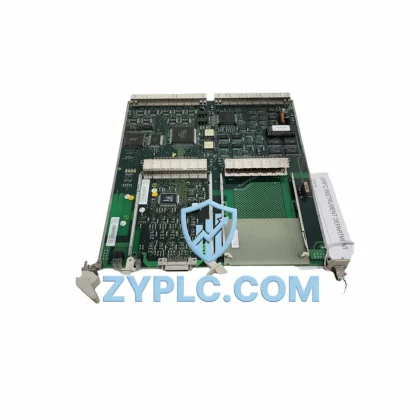
The ABB DSQC601 (3HAC12815-1) is a dedicated Axis Computer Module engineered as a core computational node within the ABB IRC5 robot controller architecture. Rather than functioning as a standalone component, the DSQC601 operates as an integral element of a layered control hierarchy — coordinating real-time motion commands, servo drive feedback, and inter-module communication across the full IRC5 system stack. Its role spans the control layer and I/O layer simultaneously, making it a critical enabler of system consistency, motion precision, and long-term maintainability in demanding industrial environments.
Understanding the DSQC601 requires viewing it within the complete IRC5 control architecture. The IRC5 controller cabinet is designed around a modular philosophy: a Main Computer (DSQC652 or DSQC662) handles high-level task execution and program management, while the Axis Computer — the DSQC601 — manages the real-time servo loop, axis interpolation, and drive communication for up to six robot axes. These two modules communicate over a dedicated internal bus, ensuring deterministic signal flow between the task layer and the motion execution layer. This separation of concerns is fundamental to ABB’s approach to scalable, redundancy-capable robot control.
Architecture Specification Table
| Parameter |
Specification |
| Part Number |
3HAC12815-1 |
| Module Designation |
DSQC601 |
| System Role |
Axis Computer — Real-Time Motion Control Node |
| Compatible Platform |
ABB IRC5 Robot Controller (Single & MultiMove) |
| Axis Control Capacity |
Up to 6 servo axes |
| Communication Interface |
Internal IRC5 backplane bus; Drive System Interface |
| Drive Compatibility |
ABB DSQC508 / DSQC374 Drive Units |
| Operating Voltage |
24 VDC (supplied via IRC5 power distribution) |
| Operating Temperature |
0°C to +55°C |
| Mounting |
IRC5 Controller Cabinet — internal DIN/backplane mount |
| Origin |
Sweden (ABB Robotics) |
| Firmware |
Compatible with RobotWare 5.x and 6.x |
| Warranty |
12-Month Warranty — Fully Tested Before Shipment |
Coordinated Control System Design
The DSQC601 does not operate in isolation — its value is realized through tight integration with the surrounding IRC5 module ecosystem. In a fully configured IRC5 cabinet, the DSQC601 works in concert with the DSQC652 Main Computer (or its successor, the DSQC662), which handles RobotWare task scheduling, program execution, and operator interface management. The Axis Computer receives interpolated path data from the Main Computer and translates it into real-time servo commands distributed to the DSQC508 Drive Unit or DSQC374 Rectifier/Drive modules, which in turn control the robot’s servo motors with microsecond-level precision.
Power distribution within the IRC5 cabinet is managed by the DSQC604 Power Supply Unit, which provides regulated 24 VDC to the DSQC601 and other logic-level modules. Stable, clean power delivery is essential for the Axis Computer’s real-time processing integrity — any voltage fluctuation can introduce servo jitter or trigger protective shutdowns. In high-availability installations, engineers often specify redundant power feeds or UPS-backed distribution to protect the DSQC601 and associated modules from transient power events.
On the I/O layer, the IRC5 architecture supports distributed I/O expansion through DSQC651 I/O Units and DSQC355 DeviceNet Gateway modules, which connect field devices — sensors, actuators, safety relays, and conveyor encoders — to the controller’s logical address space. The DSQC601 coordinates with these I/O nodes through the Main Computer’s I/O management layer, ensuring that axis motion commands are synchronized with field-level signal states. This synchronization is particularly critical in pick-and-place, welding, and palletizing applications where robot motion must be gated by external sensor inputs.
For human-machine interface integration, the IRC5 platform supports the FlexPendant (DSQC679) — ABB’s touch-based teach pendant — which communicates with the Main Computer over a dedicated USB/Ethernet link. Operator commands issued through the FlexPendant are processed by the Main Computer and relayed to the DSQC601 for motion execution, creating a seamless command chain from operator intent to physical axis movement. In MultiMove configurations, multiple DSQC601 modules can be deployed within a single IRC5 cabinet to independently control coordinated robot arms, expanding system throughput without sacrificing synchronization.
Safety architecture integration is handled through the DSQC400 Safety Board or the Electronic Position Switch (EPS) module, which monitors axis positions and enforces safety-rated speed and zone limits. The DSQC601 receives safety-qualified enable signals from these modules before executing motion commands, ensuring that the system complies with ISO 10218 robot safety standards. This layered safety design — spanning the Axis Computer, safety board, and drive units — is a defining characteristic of the IRC5 platform’s suitability for collaborative and high-speed industrial environments.
Application in Layered Automation Systems
The DSQC601 finds application across a broad spectrum of industrial automation sectors where the IRC5 platform is deployed. In automotive manufacturing, IRC5-controlled robots equipped with DSQC601 Axis Computers perform spot welding, seam sealing, and body assembly tasks with sub-millimeter repeatability. The Axis Computer’s real-time servo management ensures that weld gun positioning and torch path accuracy meet the stringent tolerances demanded by automotive body-in-white production lines.
In electronics and semiconductor manufacturing, the DSQC601 supports high-speed, low-payload robot applications such as PCB handling, component insertion, and optical inspection positioning. The module’s deterministic motion control — free from the latency variability of general-purpose computing — is essential for maintaining throughput rates in cleanroom and ESD-sensitive environments.
Within food and beverage packaging lines, IRC5 robots with DSQC601 modules handle primary and secondary packaging, case erecting, and palletizing operations. The Axis Computer’s ability to manage coordinated multi-axis motion enables complex pick-and-place patterns that adapt to variable product flow rates on high-speed conveyor systems. Integration with DSQC651 I/O Units allows the robot to respond dynamically to upstream and downstream line signals, maintaining synchronization across the entire packaging architecture.
In metal fabrication and arc welding applications, the DSQC601 manages the precise torch path control required for MIG, TIG, and plasma welding processes. Coordinated with external axis modules and positioner drives, the Axis Computer enables synchronized robot-positioner motion — a capability critical for circumferential weld seams on pressure vessels, pipe spools, and structural steel components used in petrochemical and power generation infrastructure.
For logistics and warehouse automation, IRC5-based robotic cells equipped with DSQC601 modules perform depalletizing, sortation, and goods-to-person fulfillment tasks. The module’s robust real-time performance supports the high cycle rates and rapid direction changes characteristic of e-commerce fulfillment environments, where robot uptime directly impacts order throughput and customer service levels.
Architecture Engineering FAQ
Q1: Is the DSQC601 (3HAC12815-1) compatible with all IRC5 controller variants, including MultiMove and Paint configurations?
The DSQC601 is designed for the standard IRC5 Single cabinet and IRC5 MultiMove configurations. In MultiMove systems, one DSQC601 is assigned per robot arm, all managed within a shared IRC5 cabinet. Compatibility with IRC5 Paint (ATEX-rated) variants should be verified against the specific RobotWare version and cabinet revision in use, as paint controller configurations may require additional hardware qualification. Our technical team can confirm compatibility based on your cabinet serial number and RobotWare version prior to shipment.
Q2: What are the key considerations when replacing a DSQC601 in an operational IRC5 system, and how does the 12-Month Warranty support long-term maintenance planning?
Replacing the DSQC601 requires a controlled shutdown of the IRC5 cabinet, ESD precautions during module handling, and a RobotWare system restore or parameter reload after installation to re-establish axis calibration data. It is strongly recommended to back up the robot system (including calibration offsets and I/O configuration) before replacement. Our 12-Month Warranty covers the replacement DSQC601 against manufacturing defects and functional failures under normal operating conditions, providing maintenance engineers with a reliable planning horizon for spare parts budgeting and scheduled maintenance windows.
Q3: How does the DSQC601 support system redundancy and what is the recommended spare parts strategy for high-availability production environments?
The IRC5 architecture does not natively support hot-swap redundancy at the Axis Computer level — a DSQC601 failure requires a controlled system stop and module replacement. For high-availability environments (automotive body shops, 24/7 packaging lines, critical process automation), the recommended strategy is to maintain at least one tested spare DSQC601 on-site, pre-configured and validated against the production system’s RobotWare version. Our Contextual Integration service ensures that supplied modules are tested for compatibility with your specific IRC5 configuration, reducing commissioning time during unplanned maintenance events and minimizing production downtime.
© 2026 ZYPLC. All rights reserved.
Original Source: https://zyplc.com
Contact: +86 19859288691 | [email protected]