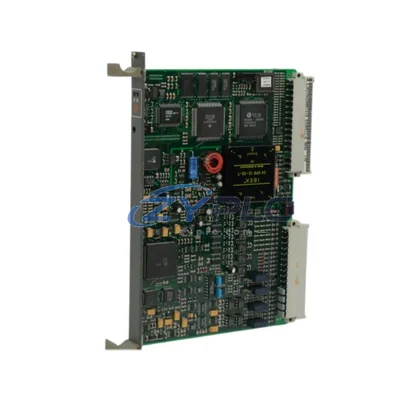
ABB DSQC651 DeviceNet I/O Unit: Industrial Data Link for IRC5 Robot Systems
The ABB DSQC651 (also referenced as DSQC 651A) is a dedicated DeviceNet I/O Unit engineered for seamless integration within ABB IRC5 robot controller architectures. As industrial automation networks grow increasingly complex — spanning field devices, PLC controllers, remote I/O modules, HMI panels, SCADA platforms, variable frequency drives, and edge computing gateways — the DSQC651 serves as a critical node in the real-time data chain. It enables deterministic, high-speed communication between the IRC5 controller and downstream DeviceNet-compliant field devices, ensuring that signal acquisition, protocol conversion, and network transmission occur with the precision that modern smart factory environments demand.
In a typical IRC5-based robotic cell, the DSQC651 connects directly to the robot controller’s internal backplane and exposes a DeviceNet master/slave interface to the plant network. This allows the IRC5 to exchange I/O data — digital inputs and outputs, analog signals, and status feedback — with peripheral devices such as the ABB DSQC652 digital I/O board, DSQC643 axis computer, and DSQC662 fieldbus adapter, all operating in concert within the same controller cabinet. The result is a tightly integrated automation backbone where every device on the DeviceNet segment is visible, addressable, and monitorable from a central SCADA or HMI system.
Compatibility & Integration Notes
| Parameter |
Specification |
| Communication Protocol |
DeviceNet (CAN-based, IEC 62026-3) |
| Interface Type |
DeviceNet Master / Slave, 5-pin open-style connector |
| Transmission Rate |
125 kbps / 250 kbps / 500 kbps (auto-negotiated) |
| Network Compatibility |
ABB IRC5 Controller, DeviceNet-compliant PLCs, Remote I/O, Drives |
| Digital I/O Capacity |
Up to 16 digital inputs / 16 digital outputs per unit |
| System Application |
Robot Cell Automation, SCADA Integration, HMI Monitoring, Smart Factory |
| Power Supply |
24 VDC (supplied via IRC5 backplane) |
| Operating Temperature |
0°C to +55°C |
| Origin |
Sweden (ABB Robotics) |
| Warranty |
Warranty and support terms confirmed before quote — Tested Before Shipment |
Connected Automation Data Flow
Understanding the DSQC651’s role requires tracing the full data flow from field level to enterprise level. At the field layer, sensors and actuators — including proximity switches, photoelectric sensors, pneumatic valve banks, and servo feedback encoders — connect to DeviceNet drop lines managed by the DSQC651. The unit polls each node cyclically, collecting real-time I/O states and forwarding them upstream to the IRC5 controller’s motion and logic engine via the internal backplane bus.
Within the IRC5 cabinet, the DSQC651 works alongside the DSQC639 main computer board and the DSQC608 power distribution unit to maintain a stable, low-latency control loop. When the robot program requires coordinated motion with external conveyors or vision systems, the DSQC651 ensures that handshake signals — part-present, gripper-closed, conveyor-ready — are exchanged within the DeviceNet scan cycle, typically under 10 milliseconds.
At the supervisory layer, the DeviceNet network interfaces with SCADA systems through a protocol gateway — often an ABB AC500 PLC or a third-party gateway device — that bridges DeviceNet to Ethernet/IP or PROFINET for plant-wide visibility. HMI panels running on the same Ethernet backbone can then display live robot status, I/O diagnostics, and alarm states sourced directly from the DSQC651’s network node. This architecture supports integration with MES and ERP platforms, enabling production data — cycle counts, fault codes, uptime metrics — to flow from the robot cell to the enterprise level without manual intervention.
For multi-robot installations, multiple DSQC651 units can be deployed across several IRC5 controllers, each assigned a unique DeviceNet node address. A DSQC679 teach pendant or remote service panel can then be used to monitor individual node health, diagnose communication faults, and perform firmware updates without interrupting production. This distributed I/O architecture is particularly valuable in automotive body-in-white lines, electronics assembly cells, and food-grade palletizing systems where uptime is non-negotiable.
Variable frequency drives — such as ABB ACS880 series drives — can also be integrated into the same DeviceNet segment via drive-specific DeviceNet adapter modules, allowing the IRC5 controller to command speed references, read drive fault registers, and trigger safe-stop sequences through the DSQC651’s I/O channels. This eliminates the need for dedicated hardwired interlocks between the robot controller and drive system, reducing panel wiring complexity and improving diagnostic transparency.
Solving Data Isolation in Industrial Sites
One of the most persistent challenges in legacy and mixed-generation factory environments is protocol fragmentation. A plant may operate ABB IRC5 robots on DeviceNet alongside Siemens S7 PLCs on PROFIBUS, Rockwell ControlLogix systems on EtherNet/IP, and legacy Modbus RTU devices — all generating valuable process data that remains siloed within each network segment. The DSQC651 addresses the DeviceNet layer of this challenge by providing a standards-compliant, deterministic interface that can be bridged to higher-level networks through appropriate gateway hardware.
Remote monitoring is another area where the DSQC651 delivers measurable value. By exposing all field-level I/O states to the DeviceNet network, the unit enables SCADA systems to implement alarm management logic based on real device conditions — not estimated states. When a digital input fails to transition within the expected window, the SCADA system can generate a predictive maintenance alert before a production fault occurs. This shift from reactive to proactive maintenance is a cornerstone of Industry 4.0 implementation in robot-intensive facilities.
System scalability is also simplified. Adding new DeviceNet nodes — additional I/O blocks, smart sensors, or barcode readers — requires only node address assignment and network configuration, with no changes to the IRC5 controller’s hardware. This plug-and-play expandability supports phased automation upgrades, allowing manufacturers to grow their DeviceNet network incrementally as production requirements evolve.
Every DSQC651 unit supplied by ZYPLC undergoes functional testing prior to shipment, verifying DeviceNet communication, I/O channel integrity, and backplane connector condition. Units are shipped with a warranty and support terms confirmed before quote, and our technical team provides pre-sales configuration support and post-sales troubleshooting assistance to ensure successful integration into your IRC5 system.
Industrial Connectivity FAQ
Q1: What is the maximum DeviceNet network length supported by the DSQC651?
A: DeviceNet supports a maximum trunk length of 500 meters at 125 kbps, 250 meters at 250 kbps, and 100 meters at 500 kbps. Drop line lengths are limited to 6 meters per node. The DSQC651 operates within these standard DeviceNet physical layer specifications, and network length should be planned according to the baud rate selected for your installation.
Q2: Is the DSQC651 compatible with IRC5 Compact and IRC5 Panel Mounted Controller variants?
A: Yes. The DSQC651 is designed for the ABB IRC5 controller family, including the standard IRC5, IRC5 Compact, and IRC5 Panel Mounted Controller (PMC) variants, provided the controller’s option slot and RobotWare configuration support the DeviceNet master option. Verify your RobotWare license includes the DeviceNet Master/Slave option before installation.
Q3: How does the DSQC651 handle network faults and communication loss?
A: The DSQC651 implements DeviceNet’s standard connection timeout and bus-off recovery mechanisms. In the event of a communication fault — cable break, node failure, or excessive bus load — the IRC5 controller’s event log records the fault with node address and error code. The robot program can be configured to enter a safe hold state pending fault clearance, and the SCADA system receives the fault status via the gateway for remote alarm notification.
Q4: What is included with the warranty and support terms confirmed before quote and how is it claimed?
A: All DSQC651 units supplied by ZYPLC carry a warranty and support terms confirmed before quote covering manufacturing defects and functional failures under normal operating conditions. Each unit is tested before shipment for DeviceNet communication and I/O channel functionality. Warranty claims are processed through our technical support team at plc.sales@zyplc.com. Replacement or repair is arranged within the warranty period at no additional cost to the customer.