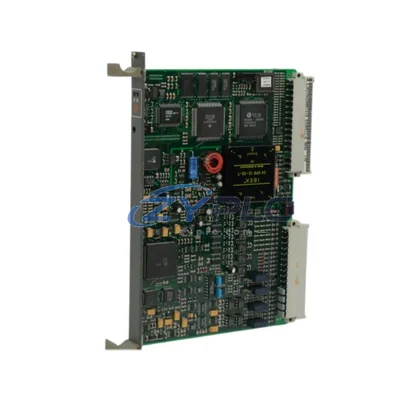
ABB DSQC662 3HAC026254-001 Industrial Network Interface for IRC5 Systems: Powering the Industrial Data Link in Smart Factory Environments
The ABB DSQC662 (3HAC026254-001) is a high-reliability Controller Power Distribution Unit engineered for the ABB IRC5 robot controller platform. Far beyond a conventional power module, the DSQC662 serves as a critical node in the industrial data link — ensuring stable, uninterrupted power delivery to the communication backplane, I/O modules, and network interface cards that keep your smart factory connected. In modern automated production lines, where every millisecond of downtime translates to measurable loss, the DSQC662 provides the electrical foundation upon which real-time data flows between field devices, controllers, and supervisory systems.
Designed to operate within the IRC5 Single Cabinet Controller and IRC5 Compact Controller architectures, the DSQC662 supports the full ecosystem of ABB robotics communication infrastructure. Its regulated DC output rails power the DSQC688 Ethernet switch module, the DSQC679 teach pendant interface, and the DSQC652 digital I/O board — all of which depend on clean, stable power to maintain deterministic communication cycles across DeviceNet, PROFIBUS-DP, EtherNet/IP, and PROFINET networks.
Compatibility & Integration Notes
| Attribute |
Specification |
| Part Number |
DSQC662 / 3HAC026254-001 |
| Compatible Platform |
ABB IRC5 Single Cabinet & Compact Controller |
| Supported Protocols |
DeviceNet, PROFIBUS-DP, EtherNet/IP, PROFINET, Modbus TCP |
| Interface Type |
Internal backplane power distribution; supports external fieldbus gateway modules |
| Transmission Capability |
Stable DC power rails enabling real-time, deterministic network communication |
| Network Compatibility |
Industrial Ethernet, Fieldbus, SCADA/DCS integration-ready |
| System Application |
Robotic welding, assembly, palletizing, material handling, smart factory automation |
| Origin |
Sweden (ABB Robotics) |
| Warranty |
Warranty and support terms confirmed before quote — Tested and verified before shipment |
| Availability |
Confirmed via RFQ before quotation |
Connected Automation Data Flow
In a fully integrated IRC5-based robotic cell, the DSQC662 sits at the heart of the power and communication architecture. Signal acquisition begins at the sensor and actuator layer — proximity switches, vision systems, and torque sensors feed raw data into the DSQC652 Digital I/O Board, which relies on the DSQC662’s regulated 24 VDC output for stable operation. From there, process data travels upstream through the IRC5 controller’s internal communication bus, where the DSQC688 Ethernet Switch Module aggregates and routes packets across the plant’s Industrial Ethernet backbone.
At the protocol conversion layer, the DSQC667 DeviceNet Master/Slave Module and DSQC658 PROFIBUS-DP Adapter translate fieldbus signals into formats compatible with upstream SCADA and MES platforms. These gateway modules depend entirely on the DSQC662 for their operating voltage — a power interruption at this stage would sever the data link between the robot controller and the plant-wide supervisory network. The DSQC662’s robust design ensures that even under peak load conditions, voltage ripple remains within tolerance, preserving the signal integrity required for high-speed PROFINET and EtherNet/IP communication cycles.
Further up the data chain, the DSQC679 FlexPendant Interface Unit connects the operator HMI layer to the IRC5 controller, enabling real-time parameter adjustment, alarm acknowledgment, and program management directly from the production floor. Simultaneously, the ABB RobotWare OmniCore communication stack and third-party SCADA platforms — including Wonderware, Ignition, and Siemens WinCC — poll the IRC5 controller via OPC-UA or Modbus TCP, pulling cycle time data, fault codes, and production counts for dashboard visualization and predictive maintenance analytics.
In multi-robot cells, the DSQC662-equipped IRC5 controllers are networked through managed industrial switches such as the ABB SCALANCE X series or equivalent DIN-rail Ethernet switches, forming a ring or star topology that feeds into the plant’s central SCADA server. Remote I/O nodes — including ABB AC500 remote I/O modules — extend the data collection perimeter to conveyor systems, safety light curtains, and pneumatic valve islands, all synchronized through the same network infrastructure that the DSQC662 powers at the controller level.
Edge computing gateways installed adjacent to the IRC5 cabinet aggregate local data streams and push pre-processed analytics to cloud-based MES platforms, enabling remote diagnostics, OEE calculation, and predictive maintenance scheduling without burdening the robot controller’s CPU. The reliability of this entire data pipeline depends on the DSQC662 maintaining stable power delivery across all communication modules simultaneously.
Solving Data Isolation in Industrial Sites
One of the most persistent challenges in legacy and mixed-generation production environments is protocol fragmentation — older robots running DeviceNet or PROFIBUS-DP alongside newer EtherNet/IP or PROFINET-capable systems, with no unified data layer connecting them. The DSQC662, by powering the full suite of ABB fieldbus adapter modules within the IRC5 controller, enables a single controller to simultaneously participate in multiple network protocols, effectively acting as a multi-protocol gateway node within the plant network.
Data silos emerge when field devices cannot communicate with supervisory systems due to incompatible protocols or unreliable hardware at the controller level. A failing power distribution unit introduces voltage instability that manifests as intermittent communication errors, dropped packets, and false fault alarms — symptoms that are frequently misdiagnosed as network configuration issues. Replacing a degraded DSQC662 with a verified, tested unit immediately restores deterministic communication, eliminates spurious alarms, and re-establishes the transparent data flow that production managers and process engineers depend on for real-time line visibility.
For facilities pursuing digital transformation and Industry 4.0 integration, the DSQC662 supports system expansion by enabling the addition of supplementary fieldbus modules to the IRC5 backplane without requiring controller replacement. New communication protocols can be introduced incrementally — adding a PROFINET adapter alongside an existing DeviceNet configuration, for example — allowing the automation network to grow in parallel with production requirements. This modularity reduces capital expenditure and accelerates the path to full plant connectivity, from signal acquisition at the sensor layer to data visualization at the enterprise dashboard.
Remote monitoring and diagnostics capabilities are equally enhanced by a reliable DSQC662. With stable power to all communication modules, the IRC5 controller can maintain persistent OPC-UA sessions with remote SCADA servers, enabling maintenance teams to monitor robot health indicators — motor temperatures, joint torques, cycle counts, and fault histories — from centralized control rooms or mobile devices, without requiring physical access to the production floor.
Industrial Connectivity FAQ
Q1: Does the DSQC662 introduce communication latency in EtherNet/IP or PROFINET networks?
No. The DSQC662 is a power distribution unit, not an active network device. It provides regulated DC power to the IRC5 controller’s communication modules, which operate independently on their respective network stacks. Properly functioning DSQC662 units maintain voltage stability within specification, ensuring that network interface cards operate at their rated cycle times without power-induced jitter or latency.
Q2: Is the DSQC662 compatible with both IRC5 Single Cabinet and IRC5 Compact Controllers?
Yes. The DSQC662 (3HAC026254-001) is designed for use across the IRC5 controller family, including Single Cabinet, Compact, and Panel Mounted Controller variants. Always verify the specific controller revision and backplane configuration against ABB’s compatibility documentation before installation.
Q3: How is network stability verified before shipment?
Every DSQC662 unit supplied by ZYPLC undergoes functional power-on testing and output voltage verification across all DC rails prior to shipment. Units are inspected for physical integrity, connector condition, and component health. A warranty and support terms confirmed before quote covers all supplied units against defects in materials and workmanship, with technical support available throughout the warranty period.
Q4: Can additional fieldbus modules be added to the IRC5 system after installing the DSQC662?
Yes. The IRC5 controller’s modular backplane architecture supports the addition of supplementary communication modules — including PROFIBUS-DP, DeviceNet, EtherNet/IP, and PROFINET adapters — without replacing the DSQC662. The power distribution unit is sized to support the full complement of ABB-approved option modules, making it straightforward to expand the controller’s network capabilities as integration requirements evolve.