ABB DSQC668 3HAC029157-001: Industrial Data Link for Smart Factory Connectivity
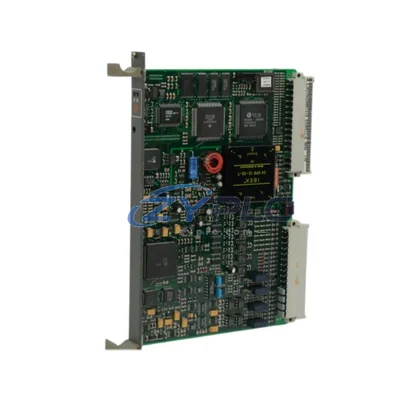
The ABB DSQC668 (3HAC029157-001) is a high-performance industrial network interface module engineered for seamless integration within ABB IRC5 robot controller architectures. Designed to bridge the communication gap between field-level devices and upper-level control systems, the DSQC668 serves as a critical data conduit in modern smart factory environments. Whether your facility relies on real-time servo feedback, multi-axis motion coordination, or plant-wide SCADA visibility, this module delivers the protocol intelligence and network stability required to keep production lines transparent, responsive, and continuously optimized.
In today’s industrial landscape, data isolation remains one of the most persistent barriers to operational efficiency. The DSQC668 addresses this challenge head-on by enabling structured, low-latency communication between the IRC5 controller’s internal drive bus and external automation networks. From signal acquisition at the servo motor level to protocol conversion at the network edge, this module ensures that every data packet — whether it carries position feedback, torque commands, fault diagnostics, or I/O status — reaches its destination with precision and reliability.
Compatibility & Integration Notes
| Parameter |
Specification |
| SKU |
DSQC668 / 3HAC029157-001 |
| Brand |
ABB |
| Series |
IRC5 Robot Controller |
| Protocol Support |
ABB Drive Bus, Ethernet/IP, DeviceNet, PROFIBUS DP |
| Interface Type |
Multi-axis Servo Drive Network Interface |
| Transmission Capability |
Real-time servo feedback, motion command, fault data |
| Network Compatibility |
IRC5 Single/MultiMove, RobotWare 5.x/6.x |
| System Application |
Robot Motion Control, SCADA Integration, Remote Diagnostics |
| Origin |
Sweden |
| Warranty |
Warranty and support terms confirmed before quote |
| Availability |
Confirmed via RFQ before quotation |
Connected Automation Data Flow
The DSQC668 sits at the heart of the IRC5 controller’s drive communication architecture, managing the high-speed data exchange between the robot’s axis computer and its servo drive units. In a typical multi-axis robot cell, the module interfaces directly with the ABB DSQC663 axis computer board, receiving interpolated motion trajectories and translating them into real-time torque and velocity commands dispatched to each servo axis. This tight integration ensures sub-millisecond cycle times essential for precision welding, assembly, and material handling applications.
Moving upstream in the data chain, the DSQC668 communicates with the ABB DSQC679 main computer unit, which coordinates RobotWare task execution, I/O management, and network gateway functions. The main computer aggregates servo status data — including current draw, encoder position, and thermal load — and forwards it via the IRC5’s integrated Ethernet/IP or PROFIBUS DP interface to plant-level SCADA systems such as ABB System 800xA or third-party platforms like Siemens WinCC and Wonderware InTouch. This end-to-end data pipeline enables operators to monitor robot health, cycle counts, and production throughput from a centralized HMI without interrupting the production process.
At the field device level, the DSQC668 works in concert with the ABB DSQC652 digital I/O board and the ABB DSQC651 analog I/O module to capture sensor signals from proximity switches, vision systems, and force-torque sensors mounted on the robot’s end-of-arm tooling. These signals are processed by the IRC5 controller and fed back into the motion planning loop, enabling adaptive path correction and collision avoidance in real time. For applications requiring remote I/O expansion, the system can be extended via DeviceNet to connect distributed I/O nodes across the robot cell, reducing wiring complexity while maintaining deterministic communication.
In facilities deploying multiple robot arms under a coordinated MultiMove configuration, the DSQC668 plays an equally vital role. Each IRC5 cabinet in the MultiMove cluster relies on its own DSQC668 to maintain synchronized drive communication, while the ABB DSQC688 fieldbus adapter module bridges the inter-controller network, ensuring that position data and synchronization signals flow seamlessly between robot arms performing collaborative tasks. This architecture is particularly valuable in automotive body-in-white welding lines, where two or more robots must coordinate their movements with micron-level precision.
For edge computing and IIoT integration, the IRC5 system equipped with the DSQC668 can connect to industrial edge gateways — such as the ABB Edge Controller or third-party platforms like Moxa UC-8100 — enabling local data preprocessing, OPC-UA publishing, and cloud forwarding to MES and ERP systems. This connectivity layer transforms raw servo data into actionable production intelligence, supporting predictive maintenance models that analyze motor current signatures and vibration patterns to forecast bearing wear before it causes unplanned downtime.
Solving Data Isolation in Industrial Sites
One of the most common challenges in legacy robot installations is the fragmentation of communication protocols. Older IRC5 systems may rely exclusively on the proprietary ABB Drive Bus, making it difficult to integrate robot performance data into modern Ethernet-based SCADA or MES platforms. The DSQC668, combined with the IRC5’s optional fieldbus adapter slots, resolves this by acting as a protocol gateway — converting internal drive bus signals into industry-standard formats compatible with PROFIBUS DP, DeviceNet, and Ethernet/IP networks. This eliminates data silos and allows robot performance metrics to flow directly into plant-wide dashboards without requiring custom middleware or proprietary software bridges.
Remote monitoring is another area where the DSQC668 delivers measurable value. By enabling continuous transmission of servo health data — including axis temperature, motor current, encoder error counts, and drive fault codes — to the SCADA layer, maintenance teams can implement condition-based monitoring strategies that replace reactive repair cycles with proactive interventions. Alarm thresholds configured in the SCADA system trigger automated notifications when drive parameters exceed safe operating limits, allowing engineers to schedule maintenance during planned downtime windows rather than responding to unexpected failures mid-production.
System scalability is equally well-served by the DSQC668’s modular design. As production requirements evolve — whether through the addition of new robot axes, the integration of collaborative robot (cobot) cells, or the expansion of sensor networks — the IRC5 architecture accommodates growth without requiring a complete controller overhaul. The DSQC668’s standardized drive bus interface ensures backward compatibility across RobotWare versions, protecting the customer’s existing automation investment while enabling incremental capability upgrades. Combined with RFQ-based availability and rapid global shipping, this module supports both greenfield deployments and brownfield modernization projects with equal effectiveness.
Industrial Connectivity FAQ
Q1: What communication protocols does the ABB DSQC668 support, and is it compatible with third-party SCADA systems?
The DSQC668 operates on ABB’s internal Drive Bus protocol within the IRC5 controller architecture. When paired with the IRC5’s fieldbus adapter options, the system supports PROFIBUS DP, DeviceNet, and Ethernet/IP, enabling integration with third-party SCADA platforms including Siemens WinCC, Wonderware InTouch, and Ignition by Inductive Automation. OPC-UA connectivity is available through RobotWare’s PC Interface option.
Q2: How does the DSQC668 ensure network stability and low communication latency in multi-axis robot applications?
The DSQC668 uses a deterministic, time-slotted drive bus protocol that guarantees fixed-cycle communication between the axis computer and servo drives, typically achieving cycle times below 4 ms per axis. This determinism eliminates jitter-related positioning errors and ensures that motion commands and feedback signals are synchronized across all axes simultaneously, which is critical for high-speed pick-and-place and precision welding applications.
Q3: Can the DSQC668 be used in a MultiMove configuration with multiple IRC5 controllers?
Yes. In a MultiMove setup, each IRC5 cabinet requires its own DSQC668 to manage local drive communication. Inter-controller synchronization is handled at the network level via the IRC5’s Ethernet interface and RobotWare’s MultiMove software option. Each DSQC668 operates independently within its cabinet while contributing to the coordinated motion plan executed across the entire robot cluster.
Q4: What quality assurance processes apply to the DSQC668, and what warranty coverage is provided?
Every DSQC668 unit supplied by ZYPLC undergoes pre-shipment functional testing, including drive bus communication verification, firmware version confirmation, and connector integrity inspection. Warranty terms are confirmed during quotation. In the event of a verified hardware defect within the warranty period, ZYPLC provides replacement or repair support. Availability and shipment timing are confirmed by RFQ, minimizing production downtime for urgent replacement requirements.