ABB DSQC697 System-Ready Ethernet Interface for IRC5 Architecture
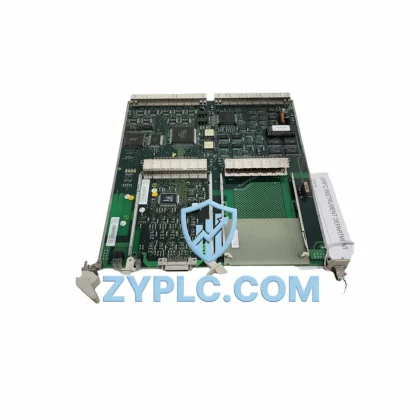
The ABB DSQC697 is a dedicated Ethernet Interface Card engineered for seamless integration within the IRC5 robot controller platform. Rather than functioning as a standalone peripheral, the DSQC697 occupies a critical position in the layered control architecture of ABB robotic systems — bridging the controller’s internal communication bus with plant-level Ethernet networks, SCADA systems, and supervisory PLC platforms. Its role spans the network layer and control layer simultaneously, making it an indispensable component for engineers designing high-availability, multi-node automation cells.
In modern industrial environments — whether automotive body-in-white lines, arc welding stations, palletizing systems, or precision assembly cells — the IRC5 controller must maintain deterministic, low-latency communication with upstream systems. The DSQC697 enables this by providing a stable, standards-compliant Ethernet interface that supports TCP/IP-based data exchange, remote I/O polling, and real-time status monitoring. When paired with the IRC5 main computer board (DSQC1000 or DSQC652), the DSQC697 ensures that the controller’s communication stack remains fully operational even under high network load conditions.
System architects integrating the DSQC697 into a multi-robot cell will find that it coordinates naturally with the IRC5 FlexPendant (DSQC679) for operator-level HMI access, while simultaneously maintaining upstream connectivity to Ethernet-based SCADA or MES platforms. This dual-layer communication capability — local HMI and plant network — is essential for facilities pursuing Industry 4.0 data transparency without sacrificing real-time control responsiveness.
From a power and backplane perspective, the DSQC697 is installed within the IRC5 controller cabinet’s modular card rack, drawing regulated DC power from the controller’s internal power supply unit (DSQC609 or equivalent). This tight integration with the IRC5 power architecture eliminates the need for external power conditioning and ensures that the interface card operates within the controller’s thermal and electrical envelope. Engineers commissioning multi-axis systems — including those using the DSQC400 I/O board or DSQC652 communication board — will find that the DSQC697 does not introduce additional power budgeting complexity.
For facilities managing distributed I/O across large workcells, the DSQC697 enables the IRC5 controller to communicate with remote I/O nodes, Profibus gateways, and DeviceNet adapters through higher-level Ethernet supervisory links. This architecture supports scalable I/O expansion without requiring additional fieldbus cabling at the controller level, reducing installation complexity and long-term maintenance overhead. The card’s compatibility with standard Ethernet switching infrastructure also means that network topology changes — such as adding a new robot station or integrating a vision system — can be accomplished without modifying the controller’s internal wiring.
In redundant system designs, the DSQC697 supports configurations where the IRC5 controller participates in a hot-standby or warm-standby network architecture. By maintaining a live Ethernet connection to the supervisory system, the controller can receive failover commands and resume operation with minimal downtime. This capability is particularly valuable in continuous-process industries such as automotive paint shops, food and beverage filling lines, and pharmaceutical packaging systems, where unplanned downtime carries significant financial and compliance consequences.
Long-term maintainability is a core consideration in the DSQC697’s design philosophy. The card’s modular form factor allows field replacement without specialized tooling, and its compatibility with ABB’s RobotWare software suite ensures that firmware updates and diagnostic routines can be executed through the standard IRC5 service interface. Facilities maintaining a mixed fleet of IRC5 and IRC5 Compact controllers will find that the DSQC697’s standardized Ethernet interface simplifies spare parts management and reduces the risk of compatibility issues during scheduled maintenance windows.
All DSQC697 units supplied by ZYPLC are fully tested under operational conditions prior to shipment, with each unit verified for signal integrity, connector reliability, and firmware compatibility with current IRC5 RobotWare versions. A 12-Month Warranty is included with every unit, covering manufacturing defects and functional failures under normal operating conditions. Our technical team is available to assist with installation guidance, compatibility verification, and system architecture consultation.
Architecture Specification Table
| Parameter |
Specification |
| System Role |
Ethernet Interface Card — IRC5 Controller Network Layer |
| Compatible Platform |
ABB IRC5 / IRC5 Compact / IRC5 Panel Mounted Controller |
| Interface Standard |
10/100 Mbps Ethernet (IEEE 802.3) |
| Protocol Support |
TCP/IP, UDP, DHCP, FTP, HTTP (RobotWare dependent) |
| Connector Type |
RJ-45 Ethernet Port |
| Installation Location |
IRC5 Controller Cabinet — Internal Card Rack |
| Power Supply |
Supplied via IRC5 internal backplane (DSQC609 or equivalent PSU) |
| Operating Temperature |
0°C to +50°C (controller ambient) |
| Communication Capability |
Plant network integration, SCADA/MES connectivity, remote monitoring |
| Firmware Compatibility |
ABB RobotWare 5.x / 6.x |
| Form Factor |
Modular PCB card — IRC5 standard slot |
| Origin |
Sweden (ABB Robotics) |
| Warranty |
12-Month Warranty (ZYPLC) |
Coordinated Control System Design
The DSQC697 achieves its full value when considered within the complete IRC5 control system architecture. At the controller core, the DSQC1000 main computer board manages program execution and axis coordination, while the DSQC697 handles all external Ethernet communication — ensuring that network traffic does not interfere with real-time motion control cycles. The DSQC652 serial measurement board and DSQC400 digital I/O board operate in parallel within the same card rack, each handling dedicated signal domains without cross-interference.
At the HMI layer, the IRC5 FlexPendant (DSQC679) connects via a dedicated pendant cable, providing operators with a local programming and monitoring interface that remains fully functional regardless of Ethernet network status. This separation of HMI and network communication layers is a deliberate architectural decision that ensures operator access is never compromised by upstream network issues.
For facilities integrating ABB robots with third-party PLC platforms — such as Siemens S7-300/S7-400 systems or Allen-Bradley ControlLogix controllers — the DSQC697 provides the Ethernet gateway through which OPC-UA or Ethernet/IP data exchange is routed. The IRC5 controller’s DSQC608 power supply unit maintains stable DC power to all internal cards, including the DSQC697, ensuring that network communication remains uninterrupted during load transients on the robot’s servo drives.
In multi-robot workcells, each IRC5 controller equipped with a DSQC697 can be individually addressed on the plant Ethernet network, enabling centralized monitoring of cycle times, fault codes, and I/O states from a single SCADA workstation. This architecture supports the integration of ABB’s RobotStudio offline programming environment, allowing engineers to upload and download programs remotely without physical access to the controller cabinet.
Application in Layered Automation Systems
In automotive manufacturing, the DSQC697 enables IRC5 controllers managing spot welding, sealing, and material handling robots to report production data in real time to plant MES systems, supporting traceability requirements for body-in-white and powertrain assembly lines. In arc welding applications, the card’s stable Ethernet connection allows weld parameter databases to be updated remotely, reducing changeover time between vehicle models.
In the power generation and electrical utility sector, IRC5 controllers equipped with the DSQC697 are deployed in transformer assembly, cable handling, and switchgear manufacturing lines, where reliable network communication is essential for coordinating robot motion with upstream conveyor and downstream testing systems. The card’s compatibility with standard industrial Ethernet switches ensures that it can be integrated into existing plant network infrastructure without requiring specialized hardware.
In food and beverage packaging lines, the DSQC697 supports high-speed pick-and-place and palletizing applications where the IRC5 controller must receive real-time product flow data from upstream vision systems and conveyors. The card’s TCP/IP communication capability allows the controller to subscribe to product presence signals and adjust robot trajectories dynamically, supporting flexible production without mechanical retooling.
In pharmaceutical and medical device manufacturing, the DSQC697’s network connectivity supports the integration of IRC5 controllers into validated automation systems, where audit trail data and production records must be transmitted to centralized data historians in real time. The card’s stable Ethernet interface ensures that data logging is not interrupted by robot motion or I/O events.
Architecture Engineering FAQ
Q1: Is the DSQC697 compatible with both IRC5 and IRC5 Compact controllers, and does it require any additional configuration for Ethernet communication?
The DSQC697 is compatible with the full IRC5 controller family, including the standard IRC5, IRC5 Compact, and IRC5 Panel Mounted Controller variants. Installation requires physical seating in the controller’s internal card rack and IP address configuration through the IRC5 FlexPendant or RobotStudio. No additional hardware adapters are required. Network protocol settings — including DHCP or static IP assignment — are configured through the RobotWare network configuration interface.
Q2: Can the DSQC697 support simultaneous communication with multiple upstream systems, such as a SCADA platform and a remote programming workstation?
Yes. The DSQC697 supports multiple concurrent TCP/IP connections, allowing the IRC5 controller to maintain simultaneous communication sessions with a SCADA system, a RobotStudio programming workstation, and an OPC-UA data server. Connection management is handled by the RobotWare communication stack, which prioritizes real-time control traffic over background data transfers to ensure motion performance is not affected.
Q3: What does the 12-Month Warranty cover, and what is the process for warranty claims on the DSQC697?
The 12-Month Warranty provided by ZYPLC covers manufacturing defects, component failures, and functional faults that arise under normal operating conditions within the IRC5 controller environment. Physical damage caused by incorrect installation, overvoltage events, or environmental contamination is not covered. To initiate a warranty claim, contact ZYPLC technical support with the unit’s serial number and a description of the observed fault. Replacement units are dispatched upon fault verification, with return shipping of the defective unit required for warranty processing.
© 2026 ZYPLC. All rights reserved.
Original Source: https://zyplc.com
Contact: +86 19859288691 | plc.sales@zyplc.com