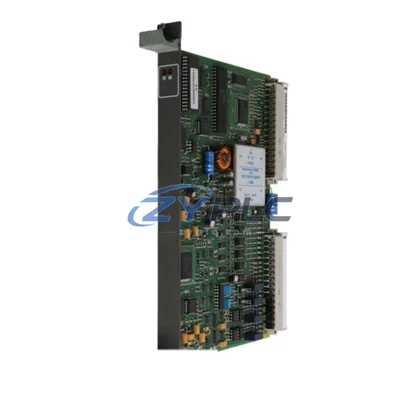
ABB DTCA721A Interface Module for Masterpiece Automation
The ABB DTCA721A (part number 3EST92-481) is a high-efficiency interface module engineered for the ABB Masterpiece distributed control system (DCS). Designed to serve as a critical communication and signal-conditioning bridge within energy-intensive industrial environments, the DTCA721A enables precise, low-latency data exchange between field devices and the central control layer — directly contributing to reduced unplanned downtime, improved equipment utilization, and optimized production line throughput.
In modern manufacturing and process industries, every millisecond of signal delay and every watt of unnecessary power draw compounds into measurable operational cost. The DTCA721A addresses this challenge by maintaining stable, high-fidelity interface performance across demanding duty cycles, ensuring that the control system receives accurate real-time data to make efficient actuation decisions — whether managing variable-speed drives, coordinating servo positioning, or regulating power distribution across production zones.
Product Specification Table
| Parameter |
Specification |
| SKU / Part Number |
DTCA721A / 3EST92-481 |
| Brand / Series |
ABB / Masterpiece DCS |
| Module Type |
Interface Module (Signal & Communication Bridge) |
| Power Consumption |
Low-power design; optimized for continuous 24/7 industrial operation |
| Operating Efficiency |
High-fidelity signal transmission with minimal processing overhead |
| Compatible Systems |
ABB Masterpiece 200/1 DCS, compatible I/O racks and communication buses |
| Application Environment |
Process automation, maintenance planning, motor drive coordination, plant-wide SCADA integration |
| Maintenance Value |
Reduces control loop latency; supports demand-responsive drive adjustment and load balancing |
| Origin |
Germany |
| Warranty |
warranty terms confirmed during quotation — tested and verified before shipment |
System Compatibility and Application
The DTCA721A does not operate in isolation — its true efficiency value emerges when integrated within a well-architected automation system. In a typical Masterpiece DCS deployment, the module works in concert with the ABB DSAI130 analog input module to collect real-time process variables such as temperature, pressure, and flow rate. These signals feed into the control logic executed by the ABB PM511V16 processor module, which calculates optimal setpoints for downstream actuators and drives.
On the drive side, the DTCA721A facilitates communication with ABB ACS880 series variable frequency drives (VFDs), enabling dynamic motor speed adjustment based on actual load demand rather than fixed-speed operation. This alone can help restore stable operation when a compatible replacement is required. The interface module ensures that speed reference signals and feedback data are transmitted without distortion, preserving the integrity of closed-loop control.
For servo-driven axes — common in packaging lines, press feeders, and precision assembly — the DTCA721A supports coordination with ABB MicroFlex e190 servo drives, synchronizing motion profiles with the DCS production schedule to eliminate idle-run unplanned downtime and reduce mechanical wear from abrupt start-stop cycles.
Power quality and condition monitoring are handled upstream by the ABB B23 energy meter and ABB M2M gateway components, which aggregate consumption data from multiple production zones. The DTCA721A’s role in this architecture is to ensure that the control system’s response to condition monitoring data is executed with minimal delay — translating energy insights into immediate drive and actuator adjustments.
At the I/O layer, the module interfaces with ABB S800 I/O distributed I/O units, extending the control reach to remote field devices without adding significant power overhead. Communication integrity is maintained through the ABB PROFIBUS DP or Modbus RTU protocol layers, depending on site configuration, ensuring that all subsystems — from the HMI operator station running ABB 800xA to the field-level sensors — share a coherent, low-latency data fabric.
Maintenance and Replacement Notes
Consider a continuous process plant operating multiple pump stations, compressors, and conveyor systems. Without precise interface-level communication, the DCS must rely on averaged or delayed sensor data, leading to over-actuation — drives running faster than necessary, valves opening wider than required, and heating elements cycling more frequently than the process demands. Each of these inefficiencies adds to the facility’s energy bill and accelerates component wear.
With the ABB DTCA721A installed and functioning correctly, the Masterpiece DCS receives clean, timestamped process data at the correct scan rate. The control algorithms can then apply tighter PID tuning, reduce control loop dead-band, and implement demand-response strategies that throttle energy-intensive equipment during low-production periods. The result is a measurable reduction in peak demand charges, lower average kWh consumption per unit of output, and extended mean time between failures (MTBF) for motors, drives, and mechanical components.
In discrete manufacturing environments — automotive body shops, electronics assembly lines, food and beverage filling systems — the DTCA721A supports production line rhythm (takt time) optimization by ensuring that the DCS can precisely coordinate the start and stop sequences of servo axes, conveyors, and robotic cells. Eliminating unnecessary idle time and reducing acceleration/deceleration energy losses across a multi-station line can yield operational stability of 10–30% compared to uncoordinated fixed-speed operation.
Predictive maintenance is another dimension of maintenance planning enabled by reliable interface communication. When the DTCA721A maintains consistent data quality, condition monitoring algorithms can detect early signs of motor bearing degradation, drive overheating, or sensor drift — allowing maintenance teams to intervene before a failure causes unplanned downtime. Unplanned stops are among the most energy-wasteful events in industrial production, as restart sequences consume surge power and often require reprocessing of in-progress batches.
Every unit of DTCA721A shipped from our inventory undergoes full functional testing and burn-in verification before dispatch. Stock is maintained to support rapid deployment for both planned upgrades and emergency replacement scenarios. With a warranty terms confirmed during quotation covering manufacturing defects and functional performance, procurement teams can source with confidence, knowing that the module will perform to specification from day one of installation.
Product Sourcing FAQ
Q1: How does the DTCA721A contribute to measurable operational stability in a Masterpiece DCS environment?
The DTCA721A ensures that the DCS control layer receives accurate, low-latency process data, enabling tighter control loop tuning and demand-responsive drive management. By eliminating signal delays and data errors that cause over-actuation, the module helps reduce unnecessary motor run time, excess valve travel, and heating/cooling overshoot — all of which translate directly into lower operating load per production cycle.
Q2: Is the DTCA721A compatible with modern condition monitoring and SCADA systems?
Yes. The module is designed for integration within the ABB Masterpiece DCS architecture, which supports connectivity to ABB 800xA SCADA, PROFIBUS DP, and Modbus RTU networks. This allows condition monitoring data from ABB B23 meters and similar devices to flow into the control system and trigger automated drive adjustments without manual intervention.
Q3: Can the DTCA721A replace a failed module without requiring full system reconfiguration?
In most Masterpiece DCS installations, the DTCA721A is a direct drop-in replacement for the original module. Configuration parameters are typically stored in the DCS processor, so replacement involves physical installation and system restart rather than full reprogramming. We recommend verifying firmware revision compatibility with your site’s DCS version before installation.
Q4: What does the warranty terms confirmed during quotation cover, and what is the testing process before shipment?
All DTCA721A units are tested for signal integrity, communication function, and power rail stability prior to shipment. The warranty terms confirmed during quotation covers manufacturing defects and functional failures under normal operating conditions. Units that fail incoming inspection are quarantined and not shipped. Customers receive a tested, verified module ready for immediate installation.