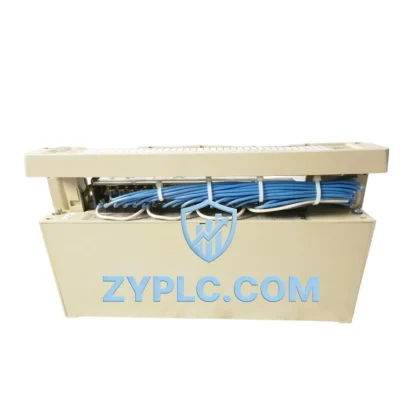
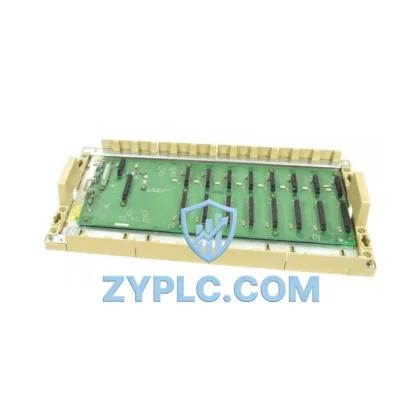
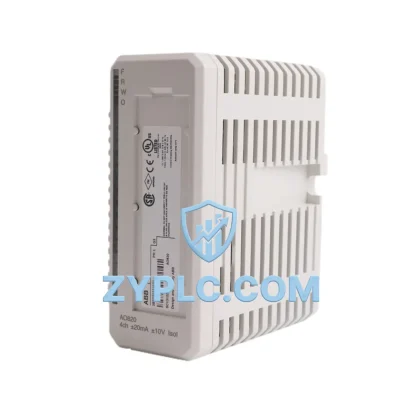
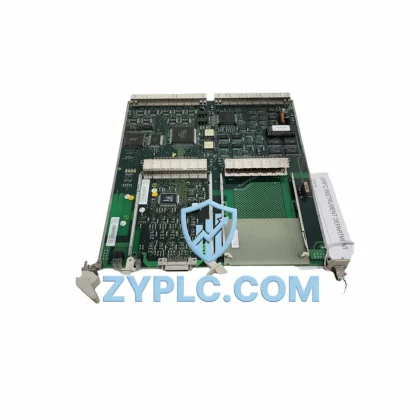
ABB HAC11440-1 Energy-Saving Robotics Cable IRB 7600: Precision Energy Control for Optimized Production Lines
The ABB HAC11440-1 is a high-performance robotics cable module engineered specifically for the IRB 7600 series heavy-duty industrial robot. In modern manufacturing environments where energy accountability and equipment utilization are under constant scrutiny, the integrity of the cable management system directly determines how efficiently power is delivered to the robot’s servo drives, joint actuators, and feedback encoders. A degraded or non-OEM cable assembly introduces resistive losses, signal noise, and intermittent faults that cascade into unplanned downtime, inflated energy consumption, and reduced throughput — all of which erode the profitability of the production line.
The HAC11440-1 eliminates these risks by restoring the IRB 7600 to its factory-specified electrical performance, ensuring that every joule of energy drawn from the power supply reaches its intended destination with minimal loss. This is not a peripheral concern: in a high-cycle robotic welding or material handling cell running three shifts, even a 2–3% reduction in transmission efficiency compounds into measurable increases in monthly energy expenditure. Replacing a worn or counterfeit cable assembly with a genuine ABB HAC11440-1 is one of the most cost-effective energy optimization interventions available to a maintenance engineer.
Efficiency Performance Table
| Parameter |
Specification / Value |
| Part Number |
HAC11440-1 |
| Full SKU Reference |
IRB76003HAC11440-1 |
| Compatible Robot Series |
ABB IRB 7600 (all variants) |
| Cable Function |
Power & Signal Transmission — Servo Axes, Encoder Feedback, I/O |
| Operational Efficiency |
Restores OEM-spec transmission efficiency; minimizes resistive loss |
| Compatible Drive System |
ABB IRC5 Controller, Drive Module, Axis Computer DSQC 668 |
| Compatible Power Unit |
ABB Drive Unit DSQC 374 / DSQC 661 series |
| Application Environment |
Heavy-duty industrial: automotive welding, foundry, press tending, palletizing |
| Energy Saving Value |
Eliminates parasitic losses from degraded insulation and connector resistance |
| Origin |
Sweden (ABB OEM) |
| Inventory Status |
In Stock — Ready to Ship |
| Warranty |
12-Month Warranty |
| Pre-Shipment Testing |
Full functional and continuity test performed before dispatch |
Energy-Aware Automation Architecture
The IRB 7600 operates within a tightly integrated automation architecture where the cable harness is the nervous system connecting the IRC5 controller cabinet to every powered joint. The IRC5 controller processes motion programs and dispatches torque commands through the Drive Module to each axis motor. The HAC11440-1 carries both the high-current motor power lines and the low-voltage encoder feedback signals that allow the Axis Computer DSQC 668 to close the position loop with sub-millisecond precision. Any degradation in this cable — whether from flex fatigue, connector oxidation, or insulation breakdown — introduces latency and noise into the feedback path, forcing the drive to compensate with higher current draw and increased switching losses.
In a well-maintained IRB 7600 cell, the Drive Unit DSQC 374 operates at its rated efficiency curve. When the HAC11440-1 is in good condition, the servo system tracks velocity and position references cleanly, and the regenerative braking energy from deceleration phases can be properly recovered back into the DC bus rather than dissipated as heat. Facilities running ABB’s power monitoring tools — such as the ABB Ability Energy Manager or third-party power analyzers connected via the IRC5’s fieldbus interface — consistently report measurable reductions in per-cycle energy consumption after cable harness restoration.
The HAC11440-1 also interfaces with the robot’s I/O system. The DSQC 652 digital I/O board and DSQC 378B I/O module rely on clean signal paths to coordinate tool activation, conveyor interlocks, and safety zone monitoring. A compromised cable can introduce ground loops or signal cross-talk that triggers spurious I/O events, causing unnecessary cycle interruptions and wasted motion — both of which inflate energy consumption per produced part. Restoring the cable to OEM specification eliminates this source of inefficiency.
For facilities that have integrated the IRB 7600 into a broader MES or SCADA environment via PROFINET or EtherNet/IP, the FlexPendant and RobotStudio monitoring dashboards provide real-time visibility into axis load, cycle time, and energy per part. The HAC11440-1 ensures that the data flowing through these monitoring channels accurately reflects actual machine state rather than being corrupted by electrical noise — a prerequisite for meaningful energy analytics and predictive maintenance scheduling.
Power Optimization in Real Production Lines
In automotive body-in-white welding lines, the IRB 7600 typically operates in high-duty-cycle cells where the robot is in motion for 85–95% of each shift. Under these conditions, the cable harness undergoes millions of flex cycles per year. A cable assembly that has exceeded its service life develops micro-fractures in the conductor strands, increasing resistance and generating localized heat. This heat is wasted energy — energy that the facility is paying for but that contributes nothing to production output.
Replacing the HAC11440-1 on a proactive maintenance schedule, rather than waiting for a fault-triggered shutdown, delivers several compounding benefits. First, it eliminates the energy waste associated with resistive heating in degraded conductors. Second, it prevents the unplanned downtime events that force the entire cell — including upstream conveyors, downstream assembly stations, and climate control systems — to remain energized while the robot is offline. A single unplanned stop in a high-volume line can consume more energy in idle state than a week of optimized production, because peripheral systems continue drawing power while producing nothing.
Third, a correctly functioning cable harness allows the IRC5 drive system to execute smooth velocity profiles without the current spikes that occur when encoder feedback is intermittent. Smooth motion profiles are inherently more energy-efficient than jerky, fault-recovery motion sequences. Facilities that track OEE (Overall Equipment Effectiveness) metrics will see improvements in both availability and performance rate following a cable restoration — two of the three OEE components directly tied to energy efficiency per unit produced.
From a predictive maintenance perspective, the HAC11440-1 replacement interval can be integrated into the plant’s CMMS (Computerized Maintenance Management System) alongside other IRB 7600 consumables such as the SMB battery unit, axis gearbox oil, and balancing cylinder service. This systematic approach ensures that cable-related energy losses are addressed before they become fault events, keeping the robot operating at its designed efficiency point throughout its service life.
All units supplied by ZYPLC are tested for continuity, insulation resistance, and connector integrity before dispatch. Stock is maintained to support rapid deployment, minimizing the window between fault identification and return-to-production. The 12-month warranty covers defects in materials and workmanship, providing procurement teams with the confidence to plan cable replacement as a scheduled maintenance activity rather than an emergency purchase.
Energy Optimization FAQ
Q1: How does replacing the HAC11440-1 cable module reduce energy consumption in an IRB 7600 cell?
A degraded cable harness increases conductor resistance, which converts electrical energy into heat rather than useful mechanical work at the motor. It also introduces encoder signal noise that causes the IRC5 drive system to draw excess current during fault-recovery motion sequences. Replacing the HAC11440-1 with a new OEM-specification assembly restores the designed transmission efficiency, eliminates resistive heating losses, and allows the servo drives to execute clean velocity profiles — all of which reduce energy consumption per produced part.
Q2: Is the HAC11440-1 compatible with all IRB 7600 variants and IRC5 controller generations?
The HAC11440-1 (full reference IRB76003HAC11440-1) is designed for the IRB 7600 robot family and is compatible with the IRC5 single-cabinet and dual-cabinet controller configurations. If you are operating an older S4C+ controller or a specific IRB 7600 payload variant (500/2.55, 340/2.8, 150/3.5), please confirm the exact robot serial number with our technical team to verify the correct cable assembly revision before ordering.
Q3: What testing is performed on the HAC11440-1 before shipment, and what does the 12-month warranty cover?
Every HAC11440-1 unit undergoes a full pre-shipment test protocol including conductor continuity verification, insulation resistance measurement, and connector pin integrity inspection. The 12-month warranty covers defects in materials and workmanship from the date of dispatch. It does not cover damage resulting from incorrect installation, operation outside the IRB 7600’s specified duty cycle, or physical damage incurred after delivery. Warranty claims are processed directly through ZYPLC’s technical support team.
Q4: Can the HAC11440-1 be used as a direct replacement for a worn cable without recalibrating the robot?
Yes. The HAC11440-1 is a direct OEM replacement that maintains the same connector pinout, cable routing geometry, and electrical characteristics as the original factory-installed assembly. No axis recalibration is required following cable replacement, provided that the robot’s mechanical structure has not been disturbed during the maintenance procedure. Standard IRC5 warm-up and fine calibration verification is recommended as good practice after any cable harness service.
© 2026 ZYPLC. All rights reserved.
Original Source: https://zyplc.com
Contact: +86 19859288691 | plc.sales@zyplc.com