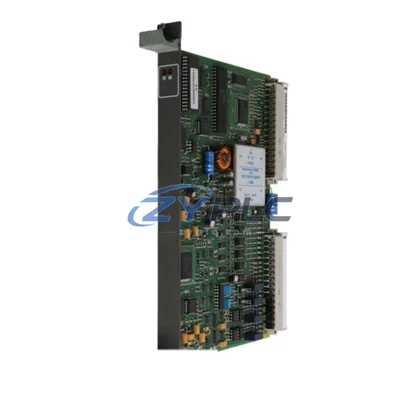
ABB HIEE300766R0001 Gate Control Unit GDB021: Precision Drive Efficiency for Optimized Automation
The ABB HIEE300766R0001 GDB021 BE01 is a high-performance gate control unit engineered for thyristor-based DC drive systems within ABB’s legacy and current industrial drive architecture. As a core firing control component, it governs the precise switching of thyristor bridges, directly influencing energy conversion efficiency, motor torque linearity, and overall drive system reliability. In energy-intensive production environments — from steel rolling mills and cement kilns to paper machines and chemical process lines — the quality of gate pulse generation determines not only motor performance but also the total energy consumed per production cycle.
Unlike generic replacement boards, the HIEE300766R0001 is factory-designed to integrate seamlessly within ABB’s DCS 400, DCS 500, and DCS 600 series DC drive platforms, ensuring that firing angle calculations, current feedback loops, and fault protection routines operate within original design tolerances. This system integration eliminates the efficiency losses that arise from mismatched firing timing, reducing harmonic distortion at the motor terminals and lowering reactive power demand on the upstream supply network.
Product Specification Table
| Parameter |
Specification / Value |
| Part Number |
HIEE300766R0001 |
| Module Designation |
GDB021 BE01 |
| Function |
Thyristor Gate Control / Firing Pulse Generation |
| Compatible Drive Series |
ABB DCS 400 / DCS 500 / DCS 600 DC Drive Platforms |
| Drive Type |
DC Thyristor Converter Drive |
| Firing Angle Control |
Closed-loop, synchronized to AC supply frequency |
| Energy Efficiency Contribution |
Minimizes thyristor conduction losses; reduces harmonic distortion |
| Operating Voltage |
Per ABB DCS series specification (24 VDC logic supply typical) |
| Operating Temperature |
0°C to +55°C (standard industrial enclosure) |
| Installation Environment |
Control cabinet, DIN rail or backplane mount |
| Communication Interface |
Internal drive bus; compatible with DDCS fiber-optic communication |
| Origin |
Sweden (ABB) |
| Condition |
Tested, functional verified prior to shipment |
| Warranty |
warranty terms confirmed during quotation |
System Compatibility and Application
The HIEE300766R0001 GDB021 BE01 does not operate in isolation — its operational-efficiency value is fully realized when it functions as part of a coordinated drive and control architecture. In a typical heavy-industry installation, the gate control unit sits at the intersection of the power conversion layer and the control execution layer, receiving speed and torque references from the drive’s main control board (such as the SDCS-CON-4 or SDCS-CON-2) and translating them into precise firing pulses for the thyristor bridge assembly.
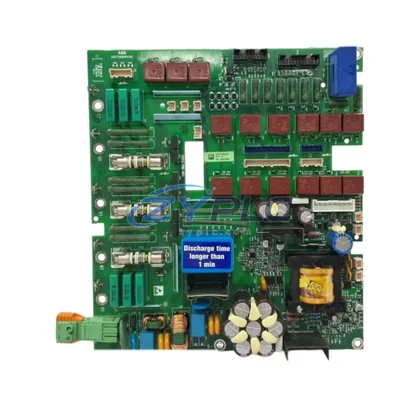
On the power side, the unit works in conjunction with the SDCS-POW-4 power supply board, which provides the stabilized logic voltages required for consistent gate pulse amplitude. Any instability in the power supply directly degrades firing precision, increasing thyristor switching losses and generating additional heat within the drive cabinet. By maintaining clean gate signals, the HIEE300766R0001 ensures that the thyristor stack — whether a 6-pulse or 12-pulse bridge configuration — operates at its rated conduction efficiency.
At the I/O and feedback layer, the gate control unit interfaces with current transducers and voltage feedback circuits that feed real-time data back to the drive’s current regulator. This closed-loop architecture, supported by I/O expansion modules such as the SDCS-IOB-3, allows the drive to continuously adjust firing angles in response to load changes, preventing overcurrent events that would otherwise force the drive into protective shutdown — a major source of unplanned downtime and unplanned downtime during restart cycles.
For multi-drive installations, the HIEE300766R0001 is compatible with systems using DDCS (Distributed Drive Control System) fiber-optic communication, enabling coordinated speed control across multiple DC drives on a single production line. This is particularly valuable in winding, unwinding, and tension-control applications where energy regeneration between drive sections can be optimized to reduce net power consumption. The NDBU-95 DDCS branching unit is commonly used in such architectures to distribute control signals across drive nodes.
At the human-machine interface layer, operators monitor drive efficiency parameters — including output current, firing angle, motor speed, and operating load trends — through ABB’s Panel Builder compatible HMI terminals or third-party SCADA systems connected via Profibus DP or Modbus RTU adapters such as the NPBA-12 or NMBA-01. Real-time visibility into firing angle utilization allows maintenance engineers to detect early signs of thyristor degradation before efficiency losses become significant, supporting a predictive maintenance strategy that reduces both unplanned downtime and unplanned outages.
Maintenance and Replacement Notes
In steel wire drawing lines, the HIEE300766R0001 controls the DC motors driving each drawing block in sequence. Precise firing angle control ensures that each motor accelerates and decelerates in synchronization with the line speed reference, eliminating the micro-slip events that generate excess heat in motor windings and increase operating load per ton of drawn wire. Plants that have replaced degraded gate control units with properly functioning HIEE300766R0001 boards have reported measurable reductions in drive cabinet operating temperatures — a direct indicator of reduced conduction losses.
In cement plant kiln drive applications, where a single DC motor may draw several hundred kilowatts continuously, even a 1–2% improvement in thyristor firing efficiency translates to significant annual operational stability. The gate control unit’s ability to maintain firing angle symmetry across all six thyristors in the bridge prevents the current imbalance that leads to uneven thyristor heating, extended thermal stress, and premature component failure. Replacing a faulty or degraded GDB021 BE01 board restores the drive to its original efficiency curve, avoiding the energy penalty of operating with asymmetric firing.
For paper machine drives, where constant tension and speed regulation are critical to product quality, the HIEE300766R0001 supports the fast current loop response required to handle rapid load changes without overshoot. This responsiveness reduces the unplanned downtimed in oscillatory current transients and protects the mechanical drivetrain from torque spikes that accelerate wear on gearboxes and couplings — reducing both maintenance frequency and the energy cost of mechanical losses.
All units supplied by ZYPLC are functionally tested prior to shipment, with gate pulse waveforms verified under load simulation conditions. This ensures that the unit installed on your production line performs to specification from day one, without the efficiency degradation that can occur with untested surplus stock. Combined with our warranty terms confirmed during quotation, this testing protocol gives maintenance engineers confidence in both immediate performance and medium-term reliability.
Product Sourcing FAQ
Q1: How does the HIEE300766R0001 GDB021 BE01 contribute to measurable operational stability in a DC drive system?
The gate control unit directly controls the firing angle of the thyristor bridge, which determines how efficiently AC power is converted to DC power for the motor. A degraded or mismatched gate control board introduces firing angle errors that increase conduction losses, raise harmonic distortion, and reduce power factor. Replacing a faulty unit with a correctly functioning HIEE300766R0001 restores the drive’s original efficiency rating, reducing operating load per production cycle. In high-load continuous applications such as kiln drives or rolling mill motors, this efficiency recovery can be quantified through power meter readings before and after replacement.
Q2: Is the HIEE300766R0001 GDB021 BE01 compatible with both DCS 500 and DCS 600 series drives, and are there any configuration differences?
The HIEE300766R0001 GDB021 BE01 is designed for use within ABB’s DCS series DC drive platforms. Compatibility with specific drive variants (DCS 400, DCS 500, DCS 600) depends on the drive’s hardware revision and the slot assignment within the drive’s control board stack. Before installation, engineers should verify the drive’s existing board configuration against ABB’s hardware compatibility matrix for the GDB021 module series. ZYPLC’s technical team can assist with compatibility verification based on your drive’s nameplate data and existing board layout.
Q3: What is the recommended replacement procedure to minimize production downtime, and what does the warranty terms confirmed during quotation cover?
The recommended procedure involves de-energizing the drive, documenting the existing board configuration and wiring, removing the faulty GDB021 BE01, installing the replacement HIEE300766R0001, and performing a no-load firing test before resuming production. The entire swap typically takes 1–2 hours for experienced drive technicians. ZYPLC’s warranty terms confirmed during quotation covers functional defects identified under normal operating conditions within 12 months of shipment. Units that fail due to installation errors, overvoltage events, or operation outside rated parameters are evaluated on a case-by-case basis. Our technical support team is available to assist with commissioning questions throughout the warranty period.
Q4: Can ZYPLC supply multiple HIEE300766R0001 units for a multi-drive installation, and what lead times apply?
Yes. ZYPLC maintains inventory of ABB drive control components including the HIEE300766R0001 GDB021 BE01 to support both single-unit replacement and multi-drive project requirements. For bulk orders or scheduled maintenance programs, we recommend contacting our sales team in advance to confirm stock availability and arrange priority allocation. Standard availability confirmed by RFQ units are dispatched within 3–5 business days after order confirmation, with expedited shipping options available for urgent production line requirements.