ABB NDBU-95C 3AFE64008366 System-Ready Branching Unit: Control System Architecture and Upstream-Downstream Coordination
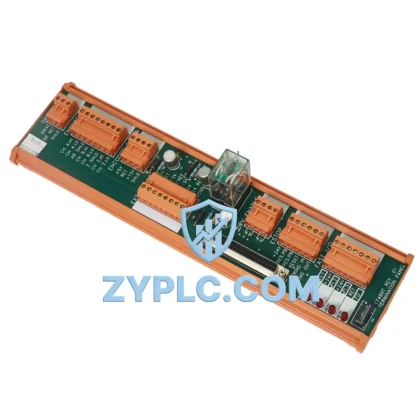
The ABB NDBU-95C (part number 3AFE64008366) is a DDCS (Distributed Drive Control System) fiber optic branching unit engineered for deployment within the ACS800 drive architecture. Rather than functioning as a standalone accessory, the NDBU-95C occupies a critical node in the multi-axis drive communication topology — distributing DDCS fiber optic signals from a master controller to multiple drive units simultaneously. In complex industrial automation environments where coordinated motion, synchronized torque control, and deterministic communication latency are non-negotiable, this branching unit ensures that the entire drive network operates as a unified, coherent system.
Understanding the NDBU-95C requires viewing it within the full control hierarchy. At the control layer, an ABB AC800M controller or an RMIO-11C drive control board issues high-level commands via the DDCS protocol. These commands travel through fiber optic channels — immune to electromagnetic interference common in high-voltage switchgear cabinets — and arrive at the NDBU-95C, which then fans out the signal to each connected ACS800 drive unit. This architecture eliminates point-to-point wiring complexity, reduces cabinet footprint, and dramatically improves signal integrity across the entire drive network.
At the I/O layer, each ACS800 drive unit connected downstream of the NDBU-95C may interface with NAIO-03 analog I/O extension modules or NDIO-01 digital I/O modules, enabling precise process variable feedback — speed references, torque limits, fault signals — to flow bidirectionally through the fiber optic backbone. The NDBU-95C acts as the communication hub that makes this bidirectional data exchange possible across all connected drives without introducing latency asymmetry.
From a network layer perspective, the NDBU-95C supports ring and star DDCS topologies. In ring configurations, a single fiber break does not interrupt the entire network, providing inherent redundancy that is essential in continuous-process industries such as petrochemical refining, pulp and paper production, and steel rolling mills. The NMBR-01 DDCS master branching unit may be used in conjunction with the NDBU-95C to extend the network further, supporting larger drive populations within a single coordinated system.
Power supply integrity is equally important. The NDBU-95C is typically powered from the ACS800 drive’s internal 24 VDC auxiliary supply or from a dedicated NPOW-41C power supply module, ensuring that the branching unit remains operational even during main power fluctuations. This design choice supports uninterrupted communication during transient grid events — a critical requirement in mining hoisting systems and offshore platform drives where communication loss can trigger emergency shutdowns.
At the human-machine interface layer, operators monitoring a multi-drive system through an ABB Panel Builder 800 HMI or a third-party SCADA system receive consolidated drive status data that is aggregated and routed through the DDCS network managed by the NDBU-95C. Fault diagnostics, speed feedback, energy consumption data, and alarm states from every connected ACS800 drive are visible in real time, enabling rapid fault isolation and reducing mean time to repair (MTTR) significantly.
At the execution layer, the drives connected through the NDBU-95C — whether controlling conveyor motors, pump drives, compressor drives, or winder tension systems — receive synchronized command updates within the DDCS cycle time. This synchronization is essential in applications such as multi-motor paper machine drives, where speed ratio accuracy between press section, dryer section, and reel drives must be maintained within fractions of a percent to prevent web breaks and product defects.
Architecture Specification Table
| Parameter |
Specification |
| Part Number |
NDBU-95C / 3AFE64008366 |
| Brand |
ABB |
| Compatible Series |
ACS800 Multi-Drive / Single Drive |
| System Role |
DDCS Fiber Optic Branching Unit |
| Communication Protocol |
DDCS (Distributed Drive Control System) — Fiber Optic |
| Topology Support |
Ring / Star DDCS Network |
| Number of DDCS Channels |
Up to 12 fiber optic channels (model dependent) |
| Fiber Optic Type |
Plastic optical fiber (POF), 1 mm |
| Supply Voltage |
24 VDC (from drive auxiliary or external NPOW-41C) |
| Operating Temperature |
0°C to +55°C |
| Storage Temperature |
-40°C to +70°C |
| Mounting |
DIN rail or panel mount within ACS800 cabinet |
| Protection Class |
IP20 |
| Origin |
Finland |
| Warranty |
12-Month Warranty — Tested, verified, ready to ship |
Coordinated Control System Design
Deploying the NDBU-95C within a coordinated ACS800 drive system requires careful consideration of the full component ecosystem. A typical multi-drive installation begins with an AC800M PLC or an ACS800 master drive running the RMIO-11C control board, which generates DDCS master signals. These signals enter the NDBU-95C’s master channel and are distributed to each slave ACS800 drive unit via individual fiber optic branches.
Each slave drive may be equipped with an RDCO-03 DDCS communication option board, which plugs directly into the drive’s option slot and terminates the fiber optic connection from the NDBU-95C. This modular approach means that adding a new drive axis to an existing system requires only an additional RDCO-03 board and a fiber optic cable run to the next available NDBU-95C port — no rewiring of the control backbone is necessary.
For systems requiring fieldbus integration — connecting the ACS800 drive network to a Profibus DP, Modbus RTU, or EtherNet/IP supervisory network — an NPBA-12 Profibus adapter or NEBA-01 EtherNet/IP adapter can be installed in the master drive, bridging the DDCS fiber optic domain with the plant-level communication network. The NDBU-95C remains transparent to this upper-layer communication, continuing to distribute DDCS signals regardless of the fieldbus protocol in use.
In redundant drive architectures, a second NDBU-95C may be deployed in parallel, with automatic switchover logic implemented in the AC800M controller. This dual-branching-unit configuration ensures that a single hardware failure does not interrupt drive communication — a design pattern commonly specified in critical infrastructure projects including water treatment pump stations, LNG terminal compressor drives, and power plant auxiliary drives.
Cabinet-level integration typically pairs the NDBU-95C with NPOW-41C auxiliary power supplies, NINT-41C inverter control boards, and NAFE-01 active front-end control units, all mounted within a standardized ACS800 multi-drive cabinet. This integrated approach simplifies spare parts management: a single cabinet design can be replicated across multiple production lines, and a single NDBU-95C spare unit covers the branching function for the entire cabinet.
Application in Layered Automation Systems
In steel and metals processing, the NDBU-95C enables synchronized speed control across roughing mill, finishing mill, and coiler drives. The DDCS fiber optic network ensures that speed ratio commands propagate to all drives within a single control cycle, preventing strip tension variations that would otherwise cause surface defects or strip breaks.
In petrochemical and refinery applications, multi-pump and multi-compressor drive systems rely on the NDBU-95C to maintain coordinated flow control. The fiber optic communication medium is inherently immune to the high levels of electromagnetic interference generated by large motor drives and power conversion equipment in these environments, ensuring reliable command delivery even in electrically noisy installations.
In mining and minerals processing, conveyor drive systems spanning hundreds of meters use the NDBU-95C to coordinate belt tension and speed across multiple drive points. The ring topology capability of the DDCS network means that a single fiber break — caused by cable damage in a harsh underground environment — does not halt production, as the ring automatically reconfigures to maintain communication with all drives.
In water and wastewater treatment, pump station drives controlled through an NDBU-95C-based DDCS network can be monitored and adjusted from a central SCADA system, with all drive status data aggregated through the fiber optic backbone. Energy optimization algorithms running on the AC800M controller can dynamically adjust pump speed setpoints across all drives simultaneously, reducing energy consumption and extending pump service life.
In packaging and converting lines, the NDBU-95C supports tension-controlled winding and unwinding drives, where precise speed ratio control between unwind, nip, and rewind drives is essential for consistent product quality. The low-latency DDCS communication ensures that tension corrections are applied across all drives within milliseconds of a process disturbance.
Architecture Engineering FAQ
Q1: How many ACS800 drives can be connected to a single NDBU-95C, and can the network be expanded?
The NDBU-95C supports up to 12 DDCS fiber optic channels in its standard configuration, allowing up to 12 ACS800 drive units to be connected to a single branching unit. For larger drive populations, multiple NDBU-95C units can be cascaded using the DDCS ring topology, or an NMBR-01 master branching unit can be used to extend the network. Each additional NDBU-95C added to the ring increases the total drive count without requiring changes to the master controller configuration, making system expansion straightforward and non-disruptive to existing drives.
Q2: Is the NDBU-95C compatible with ACS800 drives that use RDCO-01 or RDCO-02 communication boards, and what firmware considerations apply?
The NDBU-95C is compatible with ACS800 drives equipped with RDCO-01, RDCO-02, and RDCO-03 DDCS communication option boards. The DDCS protocol is consistent across these board generations, so mixed installations — where some drives use older RDCO-01 boards and others use RDCO-03 — are fully supported. Firmware compatibility should be verified against the ACS800 firmware release notes for the specific drive software version in use; ABB recommends using drive firmware version 7.x or later for optimal DDCS network stability. Our technical team can assist with firmware compatibility verification prior to installation.
Q3: What does the 12-Month Warranty cover, and how does ZYPLC support long-term maintenance and spare parts availability?
Every NDBU-95C 3AFE64008366 supplied by ZYPLC is covered by a 12-Month Warranty against manufacturing defects and functional failures under normal operating conditions. Prior to shipment, each unit undergoes functional testing to verify DDCS channel integrity, power supply operation, and fiber optic signal transmission. For long-term maintenance planning, ZYPLC maintains stock of NDBU-95C units and related ACS800 communication components, enabling rapid replacement in the event of field failures. Our engineering support team is available to assist with installation verification, network topology planning, and troubleshooting throughout the warranty period and beyond. Contact us at +86 19859288691 or plc.sales@zyplc.com for spare parts availability and technical consultation.
© 2026 ZYPLC. All rights reserved.
Original Source: https://zyplc.com
Contact: +86 19859288691 | plc.sales@zyplc.com