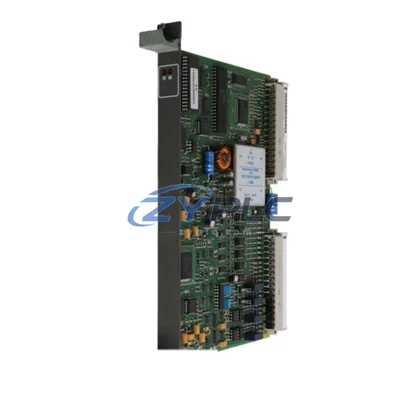
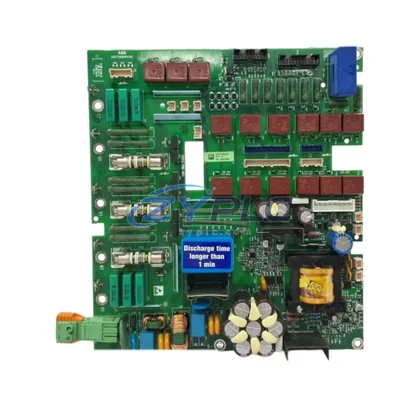
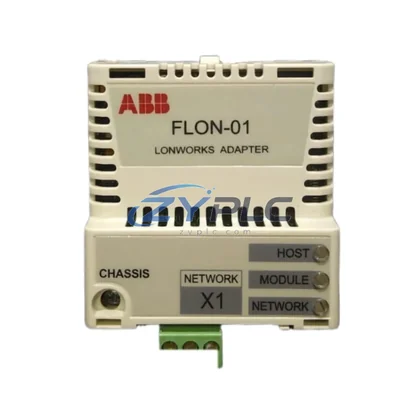
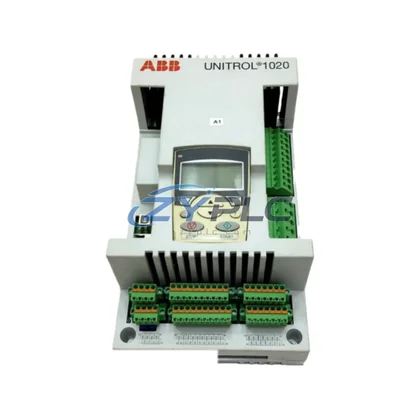
ABB NDBU-95C Industrial Network Interface for ACS/DCS Drive Systems
The ABB NDBU-95C is a high-performance DDCS (Distributed Drive Control System) Branching Unit engineered to serve as the critical industrial network interface between ABB drive systems and upper-level automation architectures. In modern smart factory environments, where data must flow seamlessly from field-level devices through control layers to SCADA and MES platforms, the NDBU-95C acts as the backbone of drive network communication — enabling real-time signal acquisition, protocol-transparent data relay, and deterministic network timing across multi-drive topologies.
Designed specifically for integration with ABB ACS800 and DCS800 series drives, the NDBU-95C supports the DDCS fiber-optic communication protocol, delivering high-speed, noise-immune data transmission in electrically harsh industrial environments. Its branching architecture allows a single master controller — such as an ABB AC800M PLC or an RDCO-02C communication module — to communicate simultaneously with multiple drive nodes, dramatically simplifying the wiring infrastructure of large-scale drive networks while maintaining microsecond-level synchronization across all connected axes.
Compatibility & Integration Notes
| Parameter |
Specification |
| Communication Protocol |
DDCS (Distributed Drive Control System) Fiber-Optic |
| Interface Type |
Fiber-Optic (HFBR connectors), DDCS Ring/Star Topology |
| Transmission Speed |
Up to 4 Mbps (DDCS) |
| Network Compatibility |
ABB ACS800, DCS800, ACS600, ACS1000 Drive Series |
| Max Drive Nodes |
Up to 12 drives per branch (topology dependent) |
| Master Controller Support |
ABB AC800M, RDCO-02C, APBU-44C, NPBU-95C |
| System Application |
Multi-drive coordination, SCADA integration, DriveWindow monitoring |
| Power Supply |
24 VDC (external) |
| Operating Temperature |
0°C to +55°C |
| Warranty |
warranty terms confirmed during quotation | Tested Before Shipment |
Connected Automation Data Flow
In a fully integrated smart factory data chain, the NDBU-95C sits at the intersection of drive-level intelligence and plant-wide visibility. The data flow begins at the field device layer: sensors and encoders feed real-time speed, torque, and current feedback into ABB ACS800 or DCS800 variable frequency drives. These drives, connected via DDCS fiber-optic links to the NDBU-95C branching unit, transmit their process data upstream to the master controller — typically an ABB AC800M PLC or a system equipped with the RDCO-02C DDCS communication adapter.
From the PLC layer, data is aggregated and forwarded through industrial Ethernet (PROFINET or Modbus TCP) to SCADA platforms such as ABB System 800xA or third-party supervisory systems, where operators gain real-time visibility into drive status, operating load, fault codes, and production KPIs. The NDBU-95C’s role in this chain is to ensure that the DDCS ring remains intact and that each drive node — whether an ACS800-04 regenerative unit, a DCS800 DC drive, or an ACS1000 medium-voltage drive — maintains its communication slot without latency accumulation.
For remote I/O expansion, the APBU-44C Pulse Encoder Interface or NAIO-03C analog I/O extension modules can be integrated into the same DDCS ring, extending the data acquisition capability to position feedback and analog process signals. HMI terminals connected to the AC800M via OPC-UA or PROFIBUS DP provide operators with a graphical interface for drive parameter visualization and alarm acknowledgment. In distributed plant architectures, edge gateways running ABB Ability™ software collect drive data from the NDBU-95C network and push it to cloud-based analytics platforms, enabling predictive maintenance and maintenance planning across the entire production line.
The NDBU-95C also supports DriveWindow Light 2 PC software connectivity, allowing maintenance engineers to perform drive parameter backup, firmware updates, and fault log retrieval directly from a laptop connected to the DDCS network — without interrupting production. This capability is essential for minimizing unplanned downtime in continuous process industries such as paper mills, cement plants, and metal processing facilities.
Solving Data Isolation in Industrial Sites
One of the most persistent challenges in industrial automation is the fragmentation of communication protocols across different generations of equipment. Legacy drives may speak DDCS while newer additions to the production line use PROFIBUS DP, CANopen, or EtherNet/IP — creating data silos that prevent unified monitoring and control. The ABB NDBU-95C addresses this challenge by serving as the DDCS network hub, consolidating all drive-level data into a single, structured communication stream that can be translated by higher-level gateways into any supervisory protocol.
In plants where production transparency is a priority, the NDBU-95C enables line-level data visibility by ensuring that every drive in the network — from the main line drive to auxiliary fan and pump drives — reports its status in real time. This eliminates the need for manual inspection rounds and allows SCADA operators to detect abnormal current draw, speed deviation, or thermal overload conditions before they escalate into production stoppages.
For remote monitoring applications, the NDBU-95C’s fiber-optic backbone provides inherent immunity to electromagnetic interference, making it suitable for deployment in high-noise environments such as steel mills, mining operations, and chemical processing plants. Remote diagnostic sessions via DriveWindow or ABB Ability™ Drivetune allow engineers to adjust drive parameters, reset faults, and verify network integrity from a central control room or even from off-site locations — reducing the need for on-site intervention and cutting maintenance costs significantly.
System scalability is another key advantage. As production capacity expands, additional ACS800 or DCS800 drives can be added to the DDCS ring managed by the NDBU-95C without requiring changes to the master controller configuration. The branching unit’s modular architecture supports incremental network growth, protecting the initial automation investment while accommodating future production demands.
Every NDBU-95C unit supplied by ZYPLC undergoes pre-shipment functional testing, including DDCS communication verification, fiber-optic link integrity check, and power supply validation. Units are shipped with a warranty terms confirmed during quotation covering manufacturing defects and communication failures, with technical support available for installation and network commissioning.
Industrial Connectivity FAQ
Q1: What is the maximum number of drives that can be connected to the ABB NDBU-95C in a single DDCS ring?
The NDBU-95C supports up to 12 drive nodes per branch in a standard DDCS ring topology. For larger installations requiring more nodes, multiple NDBU-95C units can be cascaded under a single AC800M master controller, with each branching unit managing its own segment of the drive network.
Q2: Is the NDBU-95C compatible with both ACS800 and DCS800 drive series on the same DDCS network?
Yes. The DDCS protocol is consistent across ABB’s ACS800 and DCS800 drive families, and the NDBU-95C can manage mixed-drive networks containing both AC and DC drive types simultaneously. Protocol compatibility is maintained at the DDCS layer, and the master controller handles any application-level differentiation between drive types.
Q3: How does the NDBU-95C ensure network stability in high-EMI industrial environments?
The NDBU-95C uses fiber-optic communication links (HFBR-type connectors) throughout the DDCS network, providing complete galvanic isolation and immunity to electromagnetic interference. This makes it suitable for installation in close proximity to high-power inverters, transformers, and other EMI-generating equipment without risk of communication errors or data corruption.
Q4: What warranty and pre-shipment testing does ZYPLC provide for the NDBU-95C?
All NDBU-95C units are covered by a warranty terms confirmed during quotation from the date of shipment. Prior to dispatch, each unit undergoes a full functional test including DDCS communication loop verification, fiber-optic signal strength measurement, and 24 VDC power supply check. Test reports are available upon request. For technical support during installation or commissioning, contact ZYPLC at plc.sales@zyplc.com or +86 19859288691.