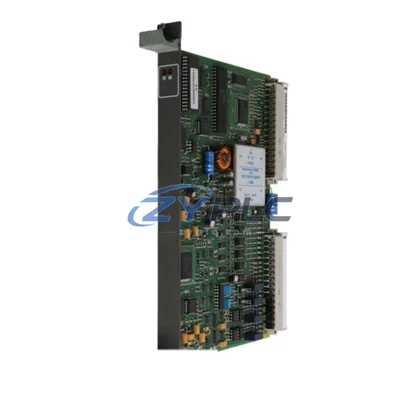
ABB NTAC-02 Pulse Encoder Interface for ACS/DCS
The ABB NTAC-02 Pulse Encoder Interface Module is a precision-engineered feedback component designed to operate within ABB’s layered drive and process control architecture. Rather than functioning as a standalone accessory, the NTAC-02 occupies a critical position in the closed-loop control chain — bridging the execution layer (motor and encoder) with the control layer (ACS or DCS drive processor), ensuring that speed, position, and direction data are transmitted with the accuracy and stability that modern industrial automation demands.
In a fully integrated ABB drive system, the NTAC-02 mounts directly onto the drive’s option slot, interfacing with the main control board of ACS800, ACS880, or DCS880 series drives. This tight hardware integration eliminates signal conversion latency and reduces the risk of feedback errors that can destabilize PID loops or cause drive trips in high-precision applications. The module supports incremental encoder inputs with configurable pulse resolutions, making it adaptable across a wide range of motor feedback devices used in manufacturing, metals processing, and process industries.
From a system architecture perspective, the NTAC-02 enables the drive to operate in closed-loop vector control mode — a significant upgrade over open-loop scalar control in terms of torque accuracy, speed regulation, and dynamic response. When paired with an ACS880 primary control unit (PCU) or an ACS800 RMIO board, the NTAC-02 feeds real-time encoder data directly into the drive’s adaptive motor model, supporting Direct Torque Control (DTC) with encoder feedback for demanding applications such as winders, cranes, extruders, and rolling mills.
At the I/O and signal layer, the NTAC-02 works in coordination with other option modules such as the RDIO-01 digital I/O extension module and the RAIO-01 analog I/O module, which handle process signals, interlocks, and reference inputs. Together, these modules form a coherent I/O architecture that allows the drive to respond to upstream PLC commands — typically issued via a Siemens S7-300/400, ABB AC500, or Rockwell ControlLogix controller — while simultaneously managing motor feedback at the hardware level.
At the network and communication layer, the NTAC-02 operates transparently beneath fieldbus adapter modules such as the RPBA-01 PROFIBUS-DP adapter or the FENA-21 EtherNet/IP and PROFINET adapter. These communication modules relay drive status, speed references, and fault diagnostics to the supervisory control system, while the NTAC-02 ensures that the physical feedback loop remains intact regardless of network load or communication cycle time. This separation of feedback and communication layers is a key principle of robust drive architecture design.
For redundancy-critical applications, the NTAC-02 can be deployed in systems where the ACS880 MultiDrive cabinet architecture provides shared DC bus operation across multiple drive modules. In such configurations, encoder feedback integrity is essential for coordinated multi-axis control, and the NTAC-02’s direct slot integration ensures that feedback signals are not subject to external wiring noise or connector degradation over time. Supplementary components such as the BCU-12 or BCU-22 brake control units and the ACH580 HVAC drive variants may also share the same control cabinet infrastructure, making module compatibility and consistent feedback architecture a priority for long-term system reliability.
From a power and electrical standpoint, the NTAC-02 draws its operating power directly from the drive’s internal option slot supply, eliminating the need for external 24 VDC wiring to the encoder interface. This simplifies cabinet wiring, reduces potential ground loop issues, and ensures that the encoder interface powers up and down in synchronization with the drive itself — a critical consideration for safe restart sequences in process-critical applications.
In terms of engineering commissioning, the NTAC-02 is configured through ABB’s Drive Composer Pro or DriveWindow Light software tools, where encoder pulse count, signal type (single-ended or differential), and feedback channel assignment are set via parameter groups. This software-driven configuration approach ensures that encoder settings are stored in the drive’s non-volatile memory and are automatically restored after a power cycle or drive replacement — reducing commissioning time during maintenance events.
For long-term maintenance and inventory planning, stocking the NTAC-02 alongside compatible spare modules such as the RDCO-04 DDCS communication module, AINT-02 analog input module, and RMIO-11 main I/O board ensures that the complete drive option architecture can be restored rapidly in the event of a module failure. This approach to modular spare parts management is particularly valuable in continuous process industries where unplanned downtime carries significant production cost.
All NTAC-02 modules supplied by ZYPLC are covered by a warranty terms confirmed during quotation and are tested prior to shipment to verify encoder signal integrity and option slot communication. Our inventory is sourced from verified supply channels, and each unit undergoes functional verification to ensure system integration compatibility within your existing ABB drive architecture.
Product Specification Table
| Parameter |
Specification |
| System Role |
Pulse Encoder Feedback Interface for ACS/DCS Drive Systems |
| Compatible Drives |
ACS800, ACS880, DCS880, ACS600 (with adapter) |
| Encoder Input Type |
Incremental TTL/HTL, Single-ended & Differential |
| Max Pulse Frequency |
Up to 200 kHz (drive-dependent) |
| Supply Voltage |
Powered via drive option slot (internal) |
| Communication Interface |
Direct option slot integration (DDCS-compatible) |
| Installation Method |
Drive option slot (plug-in module) |
| Operating Temperature |
0°C to +55°C (drive ambient) |
| Protection Class |
IP20 (within drive enclosure) |
| Configuration Tool |
Drive Composer Pro / DriveWindow Light |
| Warranty |
warranty terms confirmed during quotation (ZYPLC) |
| system integration |
Compatible with ABB ACS/DCS closed-loop vector control architecture |
System Compatibility Notes
The NTAC-02 achieves its full value when integrated within a coordinated ABB drive system. A typical architecture includes the ACS880-01 single drive or ACS880-07 cabinet drive as the primary power conversion unit, with the NTAC-02 installed in the drive’s option slot 1 or slot 2 to provide encoder feedback. The BCU-12 brake control unit manages dynamic braking resistor switching, while the FENA-21 EtherNet/IP/PROFINET adapter handles upstream communication with the plant DCS or SCADA system. At the I/O layer, the RDIO-01 digital I/O extension module and RAIO-01 analog I/O module manage process interlocks and analog references, ensuring that the drive responds correctly to both hardware signals and network commands. For multi-drive cabinet applications, the BCU-22 brake chopper unit and shared DC bus architecture of the ACS880 MultiDrive platform rely on consistent encoder feedback from each axis — making the NTAC-02 a system-level component rather than a peripheral accessory. The RDCO-04 DDCS communication module may also be present in master-follower drive configurations, where encoder synchronization between drives is essential for coordinated motion. At the HMI layer, an ABB CP600 operator panel or third-party SCADA terminal provides real-time speed and torque visualization, with data sourced from the drive’s feedback loop — of which the NTAC-02 is the foundational input.
Industrial Application Notes
The NTAC-02 is deployed across a broad range of industrial sectors where precise motor speed and position feedback is essential to process quality and safety. In metals and rolling mill applications, the module enables closed-loop tension control across multi-stand rolling lines, where speed synchronization between drive sections must be maintained within fractions of a percent. In paper and pulp manufacturing, the NTAC-02 supports winder and unwinder drives where web tension control depends on accurate encoder feedback to maintain consistent reel torque profiles. In petrochemical and refinery environments, the module is used in compressor and pump drive systems where speed accuracy directly affects process throughput and energy efficiency. In water and wastewater treatment plants, the NTAC-02 supports variable speed pump drives operating under closed-loop pressure or flow control, where encoder feedback improves regulation accuracy compared to open-loop operation. In mining and mineral processing, the module is found in conveyor, hoist, and crusher drive systems where load variations demand robust torque control with reliable feedback. In packaging and material handling lines, the NTAC-02 enables precise positioning and speed matching between conveyor sections, ensuring product integrity and line synchronization. Across all these applications, the module’s direct integration with the ABB drive platform ensures that feedback data is processed at the drive’s native control cycle rate — typically 125 µs for DTC-based drives — providing the responsiveness required for demanding dynamic applications.
Product Compatibility FAQ
Q1: Is the NTAC-02 compatible with both ACS800 and ACS880 series drives, and are there any configuration differences?
The NTAC-02 is compatible with ACS800 and ACS880 series drives, as well as DCS880 DC drives with appropriate option slot availability. Configuration differences exist primarily in the parameter group assignments within Drive Composer Pro versus DriveWindow Light — ACS880 drives use parameter group 92 for encoder module settings, while ACS800 drives use group 50. Both platforms support the same encoder signal types and pulse resolution settings, ensuring consistent feedback performance across drive generations.
Q2: Can the NTAC-02 be used in a redundant drive architecture, and what happens to encoder feedback during a drive module swap?
In ABB MultiDrive cabinet architectures with hot-swap capability, the NTAC-02 is physically mounted in the drive module and moves with it during a swap. For applications requiring continuous encoder feedback during maintenance, it is recommended to maintain a spare NTAC-02 pre-configured with the correct parameter settings, so that a replacement module can be installed and commissioned within the drive’s standard restart sequence. ZYPLC recommends stocking at least one spare NTAC-02 per critical drive axis to support this maintenance strategy under the warranty terms confirmed during quotation coverage period.
Q3: What encoder specifications are required for compatibility with the NTAC-02, and how is the module commissioned on-site?
The NTAC-02 supports incremental encoders with TTL (5V) or HTL (10–30V) signal levels, in both single-ended and differential configurations. Encoder pulse counts from 256 to 4096 PPR are typically used, though the module supports a wider range depending on drive firmware. On-site commissioning involves installing the module in the designated option slot, connecting the encoder cable to the NTAC-02 terminal block, and configuring the encoder parameters via Drive Composer Pro or DriveWindow Light. A motor identification run (ID run) is then performed to calibrate the drive’s motor model with encoder feedback active. ZYPLC’s technical support team is available to assist with commissioning guidance throughout the warranty terms confirmed during quotation period.