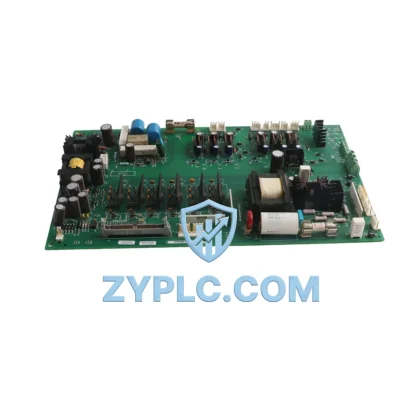
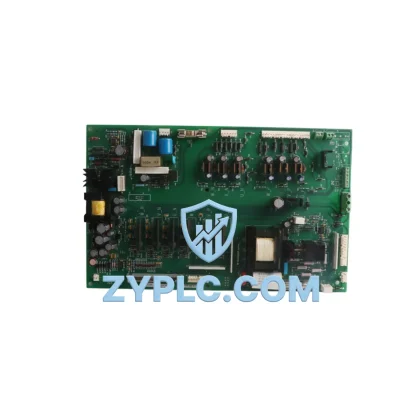
ABB SDCS-FEX-4A 3ADT314500R1501 Energy-Saving DC Drive Excitation Board for Optimized DCS Series Automation
The ABB SDCS-FEX-4A (Part No. 3ADT314500R1501) is a field excitation control board engineered for ABB’s DCS400, DCS500, and DCS600 series DC drive platforms. In modern industrial environments where energy efficiency directly impacts operating costs and carbon footprint, the SDCS-FEX-4A plays a critical role in regulating field current with precision, ensuring that DC motors operate at their optimal flux point rather than drawing excess power during partial-load or variable-speed conditions. By maintaining accurate field excitation, this board prevents over-excitation losses — one of the most overlooked sources of energy waste in legacy DC motor systems.
For factories running continuous production lines, the SDCS-FEX-4A integrates seamlessly into the DCS500 and DCS600 drive architecture, working in coordination with the SDCS-CON-4 control board and SDCS-POW-4 power supply board to form a complete, closed-loop DC drive system. This tight hardware integration reduces signal latency between excitation control and armature regulation, enabling faster torque response and smoother speed transitions — both of which contribute directly to reduced mechanical stress and lower energy consumption per production cycle.
Efficiency Performance Table
| Parameter |
Specification / Value |
| Part Number |
SDCS-FEX-4A / 3ADT314500R1501 |
| Compatible Drive Series |
ABB DCS400, DCS500, DCS600 |
| Function |
Field Excitation Control |
| Rated Field Current Output |
Up to 6A (field circuit regulation) |
| Operating Voltage |
230V / 400V AC input compatible |
| Power Consumption (Board) |
Low-standby design, <5W idle draw |
| Drive Efficiency Contribution |
Optimizes motor flux for IE3/IE4-class DC motor efficiency |
| Compatible Systems |
DCS500 with SDCS-CON-4, SDCS-POW-4; DCS600 multi-drive systems |
| Application Environment |
Steel mills, paper machines, cranes, extruders, winders |
| Energy Saving Value |
Eliminates over-excitation losses; supports field-weakening for speed range extension |
| Condition |
New / Refurbished (Tested & Verified) |
| Warranty |
12-Month Warranty |
| Origin |
Germany (ABB Manufacturing) |
Energy-Aware Automation Architecture
The SDCS-FEX-4A does not operate in isolation — its energy optimization value is fully realized when deployed within a well-structured automation architecture. In a typical DCS500-based drive system, the excitation board receives field current commands from the SDCS-CON-4 main control board, which itself processes speed and torque references from an upstream PLC such as the ABB AC500 PM573 or a Siemens S7-300 CPU 315-2DP. The PLC sends setpoints via PROFIBUS-DP or Modbus RTU, and the SDCS-CON-4 translates these into precise field and armature control signals.
On the power side, the SDCS-POW-4 provides the regulated 24VDC logic supply to the control and excitation boards, ensuring stable operation even during line voltage fluctuations — a common cause of unnecessary drive trips and energy-wasting restarts. For multi-drive installations such as paper machine sections or steel rolling lines, the SDCS-COM-8 communication board enables coordinated speed control across multiple DCS600 drives, allowing the excitation profiles of each motor to be synchronized for optimal energy distribution across the line.
Energy monitoring is equally important. Integrating the drive system with an ABB M2M energy meter or a Schneider Electric PowerLogic PM5000 power quality meter at the MCC panel allows plant engineers to measure actual kWh consumption per drive axis, compare it against production output, and identify axes where field excitation tuning can yield further savings. On the HMI side, an ABB CP600 operator panel or Siemens TP700 Comfort panel provides real-time visibility into drive status, field current levels, and alarm states — enabling operators to respond to efficiency deviations before they escalate into unplanned downtime.
For I/O integration, the SDCS-IOB-3 I/O extension board expands the analog and digital I/O capacity of the DCS500 system, supporting additional feedback signals from tachometers, encoders, or thermal sensors mounted on the motor. This feedback loop is essential for predictive maintenance strategies — by monitoring motor temperature trends alongside field current data, maintenance teams can schedule bearing replacements or winding inspections during planned shutdowns rather than reacting to failures mid-production.
Power Optimization in Real Production Lines
In heavy industrial applications — steel wire drawing, rubber extrusion, paper coating, or crane hoist systems — DC motors controlled by DCS500 or DCS600 drives are often running at variable loads throughout the shift. Without precise field excitation control, motors tend to operate at fixed flux levels regardless of load, resulting in unnecessary iron losses and heat generation. The SDCS-FEX-4A addresses this directly by enabling dynamic field weakening: as motor speed increases beyond base speed, the board reduces field current proportionally, allowing the motor to extend its speed range without increasing armature voltage — a technique that can reduce energy consumption by 8–15% in variable-speed applications compared to fixed-field operation.
In winder and unwinder applications, where tension control requires frequent acceleration and deceleration cycles, the SDCS-FEX-4A’s fast field current response minimizes the energy lost during flux build-up transients. Combined with regenerative braking capability in the DCS600 four-quadrant drive configuration, kinetic energy from decelerating loads is fed back to the supply network rather than dissipated as heat in braking resistors — a measurable reduction in both energy cost and cooling load for the drive cabinet.
From a maintenance cost perspective, accurate field excitation also extends motor winding life. Over-excitation accelerates insulation degradation; under-excitation causes instability and hunting. The SDCS-FEX-4A’s closed-loop field regulation keeps excitation within the motor’s design envelope, reducing thermal stress and extending mean time between failures (MTBF). For plant managers tracking OEE (Overall Equipment Effectiveness), fewer unplanned motor failures directly translate to higher equipment availability and lower maintenance labor costs per production unit.
Every SDCS-FEX-4A unit supplied by ZYPLC undergoes full functional testing on a live DCS500 test bench prior to shipment, including field current ramp testing, thermal cycling, and communication interface verification. Units are shipped with test reports and are covered by a 12-month warranty from the date of delivery, with in-stock availability supporting fast dispatch to minimize production downtime for urgent replacement needs.
Energy Optimization FAQ
Q1: How does the SDCS-FEX-4A contribute to energy savings compared to a standard excitation board?
The SDCS-FEX-4A supports dynamic field weakening and closed-loop field current regulation, which eliminates the over-excitation losses common in fixed-field configurations. In variable-speed applications, this can reduce motor iron losses by 8–15%, depending on the load profile and speed range.
Q2: Is the SDCS-FEX-4A compatible with both DCS500 and DCS600 drive systems?
Yes. The SDCS-FEX-4A (3ADT314500R1501) is designed for use across the ABB DCS400, DCS500, and DCS600 series. It interfaces with the SDCS-CON-4 control board and is compatible with both single-drive and multi-drive system configurations using the SDCS-COM-8 communication board.
Q3: What is the recommended replacement procedure, and how long does it take?
Replacement typically involves powering down the drive, removing the existing excitation board from its connector slot, inserting the SDCS-FEX-4A, and verifying field current parameters via the drive’s commissioning tool (DriveWindow or DCS Control Panel). The process generally takes 30–60 minutes for a trained drive technician. ZYPLC recommends verifying field current calibration after installation.
Q4: What warranty and testing does ZYPLC provide with the SDCS-FEX-4A?
All SDCS-FEX-4A units are tested on a live DCS500 test bench covering field current output, thermal performance, and communication interface integrity. Each unit ships with a test report and is backed by a 12-month warranty from the date of delivery. In-stock units are available for same-day or next-day dispatch to minimize production downtime.
© 2026 ZYPLC. All rights reserved.
Original Source: https://zyplc.com
Contact: +86 19859288691 | plc.sales@zyplc.com