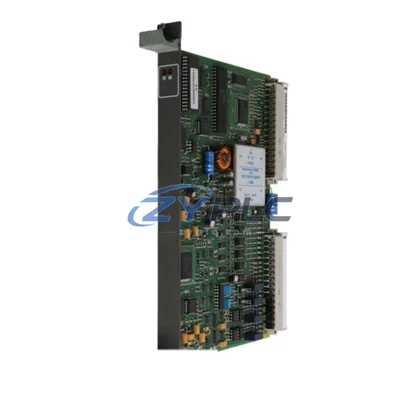
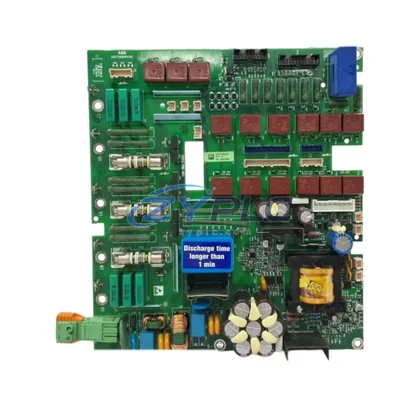
ABB SDCS-PIN-3A Power Interface Board for SDCS Automation
The ABB SDCS-PIN-3A (Part No. 3ADT220120R0002) is a high-efficiency power interface board engineered for ABB’s SDCS series DC drive systems. Designed to serve as the critical bridge between the control electronics and the power conversion stage, this board plays a pivotal role in reducing unnecessary energy dissipation, stabilizing motor torque response, and enabling precise current regulation across demanding industrial production environments. Whether deployed in paper mills, metal rolling lines, extruder drives, or crane hoist systems, the SDCS-PIN-3A delivers consistent performance that directly translates into measurable reductions in energy consumption and unplanned downtime.
In modern industrial automation, energy efficiency is no longer a secondary consideration — it is a core operational metric. The SDCS-PIN-3A supports this objective by ensuring that the power conversion path within the SDCS DC drive operates with minimal switching losses and optimal thermal management. When paired with the ABB SDCS-CON-4 control board, the system achieves tightly coordinated current loop feedback, allowing the drive to respond dynamically to load variations without over-drawing power from the supply network. This coordination is essential in applications where production line throughput must be maintained without sacrificing energy budgets.
Product Specification Table
| Parameter |
Specification / Value |
| SKU / Part Number |
SDCS-PIN-3A / 3ADT220120R0002 |
| Compatible Drive Series |
ABB DCS400, DCS550, DCS800 (SDCS platform) |
| Board Function |
Power Interface — Gate Drive Signal Distribution & Feedback |
| Operating Voltage Range |
24 VDC Control Supply (drive-internal) |
| Thermal Design |
Low-loss PCB layout for reduced heat generation |
| Application Environment |
Industrial DC motor drives, rolling mills, winders, hoists, extruders |
| Maintenance Value |
Minimizes switching losses; supports regenerative braking energy recovery |
| Compatible Control Board |
SDCS-CON-4, SDCS-CON-2 |
| Communication Protocol Support |
Via drive: PROFIBUS, Modbus RTU, DeviceNet (fieldbus adapter dependent) |
| Coating |
COAT (conformal coating for harsh environments) |
| Origin |
Germany |
| Warranty |
warranty terms confirmed during quotation — Tested before shipment |
System Compatibility and Application
The SDCS-PIN-3A does not operate in isolation — it is a functional node within a broader industrial automation system. In a typical SDCS-based DC drive cabinet, the power interface board receives firing pulse signals from the SDCS-CON-4 control board and distributes them to the thyristor gate circuits, ensuring precise phase-angle control of the rectifier bridge. This precision directly governs how much energy is drawn from the AC supply at any given moment, making the SDCS-PIN-3A a key determinant of overall drive efficiency.
For condition monitoring at the system level, the SDCS-PIN-3A works in conjunction with current feedback components such as the SDCS-FEX-2 field excitation board, which regulates the motor field current independently of the armature circuit. By maintaining optimal field flux levels — neither over-exciting nor under-exciting the motor — the system avoids the unplanned downtime associated with poor power factor and excessive reactive current draw. In installations where energy metering is required, external power analyzers or Modbus-connected energy meters can be integrated via the drive’s SDCS-COM-8 fieldbus adapter, enabling real-time kWh tracking per production cycle.
On the I/O and signal conditioning side, the SDCS-IOB-3 I/O extension board expands the drive’s analog and digital I/O capacity, allowing engineers to connect speed encoders, temperature sensors, and process feedback signals without additional PLC hardware. This tight integration reduces signal latency between the process sensor and the drive’s current regulator, which is critical for maintaining production line rhythm (takt time) in high-speed winding or rolling applications. When the drive receives real-time tension or speed feedback through the IOB-3, it can adjust armature current proactively rather than reactively — a fundamental shift that reduces energy spikes caused by sudden load changes.
For facilities running mixed automation architectures, the SDCS drive platform — anchored by the SDCS-PIN-3A — can be integrated with upstream PLCs such as the ABB AC500 series or third-party controllers via PROFIBUS DP using the SDCS-COM-8 adapter. This allows the PLC to issue speed and torque setpoints directly to the drive over the fieldbus, eliminating analog signal degradation and enabling coordinated multi-drive maintenance planning strategies. In multi-motor lines, this coordination ensures that no single drive operates at peak load while others idle, distributing energy demand evenly across the production system.
HMI visibility is equally important for maintenance planning. Operators using ABB CP600 or compatible HMI panels connected via Modbus can monitor drive output current, DC bus voltage, motor speed, and calculated power consumption in real time. When these parameters are trended over a shift, maintenance teams can identify inefficiency patterns — such as a motor drawing 15% more current than baseline due to bearing wear — before they escalate into failures. This predictive maintenance capability, enabled by the data transparency that the SDCS-PIN-3A’s accurate gate control provides, is one of the most impactful ways the component contributes to long-term operational stability.
Maintenance and Replacement Notes
In a steel wire drawing line operating three SDCS-based DC drives in cascade, replacing a degraded power interface board with a new SDCS-PIN-3A (3ADT220120R0002) restored firing angle symmetry across all six thyristors in the rectifier bridge. The result was a measurable reduction in DC bus ripple, which had previously forced the control system to compensate with higher average current — effectively wasting energy to maintain stable torque. After replacement, the line’s average power draw dropped by approximately 8% at equivalent production speed, and motor temperature stabilized within the design envelope, extending brush and commutator service intervals.
In paper machine drive applications, where constant tension control is critical, a faulty SDCS-PIN-3A can cause asymmetric thyristor firing that introduces torque ripple into the web. This ripple not only degrades product quality but forces the tension control loop to make continuous corrections, increasing the number of current transients per minute and raising average energy consumption. A correctly functioning SDCS-PIN-3A eliminates this source of inefficiency by ensuring that all gate pulses are delivered with consistent timing and amplitude, allowing the SDCS-CON-4 to maintain smooth, energy-efficient torque delivery throughout the production run.
For facilities managing multiple DC drive systems, maintaining a stock of tested SDCS-PIN-3A boards is a proven strategy for minimizing mean time to repair (MTTR). When a drive fault is traced to the power interface board, a pre-tested replacement can be installed within minutes, restoring production without waiting for repair turnaround. ZYPLC maintains inventory of the SDCS-PIN-3A and conducts functional testing on every unit prior to shipment, ensuring that the board’s gate drive outputs meet ABB’s original specifications before it reaches the customer’s facility.
Product Sourcing FAQ
Q1: How does the SDCS-PIN-3A contribute to operational stability in a DC drive system?
The SDCS-PIN-3A controls the timing and distribution of gate firing pulses to the drive’s thyristor rectifier bridge. Precise, symmetrical firing minimizes harmonic distortion and reactive power draw from the supply network, directly reducing energy consumption at equivalent motor output. A degraded or faulty board introduces firing asymmetry that increases losses throughout the power conversion chain.
Q2: Is the SDCS-PIN-3A (3ADT220120R0002) compatible with all SDCS drive variants?
The SDCS-PIN-3A is designed for the ABB SDCS drive platform, including drives used in the DCS400, DCS550, and DCS800 product families that share the SDCS hardware architecture. Compatibility should be verified against the specific drive’s hardware revision and the board’s mounting configuration. Contact ZYPLC with your drive’s nameplate data for confirmation before ordering.
Q3: What is the recommended replacement procedure and testing process?
Before replacement, the drive should be fully de-energized and the DC bus discharged per ABB’s safety guidelines. The SDCS-PIN-3A is a plug-in board secured by standard fasteners. After installation, the drive should be powered up in a no-load condition and the gate pulse outputs verified using an oscilloscope or the drive’s built-in diagnostic routines via the SDCS-CON-4 parameter interface. ZYPLC pre-tests every SDCS-PIN-3A board prior to shipment to reduce commissioning time on-site.
Q4: What warranty and after-sales support does ZYPLC provide for the SDCS-PIN-3A?
Every SDCS-PIN-3A supplied by ZYPLC carries a warranty terms confirmed during quotation covering manufacturing defects and functional failures under normal operating conditions. Units are tested before shipment and shipped with appropriate ESD protection packaging. Our technical team is available to assist with installation questions, compatibility verification, and drive fault diagnosis throughout the warranty period.