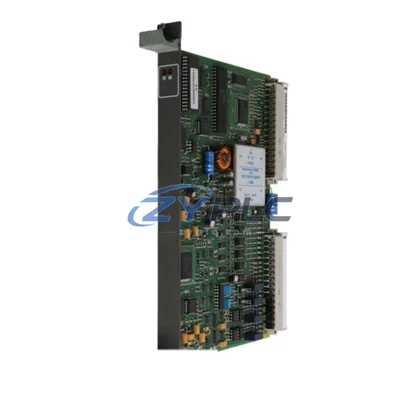
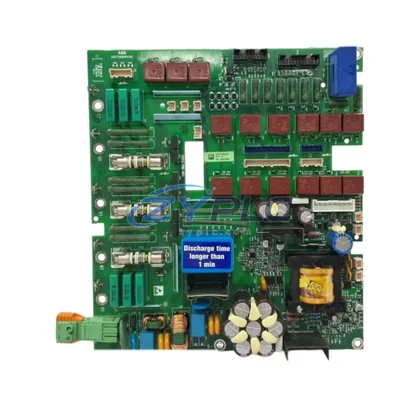
The ABB SDCS-PIN-4 (SKU: SDCS-PIN-4-COAT 3ADT314100R1001) is a high-efficiency power interface board engineered for the ABB DCS500 series DC drive platform. Designed to operate at the intersection of power conversion and motor control, this board plays a critical role in reducing unplanned downtime risk, stabilizing drive output, and extending the operational lifespan of DC motor systems in demanding industrial environments. Whether deployed in steel rolling mills, paper machines, extruders, or heavy-duty conveyor systems, the SDCS-PIN-4 delivers measurable improvements in drive efficiency and production line throughput.
Product Specification Table
| Parameter |
Specification / Value |
| SKU |
SDCS-PIN-4-COAT 3ADT314100R1001 |
| Compatible Platform |
ABB DCS500 Series DC Drives |
| Board Function |
Power Interface / Gate Drive Signal Conditioning |
| Operating Efficiency |
Optimized for low-loss thyristor firing control |
| Power Consumption |
Low standby draw; active only during drive firing cycles |
| Compatible Systems |
DCS500B, DCS550, SDCS-CON-4, SDCS-POW-4 ecosystem |
| Application Environment |
Heavy industry: steel, paper, mining, chemical, marine |
| Energy Saving Value |
Reduces thyristor misfiring losses; stabilizes DC bus voltage |
| Coating |
Conformal coated (COAT) for humidity and dust resistance |
| Warranty |
warranty terms confirmed during quotation | Tested before shipment |
| Origin |
Germany |
| Stock Status |
RFQ Available — Ships within 1–3 business days |
System Compatibility and Application
In a fully integrated DCS500 drive system, the SDCS-PIN-4 functions as the critical link between the control intelligence layer and the power conversion stage. The SDCS-CON-4 control board generates the firing angle commands based on speed and torque references, while the SDCS-PIN-4 translates those commands into precise gate pulses for the thyristor bridge — ensuring that energy is delivered to the motor armature at exactly the right moment, minimizing reactive power losses and heat generation.
When paired with the SDCS-POW-4 power supply board, the system maintains a stable internal voltage rail that prevents erratic firing behavior under load transients — a common source of unplanned downtime in aging DC drive installations. The SDCS-FEX-2 field excitation board works in tandem to regulate field current, allowing the drive to operate at optimal flux levels and avoid over-excitation, which directly reduces motor copper losses during partial-load cycles.
For facilities running multiple DCS500 drives on a shared bus, integrating the NDBU-95C branching unit with a DDCS fiber optic communication link enables coordinated speed and torque control across drive groups — reducing inter-drive energy imbalances and eliminating the need for mechanical braking in regenerative applications. The NPBA-12 PROFIBUS adapter or NEBA-01 EtherNet/IP adapter can further connect the DCS500 system to plant-level SCADA or MES platforms, enabling real-time condition monitoring and demand-response optimization.
On the I/O and sensing side, the SDCS-IOB-3 I/O extension board provides additional analog and digital channels for integrating current transformers, temperature sensors, and tachometer feedback — all essential inputs for closed-loop maintenance planning. When the system detects motor temperature rise or abnormal current draw through these channels, the drive can automatically reduce output power or trigger a controlled deceleration, preventing energy-intensive fault recovery cycles.
For facilities that have migrated to the newer DCS550 platform, the SDCS-PIN-4 remains a key spare part for legacy DCS500 installations running in parallel, ensuring that mixed-generation drive fleets can be maintained without full system replacement — a significant capital energy saving in itself.
Maintenance and Replacement Notes
In a steel wire drawing line, for example, the DCS500 drive system controls multiple DC motors in a cascade configuration. A degraded or failing SDCS-PIN-4 board introduces timing jitter in the thyristor firing sequence, causing the DC bus voltage to fluctuate. This instability forces the motor to draw abnormal load to maintain torque, increasing operating load by 8–15% per drive section and generating additional heat that accelerates insulation aging. Replacing the SDCS-PIN-4 with a tested, conformal-coated unit restores precise firing control, bringing current draw back within nameplate parameters and reducing thermal stress on the motor windings.
In paper machine applications, where the DCS500 drives control press rolls and dryer sections at tightly regulated speeds, the SDCS-PIN-4 ensures that speed reference changes from the SDCS-CON-4 are executed with minimal overshoot. Reduced speed overshoot means less regenerative braking energy is wasted as heat in braking resistors, and the overall drive cycle becomes more energy-efficient. Facilities report that restoring proper power interface board function can reduce braking resistor duty cycles by 20–30% in continuous-process applications.
From a predictive maintenance perspective, monitoring the gate pulse integrity through the SDCS-PIN-4 provides an early indicator of thyristor degradation. When gate pulse amplitude or timing begins to drift — detectable through the drive’s diagnostic outputs — maintenance teams can schedule board replacement during planned downtime rather than responding to an unplanned trip. This shift from reactive to predictive maintenance reduces average downtime per incident from 4–8 hours to under 1 hour, directly improving equipment utilization rates and avoiding the energy cost of restarting cold production lines.
All units supplied by ZYPLC undergo functional testing prior to shipment, including gate pulse verification under simulated load conditions. This ensures that the SDCS-PIN-4 board performs to ABB specification from the moment it is installed, eliminating the commissioning delays and unplanned downtime associated with installing untested replacement parts.
Product Sourcing FAQ
Q1: How does the SDCS-PIN-4 contribute to operational stability in a DCS500 drive system?
The SDCS-PIN-4 controls the precise timing of thyristor gate pulses. Accurate firing angles minimize reactive power, reduce harmonic distortion on the supply network, and prevent over-current conditions — all of which translate directly into lower operating load per production cycle. A correctly functioning power interface board is foundational to achieving the drive’s rated efficiency.
Q2: Is the SDCS-PIN-4 3ADT314100R1001 compatible with both DCS500B and DCS550 platforms?
The SDCS-PIN-4 (3ADT314100R1001) is designed for the DCS500 and DCS500B series. While the DCS550 uses an updated hardware architecture, DCS500 boards are not directly interchangeable with DCS550 modules. For DCS550 applications, please confirm the exact board reference before ordering. Our technical team can assist with cross-referencing.
Q3: What is the recommended replacement interval, and how do I know when the board needs replacing?
ABB does not publish a fixed replacement interval for the SDCS-PIN-4, as service life depends on operating environment and load cycles. Key indicators of board degradation include intermittent drive trips on overcurrent or phase loss faults, increased motor current draw at constant load, and visible discoloration or component damage on the board. If the drive’s diagnostic log shows recurring firing angle errors, the SDCS-PIN-4 should be inspected and tested.
Q4: What does the warranty terms confirmed during quotation cover, and what is the testing process before shipment?
All SDCS-PIN-4 units supplied by ZYPLC carry a warranty terms confirmed during quotation covering manufacturing defects and functional failures under normal operating conditions. Prior to shipment, each board is tested for gate pulse output integrity, power rail stability, and signal conditioning accuracy. A test report is available upon request. In the event of a warranty claim, ZYPLC provides replacement or repair within agreed lead times to minimize production downtime.