ABB SNAT7120 Industrial Network Interface for ACS600 Systems: Bridging the Drive Communication Data Link
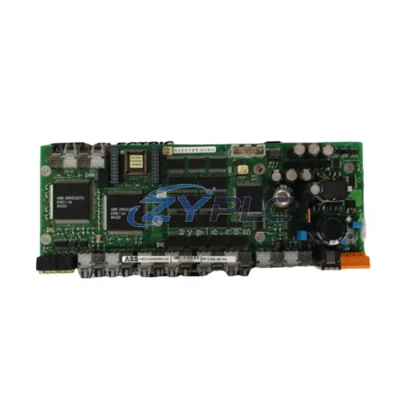
The ABB SNAT7120 is a DDCS (Distributed Drive Communication System) gate driver and communication board engineered for seamless integration within ABB ACS600 and DCS600 series variable frequency drive platforms. As industrial automation networks evolve toward fully connected smart factory architectures, the SNAT7120 serves as a critical node in the data chain — enabling real-time signal exchange between field-level drive hardware and upper-level control systems including PLCs, SCADA platforms, HMI terminals, and remote diagnostic gateways.
Designed to operate within ABB’s proprietary DDCS fiber optic communication protocol, the SNAT7120 provides a high-speed, noise-immune data pathway that is essential in environments where electromagnetic interference from high-power drives, motors, and switching equipment would otherwise compromise copper-based communication links. Its fiber optic interface ensures signal integrity across long cable runs in large-scale industrial facilities, making it a preferred solution for steel mills, paper machines, marine propulsion systems, and heavy process industries.
Compatibility & Integration Notes
| Parameter |
Specification |
| Communication Protocol |
DDCS (Distributed Drive Communication System) – ABB Fiber Optic |
| Interface Type |
Fiber Optic (DDCS), Gate Driver Signal Interface |
| Transmission Capability |
High-speed real-time drive control and status data exchange |
| Network Compatibility |
ABB ACS600, DCS600, ACS800 (via adapter), NDCO-03, RDCO-03C |
| System Application |
VFD Control, PLC Integration, SCADA Monitoring, Remote Diagnostics |
| Compatible Controllers |
ABB AC500 PLC, RMIO-01C, OPMP-01, NINT-46C, RETA-02 |
| Product Type |
Industrial Communication Module / Gate Driver Board |
| Origin |
Germany (ABB Manufacturing) |
| Warranty |
warranty terms confirmed during quotation – Factory Tested Before Shipment |
Connected Automation Data Flow
In a typical smart factory deployment, the SNAT7120 sits at the heart of the drive communication architecture. Field-level sensors — including temperature transmitters, current transducers, and encoder feedback modules — feed real-time process data into the ACS600 drive. The SNAT7120 board then relays this data upstream via the DDCS fiber optic ring to the NDCO-03 communication option board, which bridges the drive network to higher-level fieldbus systems such as PROFIBUS-DP or Modbus TCP.
From there, the ABB AC500 PLC receives structured process variables — motor speed, torque reference, fault codes, and thermal status — and executes closed-loop control logic. The RMIO-01C motor control board works in tandem with the SNAT7120 to manage gate firing sequences and ensure precise IGBTs switching, directly impacting drive efficiency and output waveform quality. Simultaneously, the OPMP-01 panel interface module provides local HMI access, allowing operators on the plant floor to monitor drive status without interrupting the DDCS communication ring.
For multi-drive systems, the RDCO-03C DDCS communication option board extends the fiber optic ring to additional ACS600 units, enabling coordinated control across multiple axes or process sections. This ring topology, supported by the SNAT7120’s robust communication stack, ensures that a single node failure does not collapse the entire network — a critical requirement in continuous process industries where unplanned downtime carries significant financial consequences.
At the SCADA level, the RETA-02 Ethernet adapter module translates DDCS data into standard Ethernet/IP or Modbus TCP packets, making drive data accessible to ABB Ability™ SCADA and third-party supervisory platforms. This integration enables plant-wide dashboards displaying real-time KPIs, energy consumption trends, and predictive maintenance alerts derived from drive-level diagnostics. The NINT-46C network interface card further extends connectivity options, supporting integration with legacy DCS environments where older communication standards remain in use.
The result is a fully transparent data flow: from the IGBT gate signals managed by the SNAT7120, through the DDCS fiber ring, across the PLC control layer, and up to the SCADA and MES systems — all without data isolation or protocol mismatch. Every layer of the automation pyramid receives the information it needs, in the format it requires, at the speed industrial processes demand.
Solving Data Isolation in Industrial Sites
One of the most persistent challenges in industrial automation is the fragmentation of communication protocols across different equipment generations and vendors. Legacy drives may speak only proprietary serial protocols, while modern PLCs and SCADA systems expect Ethernet-based data. The SNAT7120, as part of ABB’s DDCS ecosystem, addresses this by providing a standardized, high-reliability communication backbone that can be bridged to virtually any upper-level system through ABB’s range of protocol adapter modules.
Data isolation — where drive-level fault data, energy consumption figures, and process variables remain trapped within the drive and never reach the control room — is eliminated when the SNAT7120 is properly integrated. Plant engineers gain full visibility into drive health, enabling condition-based maintenance strategies that reduce unplanned downtime by identifying developing faults before they cause production stoppages. Remote diagnostics become possible through the SCADA gateway, allowing ABB service engineers or in-house automation teams to interrogate drive parameters and fault logs without physical access to the switchgear room.
For production line transparency, the SNAT7120 enables real-time tracking of motor load, speed reference versus actual speed, and energy consumption per production cycle. This data feeds directly into MES and ERP systems, supporting OEE (Overall Equipment Effectiveness) calculations and energy management reporting. As factories scale — adding new drive sections, expanding production lines, or integrating additional process equipment — the DDCS ring topology supported by the SNAT7120 accommodates system expansion without requiring a complete network redesign.
All units are factory-tested prior to shipment, with full functional verification of the DDCS communication interface and gate driver signal paths. Stock is maintained for shipment arranged after confirmation, supporting both planned maintenance schedules and emergency replacement requirements. A warranty terms confirmed during quotation covers all SNAT7120 units, providing procurement teams and maintenance engineers with the confidence needed for critical infrastructure purchases.
Industrial Connectivity FAQ
Q1: What communication protocol does the ABB SNAT7120 use, and is it compatible with standard fieldbus systems?
The SNAT7120 operates on ABB’s proprietary DDCS (Distributed Drive Communication System) fiber optic protocol, which is native to the ACS600 and DCS600 drive platforms. Direct connection to standard fieldbus systems such as PROFIBUS, Modbus, or Ethernet/IP requires an adapter module such as the NDCO-03 or RETA-02, which translate between DDCS and the target fieldbus protocol.
Q2: How does the SNAT7120 ensure network stability in high-EMI industrial environments?
The fiber optic communication interface of the SNAT7120 is inherently immune to electromagnetic interference, making it suitable for installation in close proximity to high-power drives, transformers, and switching equipment. The DDCS ring topology also provides redundancy — if one segment of the fiber ring is interrupted, the network can continue operating in a degraded mode, maintaining drive control and data communication.
Q3: Can the SNAT7120 support system expansion when additional drives are added to the network?
Yes. The DDCS fiber optic ring architecture supported by the SNAT7120 is designed for scalability. Additional ACS600 drives equipped with RDCO-03C communication option boards can be added to the ring without disrupting existing nodes. The AC500 PLC controller can be configured to recognize and communicate with new drive nodes through standard DDCS addressing, making system expansion straightforward.
Q4: What does the warranty terms confirmed during quotation cover, and how are units tested before shipment?
Every SNAT7120 unit undergoes functional testing of the gate driver signal interface and DDCS communication port prior to shipment. The warranty terms confirmed during quotation covers manufacturing defects and component failures under normal operating conditions. Units are shipped with test documentation upon request, and our technical team provides post-sale support for integration and commissioning queries.