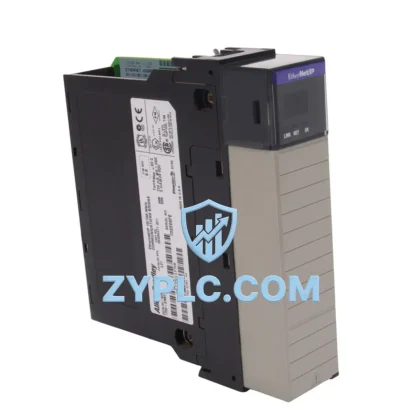
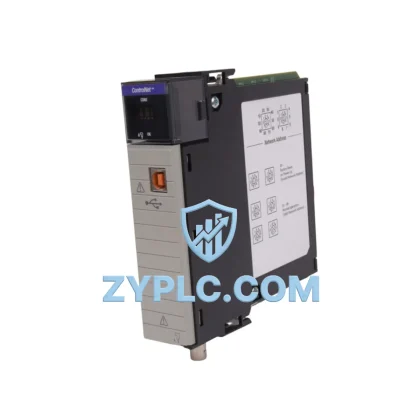
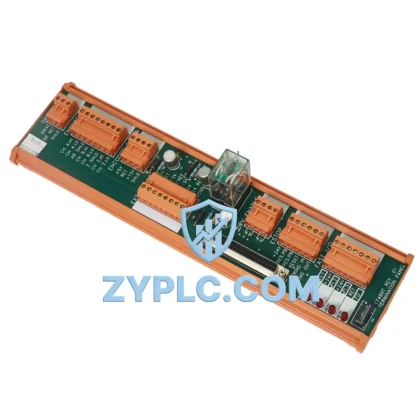
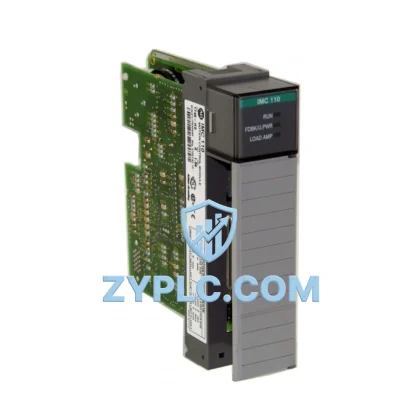
ABB TB840 3BSE021456R1 System-Ready Modulebus Cluster Modem for AC800M Control System Architecture
The ABB TB840 (3BSE021456R1) is a Modulebus Cluster Modem designed as a critical communication backbone component within the ABB AC800M distributed control system platform. Rather than functioning as a standalone device, the TB840 operates at the intersection of the control layer and the I/O layer, enabling high-integrity, deterministic data exchange across multi-cluster DCS architectures. Its role is to extend the Modulebus network beyond a single controller cabinet, allowing engineering teams to distribute I/O clusters across physical distances while maintaining synchronous, low-latency communication with the AC800M CPU modules.
In large-scale process automation environments — including power generation, petrochemical refining, water treatment, metallurgical processing, and continuous manufacturing — the ability to expand I/O capacity without compromising control loop integrity is a fundamental engineering requirement. The TB840 addresses this by providing a reliable optical or electrical Modulebus extension path, ensuring that remote I/O clusters remain tightly coupled to the central control logic executed by the PM861, PM864, or PM866 processor modules. This architecture eliminates the latency and topology constraints that would otherwise limit system scalability.
Architecture Specification Table
| Parameter |
Specification |
| Part Number |
TB840 / 3BSE021456R1 |
| Brand |
ABB |
| Series / Platform |
AC800M DCS |
| Module Function |
Modulebus Cluster Modem (I/O Cluster Extension) |
| System Role |
Communication Bridge — Control Layer to Remote I/O Cluster |
| Communication Interface |
Modulebus (ABB proprietary high-speed I/O bus) |
| Topology Support |
Multi-cluster, extended Modulebus architecture |
| Redundancy Capability |
Supports redundant Modulebus configurations |
| Power Supply |
Supplied via S800 I/O station / TB807 or TB840 cluster base |
| Mounting |
DIN rail / S800 I/O cluster base unit |
| Operating Temperature |
0°C to +55°C (standard industrial range) |
| Origin |
Sweden (ABB Automation Products) |
| Warranty |
12-Month Warranty — Covered by ZYPLC Quality Assurance Program |
| Condition |
New / Tested Surplus / Refurbished (as specified at order) |
Coordinated Control System Design
The TB840 3BSE021456R1 achieves its full engineering value only when understood within the context of a complete AC800M control system architecture. At the control layer, the PM864 or PM866 CPU modules execute the application logic and manage all Modulebus communication cycles. The TB840 acts as the physical and logical bridge that extends this communication to remote S800 I/O clusters, which may be located in separate marshalling cabinets or field junction boxes tens of meters away from the main controller rack.
Within the I/O layer, the TB840 interfaces directly with S800 I/O modules such as the AI810 analog input module, the AO810 analog output module, the DI810 digital input module, and the DO810 digital output module. These modules are mounted on TB807 or TB820 cluster base units, and the TB840 provides the Modulebus modem function that allows the AC800M CPU to address each I/O channel as if it were locally connected. This transparent extension is essential for maintaining deterministic scan times across large I/O counts.
For redundancy-critical applications, the TB840 supports dual-modem configurations where two TB840 units operate in parallel across redundant Modulebus paths. This mirrors the redundancy architecture of the PM864 CPU module itself, ensuring that a single point of failure in the communication path does not interrupt process control. The SD821 or SD822 power supply modules provide the stable 24VDC rail required by the I/O cluster, and their health status is monitored continuously by the AC800M system diagnostics.
At the network layer, the AC800M communicates upstream with SCADA systems and engineering workstations via the SC510 communication interface module or through the built-in Ethernet port of the PM866 CPU. The TB840’s role is entirely within the lower Modulebus layer, but its reliability directly affects the quality of process data available at the PROFIBUS DP, FOUNDATION Fieldbus, or Industrial Ethernet network layers above it. Any communication degradation at the Modulebus level propagates upward, making the TB840 a foundational component for overall system data integrity.
From a human-machine interface perspective, operators interacting with ABB’s System 800xA or third-party SCADA platforms depend on accurate, real-time I/O data that originates from the S800 modules connected through the TB840. Panel 800 operator terminals or third-party HMI systems display process variables whose accuracy is contingent on uninterrupted Modulebus communication. Engineering teams commissioning new control loops or troubleshooting process deviations rely on the TB840’s stable operation to ensure that diagnostic data from field instruments reaches the controller without corruption or delay.
Application in Layered Automation Systems
Power Generation & Utilities: In combined-cycle power plants and hydroelectric facilities, the AC800M platform with TB840 cluster modems manages turbine control, boiler management, and auxiliary systems. The ability to distribute I/O clusters across large turbine halls while maintaining tight control loop timing is a key operational requirement that the TB840 directly enables.
Petrochemical & Refining: Continuous process plants require DCS architectures with high availability and fault tolerance. The TB840’s support for redundant Modulebus paths ensures that reactor temperature control, distillation column management, and compressor sequencing remain unaffected by individual component failures. Its compatibility with SIL-rated safety instrumented systems makes it suitable for integration adjacent to safety layers.
Water & Wastewater Treatment: Municipal water treatment facilities operating AC800M-based control systems use TB840 modems to connect remote pump station I/O to central control rooms. The extended Modulebus topology eliminates the need for additional remote PLCs, reducing system complexity and long-term maintenance overhead.
Metallurgy & Mining: Smelting operations, ore processing plants, and mine ventilation systems demand robust communication infrastructure capable of operating in high-vibration, high-temperature environments. The TB840’s industrial-grade design and compatibility with the AC800M’s proven reliability record make it a preferred choice for these demanding applications.
Packaging & Discrete Manufacturing: High-speed packaging lines and assembly systems using AC800M controllers benefit from the TB840’s ability to consolidate distributed I/O without introducing additional network hops. This simplifies the control architecture and reduces the number of communication failure points in high-throughput production environments.
Architecture Engineering FAQ
Q1: How many TB840 units can be connected in a single AC800M Modulebus cluster chain, and does adding multiple units affect control loop scan times?
The AC800M Modulebus architecture supports multiple cluster extensions using TB840 modems, with the exact number of clusters per CPU determined by the specific PM8xx processor model and its Modulebus port configuration. Each additional cluster introduces a defined, bounded communication cycle increment that is accounted for in the AC800M’s deterministic scheduling. Engineering teams should consult the AC800M Hardware Configuration manual (3BSE041434) to calculate total Modulebus cycle time for their specific I/O count and cluster topology before finalizing cabinet layouts.
Q2: Is the TB840 3BSE021456R1 compatible with both redundant and non-redundant AC800M CPU configurations, and what additional hardware is required for full redundancy?
Yes, the TB840 is compatible with both simplex and redundant AC800M architectures. In a redundant configuration, two TB840 units are installed — one per Modulebus path — and operate in active/standby mode coordinated by the redundant PM864 or PM866 CPU pair. The TB840 itself does not require additional configuration for redundancy; the switchover logic is managed at the CPU level. Customers implementing redundant architectures should also ensure that the SD822 power supply modules and TB807 cluster bases are specified for dual-feed operation to achieve full system redundancy.
Q3: What does the 12-Month Warranty cover for the TB840 3BSE021456R1, and what support is available during the warranty period?
All TB840 3BSE021456R1 units supplied by ZYPLC are covered by a 12-Month Warranty that includes functional testing verification, DOA (Dead on Arrival) replacement, and technical support for installation and commissioning queries. Units are tested against ABB’s published electrical and communication specifications prior to shipment. In the event of a warranty claim, ZYPLC provides advance replacement or repair service to minimize control system downtime. For warranty claims or pre-sales technical consultation, contact ZYPLC at +86 19859288691 or plc.sales@zyplc.com.
© 2026 ZYPLC. All rights reserved.
Original Source: https://zyplc.com
Contact: +86 19859288691 | plc.sales@zyplc.com