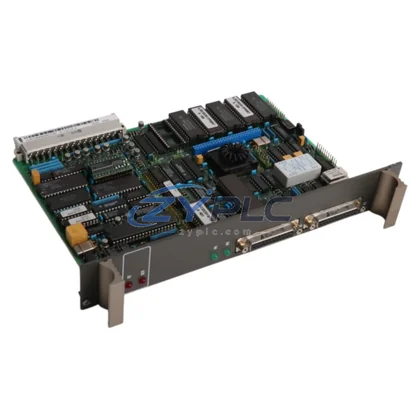
The ABB YPR104B is a high-performance PLC main board from ABB’s PROCONTIC series, engineered to deliver precise process control while minimizing operating load across demanding industrial environments. Designed for integration into complex automation architectures, the YPR104B serves as the central processing unit responsible for coordinating control signals, managing I/O communication, and executing logic sequences that directly influence equipment utilization rates and production line throughput.
In modern manufacturing, unplanned downtime is rarely caused by a single component failure — it accumulates through inefficient motor control cycles, idle drive states, unoptimized scan times, and poor feedback loop resolution. The YPR104B addresses these inefficiencies at the controller level, enabling tighter synchronization between the control layer and field devices, which translates directly into measurable reductions in standby power draw and cycle operating load.
Product Specification Table
| Parameter |
Specification |
| SKU |
YPR104B |
| Brand / Series |
ABB / PROCONTIC |
| Product Type |
PLC Main Board |
| Operating Voltage |
24 VDC (typical PROCONTIC supply) |
| Power Consumption |
Low-standby design; optimized scan-cycle power draw |
| Control Efficiency |
High-speed logic execution; reduced idle-state energy loss |
| Compatible Systems |
ABB PROCONTIC CS31, AC31 series; compatible I/O expansion modules |
| Application Environment |
Industrial automation, process control, maintenance planning panels |
| Communication Protocols |
CS31 bus; serial interfaces (system-dependent) |
| Maintenance Value |
Enables precise motor control sequencing, reducing unnecessary drive activation |
| Origin |
Germany |
| Warranty |
warranty terms confirmed during quotation |
| Stock Status |
RFQ Available – Pre-shipment tested |
System Compatibility and Application
The YPR104B functions as the command core within an maintenance-focused automation stack. In a typical deployment, it interfaces directly with ABB AC31 I/O expansion modules to collect real-time field signals — including motor current feedback, temperature sensor data, and actuator position states — allowing the controller to make energy-relevant decisions at the scan-cycle level rather than relying on delayed supervisory commands.
On the drive side, the YPR104B integrates seamlessly with ABB ACS series variable frequency drives (VFDs) such as the ACS550 and ACS800, enabling speed-reference outputs that match actual load demand rather than running motors at fixed full-speed. This alone can help restore stable operation when a compatible replacement is required. The controller’s output timing precision ensures that drive ramp-up and ramp-down sequences are executed without energy-wasting overshoot.
For servo-driven axes, the YPR104B coordinates with ABB MicroFlex or MotiFlex servo drives, synchronizing motion profiles to eliminate unnecessary holding torque during idle phases. In multi-axis systems, this coordinated approach reduces reactive power demand across the entire servo network, improving the overall power factor of the production cell.
Power quality monitoring is handled upstream by ABB M2M energy meters or compatible power monitoring relays that feed consumption data back to the PROCONTIC system via the CS31 bus. This closed-loop energy feedback allows the YPR104B to adjust control parameters dynamically — for example, delaying non-critical actuator cycles during peak demand windows to flatten the facility’s load curve.
At the HMI layer, operators interact with the system through ABB CP600 operator panels or compatible SCADA terminals, where energy KPIs — including kWh per production unit, motor runtime ratios, and drive efficiency scores — are displayed alongside standard process variables. This visibility enables shift supervisors to identify energy anomalies in real time rather than discovering them in monthly utility reports.
The YPR104B also supports integration with ABB Ability™ condition monitoring sensors and vibration analysis modules, enabling predictive maintenance workflows that prevent energy-wasting mechanical degradation. A bearing running with increased friction, for instance, draws measurably more current from its drive — a pattern the YPR104B-based system can detect and flag before it escalates into an unplanned shutdown.
For facilities running mixed automation environments, the YPR104B can coexist with Modbus RTU gateway modules and Profibus DP communication adapters, allowing PROCONTIC-controlled zones to share energy data with plant-level MES or ERP systems. This interoperability ensures that the maintenance planning work done at the controller level is visible and actionable at the enterprise level.
Maintenance and Replacement Notes
In practice, the YPR104B delivers operational stability through three primary mechanisms: tighter control timing, smarter drive coordination, and reduced unplanned downtime.
Tighter control timing means that the YPR104B executes its scan cycle with sufficient speed to respond to process deviations before they require energy-intensive correction. A temperature excursion caught early requires a brief heater pulse; one caught late requires a sustained high-power recovery cycle. The YPR104B’s processing architecture is designed to keep control loops responsive enough to operate in the former mode consistently.
Smarter drive coordination is achieved through the board’s ability to issue coordinated start/stop and speed-reference commands to multiple drives simultaneously. In a conveyor system, for example, the YPR104B can stagger motor starts to avoid simultaneous inrush current spikes that inflate peak demand charges on the facility’s electricity bill. It can also implement coast-to-stop sequences instead of active braking where process timing permits, recovering energy through the drive’s DC bus rather than dissipating it as heat.
Reduced unplanned downtime is perhaps the most significant maintenance planning lever. Every unplanned stop triggers a restart sequence that consumes 3–7 times the normal running current for several seconds. By maintaining stable, reliable control execution and supporting predictive maintenance data collection, the YPR104B helps production lines sustain continuous operation — which is inherently more energy-efficient than repeated start-stop cycles.
All units supplied by ZYPLC undergo pre-shipment functional testing to verify logic execution, I/O response, and communication integrity. Each YPR104B is covered by a warranty terms confirmed during quotation, and our inventory is maintained to support fast dispatch for both planned maintenance replacements and emergency breakdown situations.
Product Sourcing FAQ
Q1: How does the ABB YPR104B contribute to measurable operational stability on the production line?
The YPR104B reduces unplanned downtime by enabling precise, scan-cycle-level control of drives, motors, and actuators. By coordinating variable frequency drives to match actual load demand and eliminating unnecessary motor run time, facilities typically see reductions in motor load of 15–40% in variable-load applications. The board’s fast response time also prevents energy-intensive correction cycles caused by delayed control action.
Q2: Is the YPR104B compatible with existing ABB PROCONTIC and AC31 system installations?
Yes. The YPR104B is designed for the ABB PROCONTIC CS31 / AC31 platform and is compatible with the associated I/O expansion modules, communication buses, and programming environments used in that series. For mixed-protocol environments, gateway modules can bridge the CS31 bus to Modbus RTU or Profibus DP networks. We recommend verifying firmware revision compatibility with your existing rack configuration before installation.
Q3: What is the recommended replacement and testing process when substituting a YPR104B in a live system?
For planned replacements, we recommend scheduling the swap during a scheduled maintenance window. The replacement board should be loaded with the existing application program backup before installation. ZYPLC supplies each YPR104B pre-tested for logic execution and I/O functionality. After installation, perform a cold-start sequence and verify all I/O states against your baseline before returning the line to production. Our technical team can provide guidance on the commissioning checklist upon request.
Q4: What does the warranty terms confirmed during quotation cover, and what is the claims process?
The warranty terms confirmed during quotation covers manufacturing defects and functional failures under normal operating conditions. It does not cover damage caused by incorrect installation, voltage surges beyond rated tolerance, or physical mishandling. To initiate a warranty claim, contact ZYPLC with your order reference and a description of the fault. We will arrange return logistics and provide a replacement or repaired unit within the agreed service timeline.