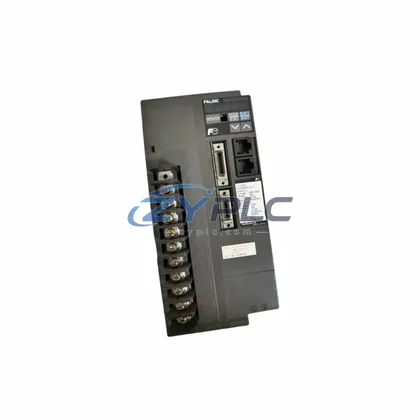
Allen-Bradley 1394C-AM75-IH AC Servo Drive for 1394C Systems: availability, compatibility, and sourcing support
The Allen-Bradley 1394C-AM75-IH is a high-performance 75A AC servo drive engineered for multi-axis motion control within Rockwell Automation’s 1394C Series architecture. Designed to serve as a critical industrial network interface, this drive enables seamless data exchange between field-level devices, PLC controllers, remote I/O modules, HMI panels, SCADA platforms, variable frequency drives, precision sensors, and upper-level supervisory systems. In today’s smart factory landscape, where real-time data transparency and zero-latency communication are non-negotiable, the 1394C-AM75-IH delivers the connectivity backbone that modern automated production lines demand.
From signal acquisition at the servo motor encoder level through protocol conversion across SCANport and DeviceNet networks, to real-time transmission into ControlLogix or CompactLogix PLC backplanes, this drive participates in every layer of the industrial data chain. Its native SCANport communication interface allows direct integration with Allen-Bradley 1336 PLUS II variable frequency drives, PowerFlex 700 series drives, and other SCANport-compatible peripherals, enabling a unified motion and drive network without additional gateway hardware. When paired with a 1747-SDN DeviceNet Scanner module installed in an SLC 500 rack, the 1394C-AM75-IH becomes a fully addressable node on the DeviceNet segment, reporting axis status, fault codes, velocity feedback, and torque demand data directly to the PLC’s data table in real time.
Compatibility & Integration Notes
| Parameter |
Specification |
| SKU / Part Number |
1394C-AM75-IH |
| Brand / Manufacturer |
Allen-Bradley (Rockwell Automation) |
| Series |
1394C Multi-Axis Motion Control |
| Communication Protocols |
SCANport, DeviceNet (via 1394-ADN adapter) |
| Interface Type |
SCANport (multi-drop serial), DeviceNet (CAN-based fieldbus) |
| Output Current |
75A continuous |
| Transmission Capability |
Real-time axis status, fault diagnostics, velocity & torque feedback |
| Network Compatibility |
ControlLogix, CompactLogix, SLC 500, PLC-5 via 1771-SDN |
| SCADA / HMI Integration |
FactoryTalk View SE/ME, RSView32, Wonderware InTouch via OPC-DA/UA |
| System Application |
Multi-axis servo motion, CNC, packaging, material handling, press control |
| Origin |
United States |
| Warranty |
Warranty and support terms confirmed before quote |
Connected Automation Data Flow
In a typical smart factory deployment, the 1394C-AM75-IH sits at the intersection of motion control and industrial networking. At the field level, servo motor feedback signals — encoder pulses, resolver outputs, and thermal sensor data — are captured by the drive’s onboard signal processing circuitry and converted into digital axis state information. This data travels upstream via the SCANport link to the 1394C system module, which aggregates multi-axis data from all connected drives including companion axes running 1394C-AM50-IH or 1394C-SJT22-C servo modules on the same shared DC bus architecture.
The system module then communicates with the motion controller — typically a 1756-M02AE or 1756-M08SE servo module installed in a ControlLogix 1756 chassis — over the high-speed backplane, delivering position, velocity, and torque loop closure at sub-millisecond cycle times. Simultaneously, a 1756-DNB DeviceNet Bridge module in the same chassis extends DeviceNet connectivity to distributed I/O nodes such as 1794-ADN FLEX I/O DeviceNet adapters, allowing remote digital and analog I/O data from sensors, proximity switches, and pressure transducers on the production floor to be integrated into the same control program.
At the supervisory layer, FactoryTalk View SE running on a SCADA server collects real-time drive parameters — including bus voltage, output frequency, fault history, and energy consumption — via RSLinx Classic or RSLinx Enterprise OPC servers. This data feeds into historian databases and dashboard displays, giving plant engineers and maintenance teams full visibility into servo system health without requiring physical access to the control panel. Remote diagnostic sessions can be initiated through FactoryTalk Remote Access or Cisco IE 4000 series industrial Ethernet switches that segment the plant network, ensuring that SCADA polling traffic does not interfere with time-critical motion control communications.
For facilities integrating legacy equipment, the 1394C-AM75-IH’s SCANport interface can be bridged to Modbus RTU or Profibus DP networks using third-party protocol gateways such as the ProSoft MVI56-MCM or HMS Anybus Communicator, enabling older SCADA systems and DCS platforms to read drive data without requiring a full controls upgrade. This interoperability makes the 1394C-AM75-IH a long-term asset in phased smart factory modernization programs.
Solving Data Isolation in Industrial Sites
One of the most persistent challenges in industrial automation is data isolation — the condition where field devices, motion controllers, and supervisory systems operate in separate communication silos, preventing plant-wide transparency and making predictive maintenance nearly impossible. The 1394C-AM75-IH directly addresses this challenge through its multi-protocol communication architecture.
In facilities where legacy SLC 500 PLCs control older servo systems while newer ControlLogix platforms manage high-speed packaging lines, the 1394C-AM75-IH can serve as a protocol bridge point. By connecting the drive’s SCANport port to a 1747-AIC isolated link coupler and then to a 1747-SDN DeviceNet scanner, plant engineers can expose servo axis data to both the legacy SLC network and the modern DeviceNet segment simultaneously, eliminating the need for manual data entry or separate HMI screens for each system.
Remote monitoring is another area where the 1394C-AM75-IH delivers measurable value. Rather than dispatching maintenance technicians to physically inspect drive status LEDs or connect laptops to the drive’s serial port, SCADA operators can monitor all axis parameters — including following error, output current, and fault queue — from a central control room or even from mobile devices via FactoryTalk View ME on Panel View Plus 7 terminals. Alarm conditions such as overcurrent faults, encoder loss, or bus undervoltage are immediately propagated through the DeviceNet network to the PLC, which triggers alarm banners on the HMI and sends email or SMS notifications through FactoryTalk Historian and alarm management software.
Production line transparency is further enhanced by integrating the 1394C-AM75-IH’s real-time data into OEE (Overall Equipment Effectiveness) dashboards. By correlating servo fault events with production count data from 1734-IB8 POINT I/O digital input modules, plant managers can identify which axis faults are causing the most downtime and prioritize maintenance resources accordingly. This data-driven approach to maintenance scheduling reduces downtime and extends the operational life of the entire servo system.
System expansion is straightforward with the 1394C architecture. Additional servo axes can be added to the shared DC bus by installing additional 1394C-AM or 1394C-SJ series drive modules, and the DeviceNet node address of each axis can be configured via RSNetWorx for DeviceNet without taking the system offline. This scalability makes the 1394C-AM75-IH an ideal foundation for phased capacity expansions in automotive, food and beverage, pharmaceutical, and electronics manufacturing environments.
Industrial Connectivity FAQ
Q1: What is the communication latency of the 1394C-AM75-IH on a DeviceNet network?
DeviceNet is a polled, change-of-state, and cyclic network with typical scan times ranging from 2ms to 10ms depending on node count and message type configuration. For the 1394C-AM75-IH connected via a 1394-ADN DeviceNet adapter, polled I/O data — including axis status words and command words — is exchanged at the configured RPI (Requested Packet Interval), typically set between 5ms and 20ms in RSNetWorx for DeviceNet. This latency is well within acceptable limits for supervisory monitoring and alarm management applications, though closed-loop motion control is handled at the backplane level with sub-millisecond cycle times independent of the DeviceNet scan rate.
Q2: Is the 1394C-AM75-IH compatible with both ControlLogix and SLC 500 control platforms?
Yes. The 1394C-AM75-IH is compatible with multiple Rockwell Automation control platforms. When used with ControlLogix, the 1394C system communicates via a 1756-M02AE or 1756-M08SE servo module over the ControlLogix backplane. For SLC 500 applications, a 1747-SDN DeviceNet Scanner module provides DeviceNet connectivity, and the 1394-ADN adapter module bridges the SCANport interface to the DeviceNet segment. PLC-5 systems can integrate via a 1771-SDN DeviceNet Scanner in the PLC-5 I/O chassis. All platforms support full parameter read/write access and fault diagnostics through their respective programming software — RSLogix 5000, RSLogix 500, or RSLogix 5.
Q3: How is network stability maintained in high-vibration or electrically noisy industrial environments?
DeviceNet uses a shielded, thick or thin trunk cable with drop lines to each node, providing inherent noise immunity through differential signaling on the CAN physical layer. The 1394C-AM75-IH’s SCANport interface uses RS-485 differential signaling, which is similarly robust against common-mode electrical noise from nearby VFDs, welding equipment, and high-current motor cables. Proper cable routing — maintaining separation between signal cables and power cables, using ferrite cores at cable entry points, and ensuring single-point grounding of cable shields — is essential for maintaining network stability. ZYPLC recommends following Rockwell Automation’s Wiring and Grounding Guidelines for Pulse Width Modulated (PWM) AC Drives (publication DRIVES-IN001) for all 1394C installations.
Q4: What does the warranty and support terms confirmed before quote cover, and how is pre-shipment testing conducted?
All 1394C-AM75-IH units supplied by ZYPLC carry a warranty and support terms confirmed before quote covering manufacturing defects, component failures, and communication interface malfunctions under normal operating conditions. Prior to shipment, each unit undergoes a pre-shipment functional test that verifies power-up self-diagnostics, SCANport communication handshake, and output stage integrity. Units that fail any test parameter are quarantined and not shipped. Warranty claims are processed through ZYPLC’s technical support team, and replacement units are dispatched within 3-5 business days of fault confirmation. For time-critical production environments, ZYPLC supports RFQ-based sourcing for common 1394C series modules to support rapid exchange programs.