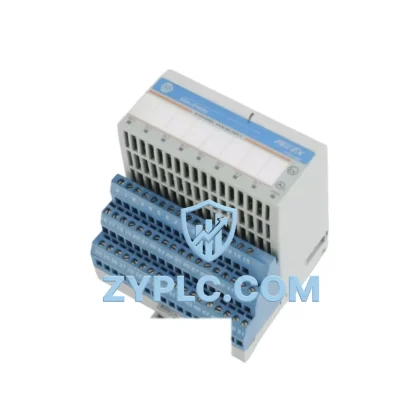
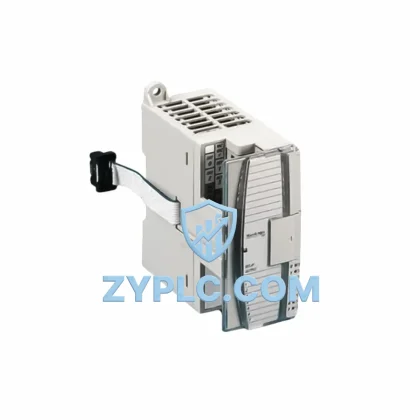
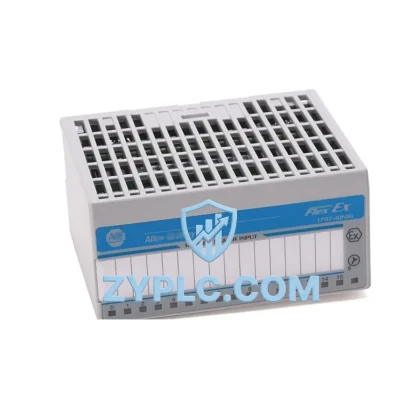
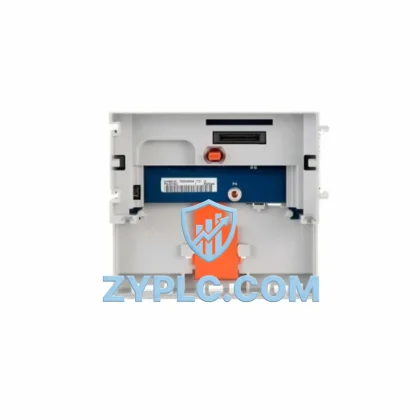
Allen-Bradley 1734-OE2C/B System-Ready Analog Output for POINT I/O Architecture
The Allen-Bradley 1734-OE2C/B is a two-channel current/voltage analog output module engineered for seamless integration within Rockwell Automation’s POINT I/O distributed control architecture. Unlike standalone signal converters, this module is purpose-built to function as a precision output node within a layered automation system — coordinating with upstream CPU logic, downstream field actuators, and lateral I/O expansion modules to deliver consistent, deterministic process control across demanding industrial environments.
In modern distributed control architectures, the 1734-OE2C/B occupies a critical position at the I/O layer, translating digital command values from the controller into calibrated analog signals — typically 4–20 mA current loops or 0–10 V voltage outputs — that drive control valves, variable frequency drives, positioners, and other final control elements. Its role is not isolated; it is deeply embedded in the signal flow that connects the control layer to the execution layer, making its reliability, accuracy, and compatibility essential to overall system performance.
Architecture Specification Table
| Parameter |
Specification |
| System Role |
Distributed Analog Output Node — POINT I/O Layer |
| SKU / Catalog Number |
1734-OE2C/B |
| Brand / Manufacturer |
Allen-Bradley (Rockwell Automation) |
| Series |
1734 POINT I/O |
| Output Channels |
2 (independently configurable) |
| Output Signal Types |
4–20 mA current / 0–10 V voltage (selectable per channel) |
| Resolution |
12-bit (current); 12-bit (voltage) |
| Electrical Supply |
24V DC (supplied via POINT I/O backplane / adapter) |
| Communication Interface |
Via POINT I/O adapter (EtherNet/IP, DeviceNet, PROFIBUS, ControlNet) |
| Backplane Compatibility |
1734 POINT I/O mounting base (1734-TB, 1734-TBS) |
| Operating Temperature |
0°C to 55°C (32°F to 131°F) |
| Protection Rating |
IP20 (panel-mount, DIN rail installation) |
| Agency Certifications |
UL, CE, cUL (series/revision dependent) |
| Product Category |
Industrial Automation / PLC Analog Output Modules |
| Warranty |
12-Month Warranty — all units tested prior to shipment |
Coordinated Control System Design
The 1734-OE2C/B achieves its full value when deployed as part of a coordinated POINT I/O system rather than as an isolated component. A typical architecture begins at the control layer with a ControlLogix or CompactLogix CPU — such as the 1756-L73 or 1769-L33ER — executing ladder logic or function block programs that generate analog output setpoints. These setpoints are transmitted via the backplane or EtherNet/IP network to a POINT I/O adapter such as the 1734-AENT (EtherNet/IP adapter) or 1734-ADN (DeviceNet adapter), which serves as the communication gateway between the controller and the distributed I/O nodes.
Mounted on a 1734-TB or 1734-TBS terminal base, the 1734-OE2C/B receives its power and data through the POINT I/O backplane, eliminating the need for separate field wiring to the module itself. Adjacent modules — such as the 1734-IE2C (2-channel analog input) or 1734-IB8 (8-channel digital input) — share the same mounting rail, enabling compact, high-density I/O assemblies within a single control cabinet. This modular architecture allows engineers to mix digital and analog I/O types on the same rail, reducing panel footprint and simplifying cable management.
At the execution layer, the 1734-OE2C/B drives field devices such as electro-pneumatic positioners, proportional control valves, and variable frequency drives (VFDs). In closed-loop control applications, the analog output from the 1734-OE2C/B is paired with a corresponding analog input module — such as the 1734-IE4C — to form a complete feedback loop, with the CPU continuously adjusting the output setpoint based on measured process variables. This tight integration between output and input modules, mediated by the controller, is the foundation of precise process regulation in industries such as chemical processing, water treatment, and power generation.
For redundancy-critical applications, the 1734-OE2C/B can be deployed within architectures that include redundant communication adapters or redundant CPU configurations using the 1756-RM2 redundancy module, ensuring that a single point of failure at the controller level does not interrupt analog output signals to critical field devices. Additionally, the system can be monitored and configured via an HMI such as the PanelView Plus 7 terminal, providing operators with real-time visibility into output channel status, engineering unit values, and fault diagnostics.
Application in Layered Automation Systems
The 1734-OE2C/B is widely deployed across a broad spectrum of industrial sectors where precise analog output control is essential to process integrity and operational safety.
In water and wastewater treatment facilities, the module controls chemical dosing pumps and flow control valves, with output signals calibrated to match the specific operating ranges of each actuator. The ability to configure each channel independently — as either current or voltage output — provides the flexibility needed to interface with diverse field equipment from multiple manufacturers without additional signal conditioning hardware.
In oil and gas and petrochemical applications, the 1734-OE2C/B is used to modulate pressure control valves, flow regulators, and heat exchanger bypass valves. Its integration within a ControlLogix-based safety instrumented system (SIS) architecture allows analog output commands to be generated by the safety controller and transmitted to field devices with the determinism and reliability required by IEC 61511 functional safety standards.
In power generation and electrical utilities, the module participates in automatic generation control (AGC) and excitation control systems, where analog output accuracy directly affects grid stability. Deployed alongside communication modules such as the 1756-EN2T EtherNet/IP bridge, the 1734-OE2C/B can be integrated into plant-wide SCADA systems, enabling remote setpoint adjustment and continuous performance monitoring.
In manufacturing and packaging environments, the module drives servo amplifiers, tension controllers, and temperature regulators on high-speed production lines. Its compact POINT I/O form factor allows it to be installed in distributed junction boxes close to the field devices, reducing analog signal cable lengths and minimizing the risk of signal degradation due to electrical noise — a critical consideration in environments with large motor drives and switching power supplies.
In mining and metallurgical operations, the 1734-OE2C/B controls conveyor speed references, crusher load regulators, and flotation cell level controllers. Its robust operating temperature range and DIN rail mounting make it suitable for installation in field control panels exposed to vibration, dust, and temperature variation.
Architecture Engineering FAQ
Q1: Is the 1734-OE2C/B compatible with both ControlLogix and CompactLogix platforms, and what adapter is required?
The 1734-OE2C/B is compatible with any controller platform that supports POINT I/O communication adapters. For EtherNet/IP-based systems — including ControlLogix (1756 series) and CompactLogix (1769 series) — the 1734-AENT adapter is the standard interface. For DeviceNet-based systems, the 1734-ADN adapter is used. The module’s Add-On Profile (AOP) is available in Studio 5000 Logix Designer, enabling straightforward configuration and tag mapping without manual parameter entry. No firmware changes to the CPU are required when adding the module to an existing POINT I/O node.
Q2: Can the 1734-OE2C/B be installed in an existing POINT I/O rack without system downtime, and what are the installation requirements?
The 1734-OE2C/B is designed for modular installation on a 1734-TB or 1734-TBS terminal base, which can be added to an existing DIN rail assembly. In systems where the POINT I/O adapter supports partial fault tolerance or hot-swap capability (depending on firmware version and adapter type), module replacement may be possible with minimal disruption. Standard installation requires 24V DC backplane power, correct terminal base selection, and configuration of the module’s output type (current or voltage) via the Studio 5000 software prior to commissioning. All units supplied by ZYPLC are pre-tested and include full documentation to support rapid commissioning.
Q3: What does the 12-Month Warranty cover, and how does ZYPLC support long-term maintenance and spare parts availability?
Every 1734-OE2C/B supplied by ZYPLC is covered by a 12-Month Warranty against manufacturing defects and functional failures under normal operating conditions. Prior to shipment, each unit undergoes functional testing to verify output channel accuracy, communication integrity, and backplane compatibility. For long-term maintenance planning, ZYPLC maintains stock of both current-production and legacy POINT I/O modules, enabling engineers to source replacement units for systems that may no longer be supported by the original manufacturer’s standard supply chain. Our technical team provides pre-sales compatibility verification and post-sales support to ensure that replacement modules integrate correctly into existing control architectures without requiring system reconfiguration.
© 2026 ZYPLC. All rights reserved.
Original Source: https://zyplc.com
Contact: +86 19859288691 | [email protected]