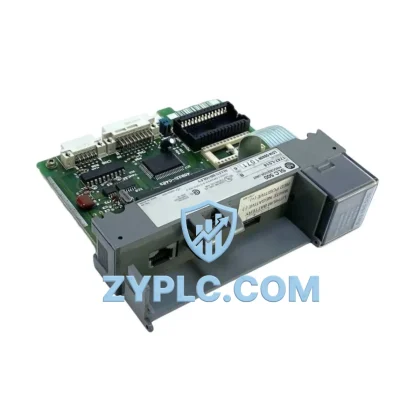
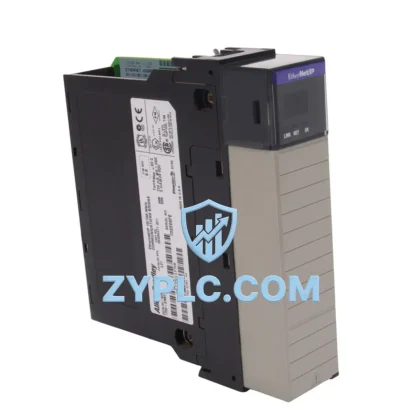
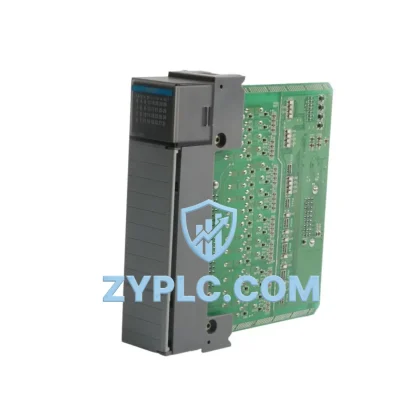
Allen-Bradley 1746-A4 System-Ready PLC Chassis for SLC 500 Architecture
The Allen-Bradley 1746-A4 is a 4-slot modular chassis engineered as the structural backbone of the SLC 500 control platform. In any layered automation architecture, the chassis is not merely a housing — it is the physical and electrical foundation that determines how well the control layer, I/O layer, communication layer, and power layer interact with one another. The 1746-A4 provides the mechanical rigidity, backplane bus integrity, and slot capacity that allow system designers to build compact yet scalable control panels without compromising signal fidelity or module coordination.
When integrated into a complete SLC 500 system, the 1746-A4 chassis hosts the processor module — typically a 1747-L532 or 1747-L543 CPU — in Slot 0, with the remaining three slots available for discrete I/O, analog I/O, or specialty modules. This configuration supports a wide range of manufacturing and process control applications where panel space is constrained but functional density is critical. The backplane architecture ensures low-latency communication between the CPU and all installed modules, maintaining scan-cycle consistency even under high I/O update demands.
Power delivery to the chassis is handled by a dedicated SLC 500 power supply module such as the 1746-P2 or 1746-P4, which mounts directly to the chassis and provides regulated DC voltage to all backplane-connected modules. Proper power supply selection is essential: the 1746-A4 backplane distributes both logic power and I/O power, and the total current draw of all installed modules must remain within the supply’s rated output. Engineers specifying the 1746-A4 should calculate the combined load of the CPU, digital input modules like the 1746-IB16, digital output modules such as the 1746-OB16, and any analog modules like the 1746-NI4 to ensure stable, long-term operation.
Architecture Specification Table
| Parameter |
Specification |
| System Role |
Modular PLC Backplane Chassis — SLC 500 Control Platform |
| Slot Capacity |
4 Slots (Slot 0 reserved for CPU/processor module) |
| Compatible Processors |
SLC 5/02, 5/03, 5/04, 5/05 (1747-L20x, L30x, L40x, L55x series) |
| Backplane Bus |
Proprietary SLC 500 parallel backplane; low-latency module communication |
| Power Input |
Via dedicated 1746-Pxx power supply module (not included) |
| Operating Temperature |
0°C to 60°C (32°F to 140°F) |
| Mounting |
DIN rail or panel mount |
| Communication Support |
DH+, DH-485, Ethernet/IP (processor-dependent) |
| Installation Environment |
Industrial control panels, MCC enclosures, process skids |
| Warranty |
12-Month Warranty — tested, inspected, and ready to ship |
Coordinated Control System Design
The 1746-A4 chassis reaches its full potential when specified as part of a coordinated SLC 500 system architecture. In a typical 4-slot configuration, the processor — such as the 1747-L532 with 16K of user memory — occupies Slot 0 and manages the program scan, I/O update, and communication tasks simultaneously. Adjacent slots can be populated with a 1746-IB16 16-point 24VDC input module for field device signal acquisition, a 1746-OB16 16-point transistor output module for actuator control, and a 1746-NI4 analog input module for process variable monitoring such as temperature, pressure, or flow.
For applications requiring network connectivity, the SLC 5/04 processor variant supports Data Highway Plus (DH+) natively, enabling peer-to-peer communication with other SLC 500 or PLC-5 controllers on the same DH+ network. Where Ethernet/IP integration is required — for example, to connect the SLC 500 system to a supervisory SCADA platform or a PanelView Plus HMI terminal — a 1761-NET-ENI Ethernet interface module can be added externally to bridge the DH-485 port to the plant Ethernet backbone. This layered communication approach allows the 1746-A4-based system to participate in both legacy and modern network architectures without requiring a full platform migration.
Terminal block wiring to the I/O modules is typically managed through 1492-IFM interface modules or direct screw-terminal wiring on the module face. For high-density installations, pre-wired cable assemblies connecting to remote I/O racks via a 1747-SN scanner module extend the system’s I/O reach beyond the local chassis, supporting distributed control architectures across larger production floors. The 1746-A4 chassis thus serves as the local control node in a hierarchical system where field signals are aggregated, processed, and acted upon within a single scan cycle.
Application in Layered Automation Systems
Across manufacturing, utilities, and process industries, the 1746-A4 chassis has been deployed in environments where reliability, compactness, and long-term parts availability are non-negotiable. In discrete manufacturing lines — such as automotive assembly, packaging machinery, and material handling conveyors — the 4-slot chassis provides sufficient I/O capacity for machine-level control tasks: motor starter interlocking, conveyor sequencing, safety relay monitoring, and cycle counting. The compact footprint allows integration into existing control panels without requiring enclosure expansion.
In water and wastewater treatment facilities, the 1746-A4 is commonly used to control pump stations, valve actuators, and level monitoring systems. The chassis hosts analog input modules reading 4–20mA signals from submersible level transmitters and flow meters, while output modules drive VFD enable signals or solenoid valve coils. The DH-485 communication port on the SLC 5/03 processor allows the local panel to report process data upstream to a plant-wide SCADA system, maintaining visibility across distributed pump stations.
In oil and gas and petrochemical applications, the 1746-A4 supports skid-mounted control panels for compressor control, separator monitoring, and chemical injection systems. The chassis’s industrial temperature rating and compatibility with hazardous-location enclosures make it suitable for installation in Class I, Division 2 environments when properly housed. Long-term spare parts availability — supported by ZYPLC’s maintained inventory of SLC 500 components — ensures that facilities running legacy SLC 500 systems can sustain operations without forced platform migrations.
In power distribution and electrical substation automation, the 1746-A4 chassis supports relay logic replacement projects where legacy hardwired panels are being modernized with programmable control. The chassis hosts input modules monitoring breaker status, transformer temperature, and bus voltage alarms, while output modules drive trip coils, alarm annunciators, and SCADA telemetry outputs. The system’s deterministic scan cycle and proven backplane reliability make it a trusted choice for critical infrastructure control.
Architecture Engineering FAQ
Q1: Can the 1746-A4 chassis be expanded if 4 slots are insufficient for my application?
The 1746-A4 is a fixed 4-slot chassis and cannot be physically expanded. However, SLC 500 systems support multi-chassis configurations: a 1747-SN scanner module installed in the local chassis can communicate with remote I/O chassis — such as the 1746-A7 (7-slot) or 1746-A13 (13-slot) — over a remote I/O link, effectively extending the system’s I/O capacity while maintaining centralized program control from the local CPU. This architecture is well-suited for distributed machine control where field devices are spread across multiple enclosures or physical locations.
Q2: Which power supply modules are compatible with the 1746-A4, and how do I select the correct one?
The 1746-A4 chassis is compatible with the full range of 1746-Pxx power supply modules, including the 1746-P1 (5VDC, 2A), 1746-P2 (5VDC, 5A), 1746-P3 (24VDC input), and 1746-P4 (5VDC, 10A). Selection depends on the total current consumption of all modules installed in the chassis. Engineers should sum the 5VDC and 24VDC current requirements listed in each module’s datasheet and select a power supply with at least 20% headroom above the calculated total load. ZYPLC can assist with power budget calculations during the pre-sales engineering process.
Q3: What does the 12-Month Warranty cover, and what is the testing process before shipment?
All 1746-A4 chassis units supplied by ZYPLC are covered by a 12-Month Warranty against defects in materials and workmanship. Prior to shipment, each unit undergoes a functional inspection that includes backplane continuity verification, slot connector integrity checks, and visual inspection for physical damage. Units sourced from controlled inventory channels are stored in ESD-safe environments to prevent latent damage. In the event of a warranty claim, ZYPLC provides replacement or repair support with documented RMA procedures. Contact [email protected] for warranty registration and claim processing.
© 2026 ZYPLC. All rights reserved.
Original Source: https://zyplc.com
Contact: +86 19859288691 | [email protected]