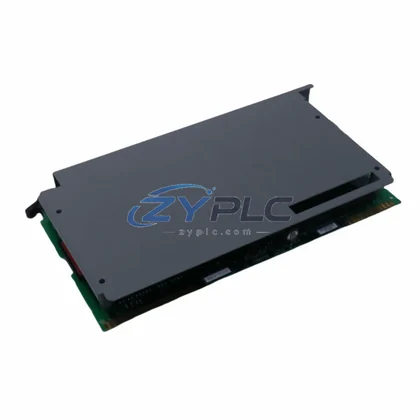
Allen-Bradley 1746-NO4I: Industrial Analog Output Gateway for SLC 500 Smart Factory Data Links
The Allen-Bradley 1746-NO4I is a 4-channel isolated analog output module engineered for the SLC 500 programmable controller platform. Delivering precision current output signals in the 4–20 mA range, this module serves as a critical bridge between the digital control layer and field-level actuators — including control valves, variable frequency drives, and proportional solenoids — across demanding industrial environments. Whether deployed in process manufacturing, water treatment, oil & gas, or discrete assembly lines, the 1746-NO4I ensures stable, low-latency analog signal transmission that underpins real-time process control and smart factory transparency.
In modern industrial architectures, the 1746-NO4I sits at the intersection of PLC logic execution and physical process actuation. Its isolated channel design eliminates ground loop interference, making it suitable for long-distance signal runs across large plant floors. When integrated with the SLC 500 backplane alongside modules such as the 1746-NI4 analog input module and the 1746-IB16 digital input module, it forms a complete I/O subsystem capable of handling both analog feedback loops and discrete control signals within a single rack.
Compatibility & Integration Notes
| Parameter |
Specification |
| SKU / Part Number |
1746-NO4I |
| Brand / Manufacturer |
Allen-Bradley (Rockwell Automation) |
| Compatible Platform |
SLC 500 PLC Series |
| Output Channels |
4 Isolated Analog Output Channels |
| Output Signal Type |
4–20 mA Current Output |
| Communication Protocol |
SLC 500 Backplane I/O Bus |
| Network Compatibility |
DH+, DH-485, EtherNet/IP (via gateway) |
| System Application |
Process Control, SCADA Integration, HMI Feedback, Drive Control |
| Interface Type |
SLC 500 I/O Chassis Slot (1746 Series) |
| Isolation |
Channel-to-Channel Isolated |
| Power Supply Compatibility |
SLC 500 Chassis Power (1746-P Series) |
| Warranty |
Warranty and support terms confirmed before quote |
| Availability |
Confirmed via RFQ before quotation |
| Shipping |
Global DHL / FedEx Express |
Connected Automation Data Flow
In a fully connected SLC 500 automation cell, the 1746-NO4I operates as the analog output backbone, translating PLC register values into precise field-level current signals. The data flow begins at the sensor layer — where devices such as pressure transmitters, flow meters, and temperature sensors feed real-time process values back into the SLC 500 rack via the 1746-NI4 or 1746-NI8 analog input modules. The SLC 500 processor — typically a 1747-L553 or 1747-L543 CPU — executes the control logic and writes output values to the 1746-NO4I’s output registers.
The 1746-NO4I then converts those digital register values into 4–20 mA signals, driving downstream actuators such as PowerFlex 40 or PowerFlex 70 variable frequency drives for motor speed regulation, or proportional control valves for flow and pressure management. This closed-loop signal chain — from sensor acquisition through PLC logic to analog actuation — forms the core of real-time process control in smart manufacturing environments.
For SCADA and HMI integration, the SLC 500 system communicates upstream via DH+ or DH-485 networks, or through a 1761-NET-ENI EtherNet/IP adapter that bridges the SLC 500 backplane to modern Ethernet-based supervisory systems. Operators monitoring the process through a PanelView 550 or PanelView Plus 600 HMI terminal receive live analog output status, enabling real-time visualization of drive setpoints, valve positions, and process loop performance. Remote diagnostic access is further extended through RSLinx Classic or FactoryTalk View software, allowing engineers to monitor 1746-NO4I channel output values, diagnose signal faults, and adjust loop parameters without physical access to the control panel.
For distributed control architectures, the 1746-NO4I can be paired with remote I/O adapters such as the 1747-ASB to extend analog output capability to remote racks across the plant floor, maintaining signal integrity and network synchronization across long cable runs. This architecture supports scalable expansion of analog control loops without requiring additional SLC 500 processors, reducing system cost while maintaining centralized data management.
Solving Data Isolation in Industrial Sites
One of the most persistent challenges in legacy industrial environments is data isolation — where field devices, PLCs, drives, and supervisory systems operate on incompatible protocols, preventing unified visibility and coordinated control. The Allen-Bradley 1746-NO4I, as part of the SLC 500 ecosystem, directly addresses this challenge by providing a standardized analog output interface that bridges the gap between digital PLC logic and analog field devices that do not support digital fieldbus protocols.
In plants where older pneumatic or analog-only actuators remain in service alongside modern digital systems, the 1746-NO4I enables seamless integration without requiring costly actuator replacement. Its 4–20 mA output is universally recognized by virtually all industrial field devices, making it the ideal protocol-agnostic interface for mixed-generation automation environments. When combined with EtherNet/IP gateway adapters, the SLC 500 system — including the 1746-NO4I — can be brought into a unified SCADA network, eliminating data silos and enabling plant-wide production transparency.
Remote monitoring capabilities are significantly enhanced when the 1746-NO4I is integrated into a FactoryTalk-enabled network. Engineers can remotely verify analog output channel health, detect signal drift, and receive alarm notifications for out-of-range output conditions — all without dispatching maintenance personnel to the field. This reduces mean time to repair (MTTR), improves overall equipment effectiveness (OEE), and supports predictive maintenance strategies that are central to Industry 4.0 initiatives.
System expansion is equally straightforward: additional 1746-NO4I modules can be added to available SLC 500 chassis slots as process requirements grow, providing a cost-effective path to scaling analog output capacity. Combined with the broad availability of SLC 500 compatible modules and Rockwell Automation’s extensive support ecosystem, the 1746-NO4I represents a reliable, long-term investment for industrial connectivity infrastructure.
Industrial Connectivity FAQ
Q1: What communication protocols does the Allen-Bradley 1746-NO4I support for SCADA integration?
The 1746-NO4I communicates natively over the SLC 500 backplane I/O bus. For SCADA integration, the SLC 500 processor supports DH+, DH-485, and — via gateway adapters such as the 1761-NET-ENI — EtherNet/IP. This allows the 1746-NO4I’s analog output data to be monitored and controlled through FactoryTalk View, RSLinx Classic, or third-party SCADA platforms supporting EtherNet/IP or Modbus TCP bridging.
Q2: How does the 1746-NO4I ensure network stability and signal integrity in noisy industrial environments?
The 1746-NO4I features channel-to-channel isolation, which eliminates ground loop interference and cross-channel signal contamination — common sources of instability in industrial analog networks. Its 4–20 mA current output is inherently noise-resistant over long cable runs, maintaining signal accuracy even in environments with significant electromagnetic interference from drives, motors, and high-voltage switching equipment.
Q3: Can the 1746-NO4I be expanded or integrated into larger control architectures?
Yes. Multiple 1746-NO4I modules can be installed in the same SLC 500 chassis to expand analog output capacity. For distributed architectures, the module can be deployed in remote I/O racks connected via the 1747-ASB adapter, extending analog output capability across large plant floors. Integration with ControlLogix or CompactLogix systems is achievable through EtherNet/IP gateway bridges, enabling migration paths to newer Rockwell Automation platforms without replacing field wiring.
Q4: What does the warranty and support terms confirmed before quote cover, and how is pre-shipment testing conducted?
Every Allen-Bradley 1746-NO4I unit supplied by ZYPLC is Warranty terms are confirmed during quotation. Prior to shipment, each module undergoes functional verification testing — including analog output channel calibration checks and backplane communication validation — to ensure it meets OEM specifications. Units are shipped via DHL or FedEx Express with full tracking, and our technical team provides post-sale support for installation, configuration, and diagnostic assistance.