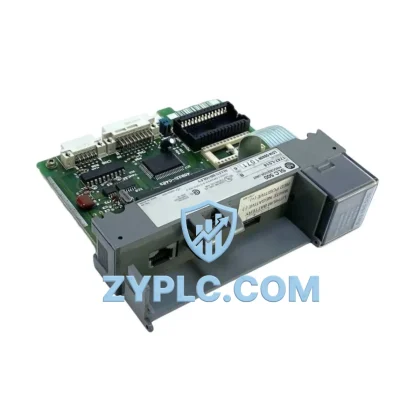
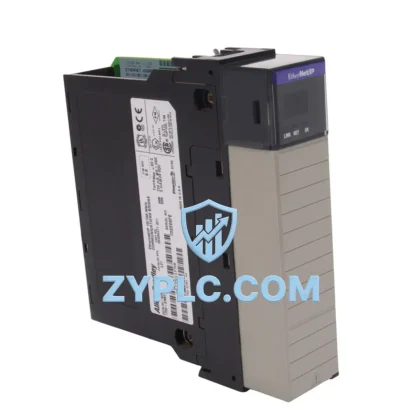
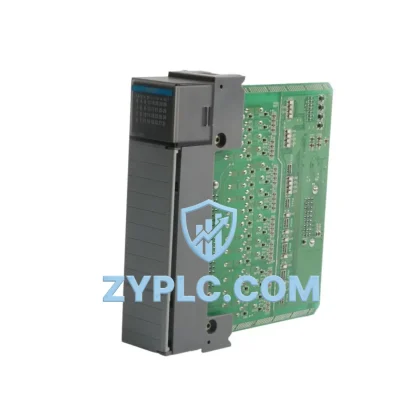
Allen-Bradley 1746-NO4V Energy-Saving Analog Output Module: Precision Energy Control for SLC 500 Automation
The Allen-Bradley 1746-NO4V is a four-channel voltage analog output module engineered for the SLC 500 modular chassis platform. In modern manufacturing environments where energy accountability is no longer optional, this module serves as a critical interface between the control layer and the physical drive layer — translating digital setpoints from the SLC 5/04 or SLC 5/05 processor into precise 0–10 VDC or ±10 VDC analog signals that govern variable-speed drives, proportional valves, and servo amplifiers. By delivering accurate, low-drift output signals, the 1746-NO4V directly reduces the energy wasted through imprecise speed references, over-driven actuators, and uncoordinated motion sequences.
In facilities running continuous process lines — extrusion, conveying, mixing, or HVAC — the difference between a stable ±0.1% full-scale output and a noisy, drifting signal can translate to measurable kilowatt-hour savings per shift. The 1746-NO4V’s 12-bit resolution ensures that drive speed commands are granular enough to keep motors operating at their optimal efficiency curve rather than hunting between setpoints. When paired with a PowerFlex 40 or PowerFlex 400 variable-frequency drive receiving its speed reference from this module, the drive can maintain a tighter slip frequency, reducing rotor losses and extending motor insulation life simultaneously.
Efficiency Performance Table
| Parameter |
Specification / Value |
| Output Channels |
4 (individually configurable) |
| Output Range |
0–10 VDC / ±10 VDC (voltage) |
| Resolution |
12-bit (1 in 4,096) |
| Output Accuracy |
±0.1% of full scale at 25 °C |
| Module Power Consumption |
120 mA @ 5 VDC backplane; 0 mA @ 24 VDC |
| Compatible Platform |
SLC 500 modular chassis (1746 series) |
| Compatible Processors |
SLC 5/01, 5/02, 5/03, 5/04, 5/05 |
| Compatible Drive Systems |
PowerFlex 40, PowerFlex 400, PowerFlex 700 |
| Application Environments |
Process control, conveying, HVAC, mixing, extrusion |
| Energy Optimization Value |
Precise speed reference → reduced motor slip → lower kWh consumption |
| Operating Temperature |
0 °C to 60 °C |
| Isolation |
None (common reference); optically isolated backplane interface |
| Warranty |
12-Month Warranty — tested before shipment |
| Availability |
In Stock — ships within 1–3 business days |
Energy-Aware Automation Architecture
The 1746-NO4V does not operate in isolation — its energy impact is realized through the broader SLC 500 control architecture. At the processor level, an SLC 5/04 processor executing a ladder logic program calculates optimal speed setpoints based on production demand signals, then writes those values to the output image table of the 1746-NO4V. The module converts those integer values into smooth analog voltages that command downstream drive equipment without the step-change artifacts that cause mechanical stress and energy spikes.
On the input side, a 1746-NI4 or 1746-NI8 analog input module collects process feedback — motor current, pressure transducer signals, or flow meter outputs — and feeds that data back to the processor for closed-loop regulation. This feedback loop is what transforms a simple open-loop drive system into an energy-responsive control architecture. When the 1746-NI8 reports that a pump is running at higher-than-expected current draw, the SLC 5/04 can reduce the speed reference sent through the 1746-NO4V, trimming energy consumption in real time without operator intervention.
Digital coordination is handled through 1746-OB16 or 1746-OW16 discrete output modules that manage contactors, soft-starter enable signals, and safety relay coils. These modules work in concert with the 1746-NO4V to sequence drive enable signals before analog speed references are applied, preventing inrush current events that spike demand charges on the facility’s utility bill. On the communication side, a 1747-SDN DeviceNet Scanner or a 1747-AENTR EtherNet/IP adapter bridges the SLC 500 rack to plant-level SCADA systems and energy management platforms, allowing the 1746-NO4V’s output data to be logged, trended, and benchmarked against production throughput KPIs.
For facilities that have integrated a PanelView 800 or PanelView Plus 7 HMI into their SLC 500 network, operators can visualize real-time analog output values, compare them against energy consumption trends, and adjust setpoints without modifying ladder logic. This visibility layer is essential for identifying inefficient operating windows — periods where drives are commanded to run at speeds that do not correspond to actual production demand. A 1746-NO4V channel running a conveyor drive at 85% speed during a low-demand shift window, when 60% would suffice, represents recoverable energy that HMI-driven setpoint management can capture.
Power quality at the panel level is supported by integrating the SLC 500 system with a PowerMonitor 500 or PowerMonitor 1000 energy meter. These devices measure true power factor, harmonic distortion, and demand peaks at the MCC level, providing the data context that makes the 1746-NO4V’s precision outputs meaningful from an energy accounting perspective. When drive speed references are stable and accurate, harmonic injection from VFDs is more predictable and easier to filter, reducing the burden on line reactors and improving overall power quality scores.
Power Optimization in Real Production Lines
Consider a bottling line where four conveyors, two filling stations, and a capping unit are all speed-coordinated through a single SLC 5/04 rack. Each drive receives its speed reference from a dedicated channel on the 1746-NO4V. When the line runs at full capacity, all four channels output near-maximum voltage. But during changeover, cleaning cycles, or upstream stoppages, the SLC 5/04 program ramps the analog outputs down proportionally — slowing conveyors to minimum crawl speeds rather than stopping and restarting drives repeatedly. This ramp-down strategy alone can reduce drive energy consumption by 20–40% during non-productive intervals, because motor power scales with the cube of speed: halving speed reduces power demand to roughly one-eighth.
In HVAC applications within large manufacturing facilities, the 1746-NO4V controls air handling unit fan drives and chilled water pump drives based on zone temperature and pressure differential feedback. Rather than running fans at fixed speeds determined by worst-case design conditions, the SLC 500 program continuously adjusts analog outputs to match actual thermal load. Facilities that have implemented this type of demand-based control report 15–30% reductions in HVAC energy consumption compared to fixed-speed operation — savings that accumulate every hour the plant is running.
Predictive maintenance integration further amplifies the energy benefits of the 1746-NO4V. When motor current feedback collected through the 1746-NI8 begins trending upward over weeks — indicating bearing wear, misalignment, or impeller fouling — the SLC 5/04 can flag a maintenance alert before the condition degrades into a failure event. Unplanned downtime not only costs production output but also generates energy waste through emergency restarts, extended warm-up cycles, and the inefficient operation of backup equipment running outside its design envelope. Proactive maintenance scheduling, enabled by the data flowing through the SLC 500 analog I/O system, keeps equipment operating at peak efficiency and minimizes these hidden energy penalties.
Every 1746-NO4V shipped from ZYPLC undergoes functional output testing across all four channels before dispatch. Output voltage accuracy is verified at multiple setpoints, channel isolation integrity is confirmed, and backplane communication is validated against a live SLC 500 rack. This pre-shipment testing protocol ensures that the module performs to specification from the first power-up, eliminating the commissioning delays and energy-wasting troubleshooting cycles that accompany untested surplus equipment.
Energy Optimization FAQ
Q1: How does the 1746-NO4V contribute to measurable energy savings on a production line?
The module’s 12-bit resolution delivers precise analog speed references to variable-frequency drives, keeping motors operating at their optimal efficiency point rather than overshooting or hunting. When drives receive stable, accurate commands, they maintain tighter slip control, reducing rotor losses. In multi-drive applications coordinated through a single SLC 5/04 rack, synchronized speed ramping through the 1746-NO4V’s four channels eliminates the inrush and overshoot events that inflate peak demand charges.
Q2: Is the 1746-NO4V compatible with my existing SLC 500 chassis and processor?
Yes. The 1746-NO4V is compatible with all SLC 500 modular chassis configurations and all SLC 500 processors (SLC 5/01 through SLC 5/05). It occupies one slot in any 1746 series chassis and is configured through RSLogix 500 software using standard analog output module addressing. No special firmware or hardware modifications are required for integration into an existing SLC 500 system.
Q3: Can the 1746-NO4V replace a failed 1746-NO4I current output module in my application?
The 1746-NO4V (voltage output) and 1746-NO4I (current output, 4–20 mA) are not direct drop-in replacements for each other, as they require different wiring and drive input configurations. If your drives accept both voltage and current references, a field rewiring and RSLogix 500 module type change can facilitate the substitution. ZYPLC’s technical team can advise on compatibility and wiring requirements before shipment to ensure the correct module is selected for your application.
Q4: What does the 12-month warranty cover, and what is the testing process before shipment?
Every 1746-NO4V supplied by ZYPLC carries a 12-month warranty covering functional defects in output accuracy, channel operation, and backplane communication. Prior to shipment, each unit is tested on a live SLC 500 rack: all four output channels are verified for voltage accuracy across the full output range, and backplane data exchange is confirmed with an active processor. Units that do not meet Allen-Bradley’s published specifications are not shipped. The 12-month warranty period begins from the date of delivery, and ZYPLC provides replacement or repair support for any module that fails under normal operating conditions within that period.
© 2026 ZYPLC. All rights reserved.
Original Source: https://zyplc.com
Contact: +86 19859288691 | [email protected]