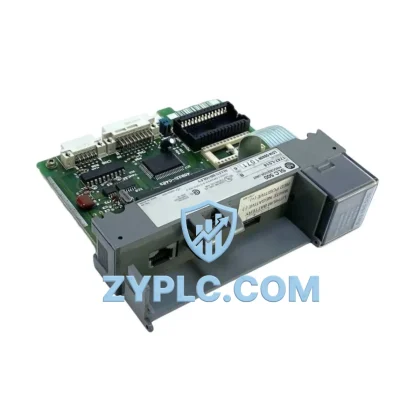
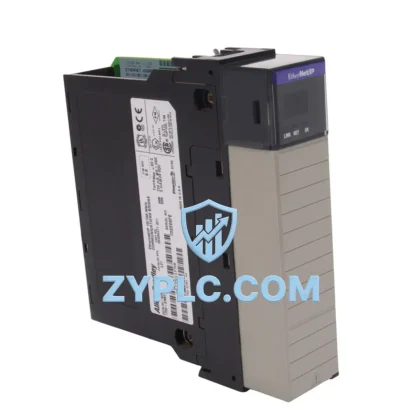
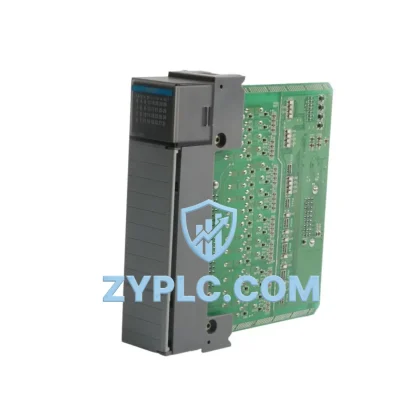
Allen-Bradley 1746-OAP12 System-Ready AC Output for SLC 500 Architecture: Coordinated Control System Integration
The Allen-Bradley 1746-OAP12 is a 12-point AC output module engineered for seamless deployment within the SLC 500 modular control platform. Rather than functioning as a standalone component, the 1746-OAP12 occupies a critical position in the output layer of a layered automation architecture — bridging the logic decisions made at the CPU level with the physical actuation demands of field devices such as solenoids, contactors, motor starters, and indicator lamps. Its role in maintaining signal integrity, system consistency, and long-term operational reliability makes it an indispensable element in any SLC 500-based control cabinet design.
In a fully realized SLC 500 system, the 1746-OAP12 operates in close coordination with the 1746-P4 or 1746-P7 power supply modules, which provide the regulated backplane voltage necessary for stable module operation. The processor — typically a 1747-L553 or 1747-L543 SLC 5/05 or SLC 5/04 CPU — executes the ladder logic program and drives output coils that directly correspond to the 1746-OAP12’s output channels. This tight coupling between the processor’s scan cycle and the output module’s switching response ensures deterministic control behavior, which is essential in time-sensitive manufacturing and process environments.
The 1746-OAP12 is housed within the 1746-A13 or 1746-A7 modular chassis, sharing the backplane with analog input modules such as the 1746-NI8 and digital input modules such as the 1746-IB16. This co-location on a common backplane reduces wiring complexity, minimizes signal propagation delays, and simplifies cabinet layout — all of which contribute to lower engineering hours during commissioning and reduced troubleshooting time during maintenance windows.
From a network and communications perspective, the SLC 500 platform supports integration with higher-level SCADA and DCS systems via the 1747-SDN DeviceNet Scanner or the 1747-KE RS-232/DH-485 Interface Module. The 1746-OAP12’s output states are fully visible and controllable through these communication pathways, enabling remote diagnostics, forced output testing, and real-time status monitoring from an HMI such as the PanelView 800 or PanelView Plus 7. This visibility across the human-machine interface layer is critical for operators managing complex, multi-zone production lines.
For applications requiring redundancy or high-availability control, the 1746-OAP12 can be deployed in parallel output configurations where dual output modules drive the same field device through redundant wiring schemes. Combined with the SLC 500’s support for hot-standby processor configurations using the 1747-BSN Backup Communication Module, this approach delivers the fault tolerance required in power generation, water treatment, and petrochemical processing environments where unplanned downtime carries significant operational and safety consequences.
The module’s 12 isolated AC output channels support loads up to 2A per point, with a voltage range of 24–240V AC, making it compatible with a wide range of industrial actuators and control panel components. Its triac-based solid-state switching eliminates mechanical wear, extends service life, and reduces electromagnetic interference compared to relay-based alternatives — a meaningful advantage in high-cycle applications such as packaging lines, conveyor systems, and automated assembly stations.
From a maintenance and lifecycle management perspective, the 1746-OAP12 benefits from Allen-Bradley’s extensive global spare parts ecosystem. Replacement modules are readily available, and the standardized 1746 form factor ensures drop-in compatibility without requiring chassis modifications or software reconfiguration beyond I/O mapping verification. This plug-and-play serviceability, combined with a 12-Month Warranty covering manufacturing defects and functional performance, significantly reduces the total cost of ownership over the system’s operational lifespan.
Inventory availability is maintained to support both planned maintenance schedules and emergency replacement scenarios. Whether integrating the 1746-OAP12 into a new SLC 500 panel build or sourcing a replacement for an aging production system, customers can rely on consistent stock levels and rapid dispatch to minimize system downtime.
Architecture Specification Table
| Parameter |
Specification |
| System Role |
Digital AC Output Module — SLC 500 Output Layer |
| Output Points |
12 Isolated AC Output Channels |
| Output Voltage Range |
24–240V AC, 47–63 Hz |
| Output Current (per point) |
2A maximum |
| Output Type |
Triac (Solid-State) |
| Backplane Compatibility |
1746-A4, 1746-A7, 1746-A10, 1746-A13 |
| Communication Interface |
SLC 500 Backplane (DH-485 / DeviceNet via scanner) |
| Isolation |
Optical isolation between field and backplane |
| Operating Temperature |
0°C to 60°C (32°F to 140°F) |
| Mounting |
1746 Modular Chassis Slot |
| Indicators |
Per-point output status LEDs |
| Contextual Integration |
Compatible with SLC 5/01–5/05 processors; Contextual Integration supported |
| Warranty |
12-Month Warranty — manufacturing defects & functional performance |
| Origin |
USA |
Coordinated Control System Design
The 1746-OAP12 achieves its full potential when deployed as part of a coordinated SLC 500 control system. A typical architecture integrating this module includes the following components working in concert:
The 1747-L553 SLC 5/05 CPU serves as the central processing unit, executing ladder logic and managing I/O data tables that directly control the 1746-OAP12’s output channels. The 1746-P4 Power Supply provides stable 5V DC backplane power, ensuring consistent module operation across all installed I/O cards. Digital inputs from field sensors are collected via the 1746-IB16 DC Input Module, while analog process variables — such as temperature or pressure — are acquired through the 1746-NI8 Analog Input Module. These input signals inform the CPU’s control decisions, which are then executed through the 1746-OAP12’s AC output channels.
Network connectivity is established via the 1747-SDN DeviceNet Scanner, enabling the SLC 500 system to communicate with distributed I/O nodes, variable frequency drives, and smart field devices across the plant floor. For operator interaction, a PanelView Plus 7 HMI provides real-time visualization of output states, alarm management, and manual override capabilities. Terminal connections to field wiring are managed through 1492-CABLE series wiring systems and 1746-HSTP1 screw terminal blocks, which simplify field wiring and reduce installation errors. In redundancy-critical applications, the 1747-BSN Backup Communication Module supports hot-standby processor configurations, ensuring continuous output control even during a primary CPU fault event.
Application in Layered Automation Systems
The 1746-OAP12 is deployed across a broad range of industrial sectors where reliable AC output switching is essential to process continuity and safety.
In manufacturing and assembly automation, the module controls solenoid valves, pneumatic actuators, and conveyor drive contactors in high-cycle environments where switching reliability directly impacts throughput and product quality. In power generation and electrical distribution facilities, it manages switchgear control circuits, transformer tap changers, and protection relay coils within SLC 500-based substation automation panels. Petrochemical and refinery applications leverage the module’s optical isolation and solid-state switching to control process valves and pump motor starters in environments where electrical noise and ground loops are persistent challenges.
In water and wastewater treatment plants, the 1746-OAP12 drives pump station controls, chemical dosing systems, and UV disinfection equipment within SLC 500 SCADA-integrated architectures. Mining and mineral processing operations use the module to control conveyor belt drives, crusher motor starters, and dust suppression systems in harsh, high-vibration environments. In packaging and food processing lines, its per-point LED status indicators and deterministic switching behavior simplify line commissioning and reduce mean time to repair during production stoppages. Across all these sectors, the module’s compatibility with the broader SLC 500 ecosystem ensures that system expansions, retrofits, and spare parts sourcing remain straightforward throughout the system’s operational life.
Architecture Engineering FAQ
Q1: Is the 1746-OAP12 compatible with all SLC 500 processor generations, and does it support Contextual Integration with existing SLC 5/03 or SLC 5/04 systems?
Yes. The 1746-OAP12 is fully compatible with all SLC 500 processor variants, including the SLC 5/01 (1747-L511), SLC 5/02 (1747-L524), SLC 5/03 (1747-L531), SLC 5/04 (1747-L543), and SLC 5/05 (1747-L553). Contextual Integration is supported across all these platforms — the module’s I/O addressing is automatically recognized by RSLogix 500 during chassis configuration, requiring no additional driver installation or firmware modification. This makes it an ideal drop-in replacement or expansion module in existing SLC 500 architectures without disrupting the established control program structure.
Q2: What chassis and power supply combinations are recommended for a system incorporating the 1746-OAP12 alongside analog and communication modules?
For systems combining the 1746-OAP12 with analog modules such as the 1746-NI8 and communication scanners such as the 1747-SDN, the 1746-A10 or 1746-A13 chassis is recommended to provide sufficient slot capacity. The 1746-P4 power supply is appropriate for most standard configurations, while the 1746-P7 should be selected for larger chassis configurations with higher aggregate current draw. Always perform a backplane current budget calculation using Rockwell Automation’s published module current consumption specifications before finalizing the chassis and power supply selection.
Q3: What does the 12-Month Warranty cover, and what is the process for warranty claims or long-term maintenance support?
The 12-Month Warranty covers manufacturing defects and verified functional failures under normal operating conditions as specified in the module’s technical documentation. Warranty claims are initiated by contacting our technical support team with the module’s serial number, purchase documentation, and a description of the observed fault. For long-term maintenance planning, we recommend maintaining at least one spare 1746-OAP12 per production line to support rapid swap-out during unplanned failures. Our inventory is maintained to support both immediate emergency replacement and scheduled preventive maintenance programs, with consistent stock availability and rapid dispatch to minimize system downtime.
© 2026 ZYPLC. All rights reserved.
Original Source: https://zyplc.com
Contact: +86 19859288691 | plc.sales@zyplc.com