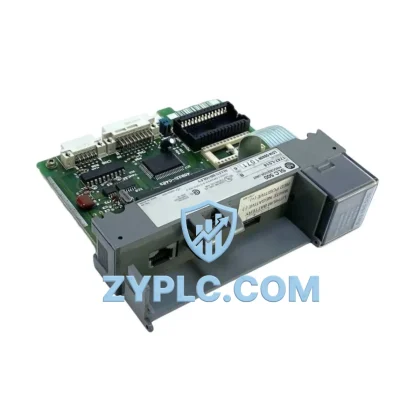
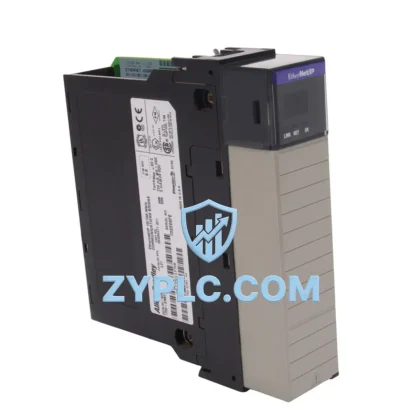
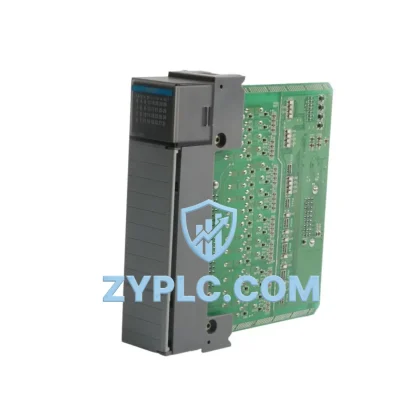
Allen-Bradley 1746-OG1 System-Ready DC Output for SLC 500 Control System Architecture
The Allen-Bradley 1746-OG1 is a 16-point DC output module engineered for seamless integration within the SLC 500 modular control platform. Rather than functioning as a standalone component, the 1746-OG1 occupies a defined role within a layered automation architecture — bridging the control layer decisions made by the SLC 5/04 or SLC 5/05 processor with the physical execution layer, including solenoids, relays, indicator lamps, and low-power actuators. Its position within the 1746 I/O chassis makes it a foundational element for engineers designing scalable, maintainable, and redundancy-capable industrial control systems across manufacturing, utilities, and process industries.
In a complete SLC 500 system architecture, the 1746-OG1 is installed into a 1746-A4, 1746-A7, 1746-A10, or 1746-A13 modular chassis alongside complementary I/O modules such as the 1746-IB16 DC input module and the 1746-IA16 AC input module. The processor — typically a 1747-L542 or 1747-L553 SLC 5/04 or 5/05 CPU — communicates with all chassis-resident modules via the SLC 500 backplane, ensuring deterministic scan-cycle execution and synchronized signal flow from input acquisition through logic processing to output actuation. This tightly integrated architecture eliminates inter-device communication latency and supports high-speed discrete control applications.
From a system hierarchy perspective, the 1746-OG1 operates at the I/O layer, receiving output commands from the processor’s output image table and driving field devices accordingly. Above it, the control layer is managed by the SLC processor in conjunction with RSLogix 500 or Studio 5000 Logix Designer programming environments. At the network layer, the SLC 5/05 variant supports Ethernet/IP connectivity, while the SLC 5/04 supports DH+ and RS-232 communication — enabling integration with SCADA systems, historian platforms, and HMI terminals such as the PanelView 600 or PanelView Plus 700. The 1746-OG1 itself does not require network configuration, as its operation is entirely governed by the processor’s I/O scan.
Power architecture is equally critical to system reliability. The 1746-OG1 requires a 1746-P1, 1746-P2, or 1746-P4 power supply module installed in the same chassis to provide regulated backplane power. Field-side DC power for the output circuits is supplied separately, allowing engineers to isolate control power from field power — a best practice in industrial panel design that reduces noise coupling and simplifies fault isolation. This separation also supports zone-based power distribution strategies commonly used in safety-critical applications.
For applications requiring system redundancy or expanded I/O capacity, the SLC 500 platform supports remote I/O expansion via the 1747-SN Scanner Module and 1747-ASB Adapter Module, enabling the 1746-OG1 to be deployed in remote chassis configurations. This is particularly valuable in large-scale installations such as water treatment facilities, mining conveyor systems, or petrochemical process units where field devices are distributed across significant distances. The remote I/O architecture maintains the same deterministic scan behavior as local chassis configurations, ensuring consistent output response times regardless of physical installation topology.
Maintenance and long-term serviceability are core considerations in SLC 500 system design. The 1746-OG1’s modular form factor allows field replacement without disturbing adjacent modules or rewiring terminal blocks, provided the chassis and power supply remain energized. Engineers can leverage the SLC processor’s fault routines and I/O status bits to implement predictive maintenance logic — monitoring output module health, detecting open-load conditions, and logging fault events to the processor’s data file for upstream SCADA analysis. This capability significantly reduces unplanned downtime in continuous-process environments.
Architecture Specification Table
| Parameter |
Specification |
| System Role |
Discrete DC Output Module — SLC 500 I/O Layer |
| SKU / Part Number |
1746-OG1 |
| Brand / Manufacturer |
Allen-Bradley (Rockwell Automation) |
| Compatible Platform |
SLC 500 (1746 Series Chassis) |
| Output Points |
16 Points (Sourcing DC Output) |
| Output Voltage Range |
10–50V DC |
| Output Current per Point |
0.5A maximum |
| Total Module Current |
4A maximum (all outputs energized) |
| Output Type |
Transistor (Sourcing / PNP) |
| Backplane Current Draw |
185mA @ 5V DC |
| Communication |
SLC 500 Backplane (Proprietary I/O Bus) |
| Compatible Chassis |
1746-A4, 1746-A7, 1746-A10, 1746-A13 |
| Compatible Processors |
SLC 5/01, 5/02, 5/03, 5/04, 5/05 |
| Operating Temperature |
0°C to 60°C (32°F to 140°F) |
| Relative Humidity |
5% to 95% (non-condensing) |
| Mounting |
Chassis Slot Mount (1746 Series) |
| Certifications |
UL Listed, CE Marked, CSA Certified |
| Warranty |
12-Month Warranty (ZYPLC) |
Coordinated Control System Design
The 1746-OG1 achieves its full performance potential when deployed as part of a coordinated SLC 500 control system. A typical architecture begins with the 1747-L553 SLC 5/05 processor as the central control node, executing ladder logic programs developed in RSLogix 500. The processor communicates with all I/O modules — including the 1746-OG1 — via the 1746 chassis backplane, with scan times typically ranging from 1ms to 10ms depending on program complexity and I/O count.
On the input side, the 1746-IB16 16-point DC input module and 1746-IA16 16-point AC input module provide field signal acquisition, feeding process status data into the processor’s input image table. The processor evaluates these inputs against programmed logic conditions and updates the output image table accordingly — driving the 1746-OG1’s 16 output points to control field actuators, motor starter coils, solenoid valves, and status indicators.
Power distribution is managed by the 1746-P2 power supply, which provides regulated 5V DC backplane power and supports chassis configurations of up to 10 slots. For larger installations requiring additional I/O capacity, the 1747-SN Remote I/O Scanner and 1747-ASB Adapter Module extend the system to remote chassis, allowing additional 1746-OG1 modules to be deployed at field locations without additional processor hardware.
At the human-machine interface layer, a PanelView Plus 700 or PanelView 600 terminal connects to the SLC 5/05 processor via Ethernet/IP or DH-485, providing operators with real-time system status visualization and manual control capability. This HMI integration is essential for applications requiring operator intervention, alarm acknowledgment, and production reporting.
For communication-intensive applications, the 1747-KE DH-485 to RS-232 Interface Module or the 1761-NET-ENI Ethernet Interface enables legacy SLC processors to participate in modern Ethernet/IP networks, facilitating integration with MES platforms, SCADA systems, and cloud-based analytics solutions. This network-layer flexibility ensures that SLC 500 systems — including those built around the 1746-OG1 — can be modernized incrementally without complete platform replacement.
Application in Layered Automation Systems
The 1746-OG1 is deployed across a broad spectrum of industrial automation applications where reliable discrete DC output control is required within an SLC 500 architecture.
In manufacturing and assembly line automation, the module controls pneumatic cylinder solenoids, conveyor drive enable signals, and part-present indicator lamps. Its 16-point density allows a single module to manage an entire workstation’s output requirements, reducing chassis slot consumption and simplifying panel wiring.
In water and wastewater treatment facilities, the 1746-OG1 drives pump motor starter coils, valve actuator signals, and chemical dosing system enable outputs. The module’s transistor output technology eliminates mechanical contact wear, extending maintenance intervals in continuously operating process environments.
In oil, gas, and petrochemical processing, the module is used within SLC 500-based safety interlock systems to control shutdown valve actuators and emergency stop relay coils. Its compatibility with the full SLC 500 processor family allows integration into both legacy and modernized control architectures without hardware redesign.
In mining and materials handling, the 1746-OG1 manages conveyor belt drive signals, crusher interlock outputs, and dust suppression system controls. The module’s wide operating temperature range and robust chassis mounting make it suitable for the demanding environmental conditions typical of mining control rooms and field enclosures.
In packaging and palletizing systems, the module controls servo drive enable signals, reject gate solenoids, and line status indicator outputs. Its deterministic backplane communication ensures synchronized output timing critical for high-speed packaging line coordination.
Architecture Engineering FAQ
Q1: Is the 1746-OG1 compatible with all SLC 500 processors, and are there any firmware or chassis slot restrictions?
The 1746-OG1 is compatible with all SLC 500 processor families, including the SLC 5/01 (1747-L511), SLC 5/02 (1747-L524), SLC 5/03 (1747-L531), SLC 5/04 (1747-L542/L543), and SLC 5/05 (1747-L551/L552/L553). It can be installed in any slot of a 1746-A4, A7, A10, or A13 chassis without slot-specific restrictions. No firmware updates are required for the module itself, as it is configured automatically by the processor during the I/O configuration scan. RSLogix 500 software is used to assign the module’s slot address and configure output data mapping within the processor’s output image table.
Q2: How does the 1746-OG1 support system redundancy and fault detection in critical control architectures?
While the SLC 500 platform does not natively support hot-standby processor redundancy (a feature available in the ControlLogix platform via the 1756-RM2 Redundancy Module), system-level redundancy for the 1746-OG1 can be achieved through architectural design strategies. These include dual-chassis configurations with manual or automated switchover logic, output circuit redundancy using parallel output points driving the same field device through diode isolation, and watchdog timer routines programmed in the SLC processor to detect output module faults and initiate safe-state transitions. The processor’s I/O fault detection routines continuously monitor module health and can trigger alarm outputs or safe-state logic upon detecting a module communication failure.
Q3: What is covered under the 12-Month Warranty, and what support is available for installation and commissioning?
ZYPLC’s 12-Month Warranty covers the 1746-OG1 against manufacturing defects, component failures, and functional non-conformance under normal operating conditions as specified in the Allen-Bradley product documentation. The warranty period begins from the date of shipment. All modules are tested prior to dispatch to verify output point functionality, backplane communication integrity, and electrical parameter compliance. For installation and commissioning support, ZYPLC’s technical team is available to assist with chassis slot assignment, RSLogix 500 I/O configuration, field wiring verification, and system integration troubleshooting. Contact our engineering support team at [email protected] or +86 19859288691 for pre-sales architecture consultation and post-sales technical assistance.
© 2026 ZYPLC. All rights reserved.
Original Source: https://zyplc.com
Contact: +86 19859288691 | [email protected]