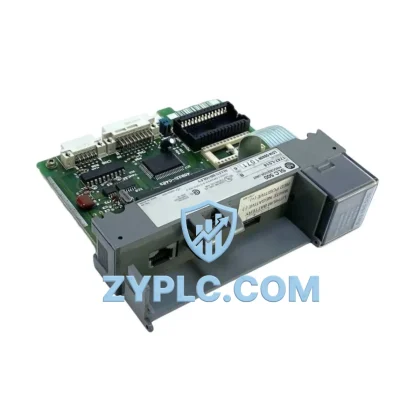
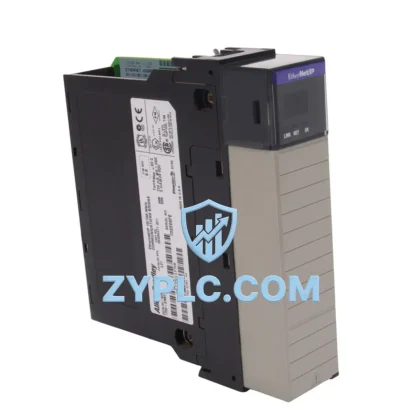
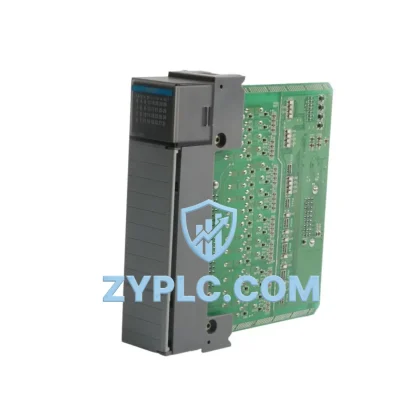
Allen-Bradley 1746-OW4 System-Ready Relay Output for SLC 500 Architecture
The Allen-Bradley 1746-OW4 is a four-point relay output module engineered for seamless integration within the SLC 500 modular control platform. Rather than functioning as a standalone component, the 1746-OW4 occupies a defined role within a layered automation architecture — bridging the control layer decisions made by the SLC 5/05 or SLC 5/04 processor with the physical execution layer, where motors, solenoids, contactors, and pilot devices respond to discrete command signals. Its relay-based output topology provides inherent electrical isolation between the control circuit and the field device circuit, making it a preferred choice in environments where load switching, voltage diversity, and signal integrity are critical engineering considerations.
In a complete SLC 500 system, the 1746-OW4 is installed into a 1746-A4, 1746-A7, 1746-A10, or 1746-A13 modular chassis alongside the processor, power supply, and complementary I/O modules. The chassis backplane provides both power distribution and high-speed data communication between all installed modules, ensuring that output commands from the CPU reach the 1746-OW4 within the processor scan cycle. This tight integration between the backplane architecture and the I/O module is fundamental to achieving deterministic control response — a requirement in process-critical applications such as chemical dosing, conveyor sequencing, and valve actuation in water treatment facilities.
System architects working with the SLC 500 platform frequently pair the 1746-OW4 with discrete input modules such as the 1746-IB16 or 1746-IA16 to create balanced I/O configurations. On the network layer, the SLC 5/05 processor’s built-in Ethernet/IP port or an optional 1747-SCNR ControlNet Scanner enables the entire rack to participate in a plant-wide communication network, exchanging data with upstream SCADA systems, historian servers, and peer PLCs. For installations requiring DeviceNet connectivity to field instruments and smart motor starters, the 1747-SDN DeviceNet Scanner module can be added to the same chassis, extending the system’s communication reach without requiring a separate gateway device.
Power supply selection is equally important to system reliability. The 1746-P1, 1746-P2, or 1746-P4 power supply modules are sized to match the chassis slot count and the aggregate current draw of all installed I/O modules, including the 1746-OW4. Proper power budgeting ensures that relay coil energization does not introduce voltage sag on the backplane bus, which could affect processor performance or cause spurious I/O faults. In redundant power architectures, dual power supply configurations with automatic switchover protect against single-point failures in mission-critical installations.
From a human-machine interface perspective, the 1746-OW4’s output states are directly visible and controllable through PanelView terminals connected via DH-485 or Ethernet/IP. Operators can monitor relay status, force outputs during commissioning, and acknowledge fault conditions without requiring a programming terminal. This integration between the HMI layer and the I/O layer accelerates startup procedures and reduces mean time to repair during production incidents. For facilities using FactoryTalk View SE or FactoryTalk View ME, tag databases can be configured to map directly to the 1746-OW4’s output bits, providing real-time visibility into relay state across the enterprise.
Long-term maintainability is a core design principle of the SLC 500 platform, and the 1746-OW4 reflects this philosophy. The module’s front-panel LED indicators provide immediate visual confirmation of each relay’s energized or de-energized state, enabling field technicians to diagnose wiring faults, blown fuses, or failed loads without connecting a laptop. Spare module inventory management is simplified by the 1746-OW4’s broad compatibility across all SLC 500 chassis generations, meaning a single spare can serve as a replacement across multiple machine lines or control panels within the same facility.
Industries that rely on the 1746-OW4 within their control architectures include automotive assembly, food and beverage processing, pharmaceutical manufacturing, oil and gas upstream and midstream operations, municipal water and wastewater treatment, mining and mineral processing, and metal fabrication. In each of these sectors, the module’s ability to switch AC and DC loads up to 240V AC / 125V DC at up to 2A per point makes it suitable for a wide range of field device types without requiring external interposing relays in most standard applications.
ZYPLC maintains verified stock of the Allen-Bradley 1746-OW4, sourced through established supply channels and subject to incoming inspection prior to dispatch. Every unit is covered by a 12-Month Warranty and supports Contextual Integration within existing SLC 500 system architectures. Our technical team can assist with module configuration, chassis compatibility verification, and system-level bill-of-materials review to ensure that your control architecture is complete, consistent, and ready for commissioning.
Architecture Specification Table
| System Role |
Discrete Relay Output Module — SLC 500 I/O Layer |
| Output Points |
4 relay output points (Form A / SPST-NO) |
| Output Voltage Range |
5–240V AC / 5–125V DC |
| Output Current Rating |
2A per point (resistive load) |
| Isolation |
Optical and mechanical isolation between control and field circuits |
| Backplane Current Draw |
75 mA @ 5V DC (typical) |
| Compatible Chassis |
1746-A4, 1746-A7, 1746-A10, 1746-A13 |
| Compatible Processors |
SLC 5/01, 5/02, 5/03, 5/04, 5/05 |
| Communication |
SLC 500 backplane (DH-485 / Ethernet/IP via processor) |
| Operating Temperature |
0°C to 60°C (32°F to 140°F) |
| Relative Humidity |
5% to 95% non-condensing |
| Mounting |
SLC 500 modular chassis slot (any I/O slot) |
| Indicators |
Per-point output status LEDs |
| Warranty |
12-Month Warranty — all units tested prior to dispatch |
Coordinated Control System Design
A complete SLC 500 control system built around the 1746-OW4 typically includes the following coordinated components: the SLC 5/05 processor (1747-L553) as the central CPU managing program execution and Ethernet/IP communications; a 1746-P2 power supply providing regulated 5V DC and 24V DC to the chassis backplane; 1746-IB16 DC input modules for capturing 24V DC discrete signals from field sensors and limit switches; a 1746-NI4 analog input module for process variable monitoring such as temperature or pressure; a 1747-SCNR ControlNet Scanner for plant-wide network integration; a 1747-SDN DeviceNet Scanner for smart field device connectivity; 1746-A10 chassis providing ten I/O slots for system expansion; PanelView 800 HMI terminals for operator interface and relay status visualization; 1492-IFM terminal blocks for organized field wiring termination; and Bulletin 700 relay modules for applications requiring higher current switching beyond the 1746-OW4’s native 2A rating. Each of these components participates in a defined system layer, and the 1746-OW4 serves as the execution-layer interface that translates CPU logic into physical switching actions.
Application in Layered Automation Systems
In municipal water treatment facilities, the 1746-OW4 controls pump start/stop sequences, valve actuators, and chemical dosing solenoids based on process logic executed by the SLC 5/05 processor. The relay output’s inherent isolation protects the control system from voltage transients generated by motor contactors and solenoid valves operating on 120V AC or 240V AC circuits.
In automotive assembly lines, the module manages conveyor indexing, fixture clamping, and part-present confirmation sequences within high-cycle-rate production environments. Its integration with the SLC 500 backplane ensures that output updates occur within the processor scan cycle, maintaining synchronization with upstream and downstream control stations.
In oil and gas midstream applications, the 1746-OW4 is deployed in pipeline control panels where it switches shutdown valves, compressor start circuits, and alarm annunciator relays. The module’s wide operating voltage range accommodates the mixed AC/DC field device environments common in remote pump stations and compressor facilities.
In pharmaceutical manufacturing, the module supports clean-in-place (CIP) and sterilize-in-place (SIP) sequences by controlling steam valves, rinse pumps, and drain solenoids. Its compatibility with FactoryTalk Batch and FactoryTalk View SE enables full recipe-driven automation with electronic batch record generation.
In mining and mineral processing, the 1746-OW4 controls crusher feed gates, conveyor belt starters, and dust suppression systems within harsh environments characterized by vibration, dust ingress, and wide ambient temperature swings — conditions within the module’s rated operating envelope.
Architecture Engineering FAQ
Q1: Is the 1746-OW4 compatible with all SLC 500 chassis and processor combinations?
The 1746-OW4 is compatible with all SLC 500 modular chassis (1746-A4 through 1746-A13) and all SLC 500 processor families (SLC 5/01 through SLC 5/05). It occupies any standard I/O slot and is addressed automatically by the processor during the I/O configuration scan. No special firmware or processor revision is required for basic relay output operation.
Q2: Can the 1746-OW4 be used in a redundant control architecture?
While the SLC 500 platform does not natively support hot-standby CPU redundancy in the same manner as the ControlLogix 1756-L7xS series, system-level redundancy can be achieved through dual-chassis configurations with cross-wired output circuits, or by migrating to a ControlLogix architecture for applications requiring IEC 61511 SIL-rated redundancy. For standard SLC 500 installations, the 1746-OW4’s relay contacts can be wired in series or parallel to implement basic output redundancy at the field device level.
Q3: What does the 12-Month Warranty cover, and how does ZYPLC support long-term maintenance?
The 12-Month Warranty covers manufacturing defects, relay contact failure, and backplane interface faults identified under normal operating conditions. ZYPLC provides pre-shipment functional testing on all 1746-OW4 units, including relay coil energization verification and contact resistance measurement. For long-term maintenance support, ZYPLC maintains ongoing stock of the 1746-OW4 and compatible SLC 500 components, enabling rapid replacement procurement without extended lead times. Technical support for installation, configuration, and system compatibility questions is available through our sales and engineering team.
© 2026 ZYPLC. All rights reserved.
Original Source: https://zyplc.com
Contact: +86 19859288691 | plc.sales@zyplc.com