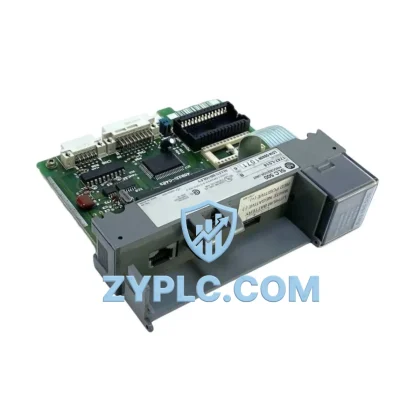
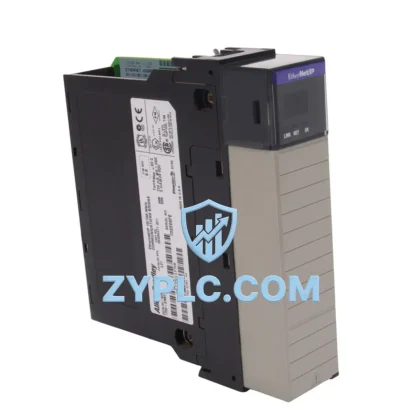
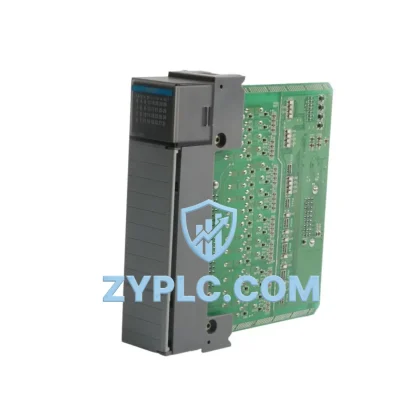
Allen-Bradley 1746SC-INI4VI System-Ready Isolated Analog Input for SLC 500 Architecture
The Allen-Bradley 1746SC-INI4VI is a four-channel isolated analog input module engineered for seamless integration within the SLC 500 modular control platform. Designed to accept both voltage and current signals simultaneously across independent, galvanically isolated channels, this module occupies a single slot in the 1746 I/O chassis and communicates directly with the SLC 500 processor backplane. Its role within a layered automation architecture is not limited to signal acquisition — it serves as the critical interface between field instrumentation and the control layer, ensuring that process variables are accurately digitized, electrically isolated, and delivered to the CPU for real-time decision-making. With a 12-Month Warranty and full Contextual Integration capability, the 1746SC-INI4VI is a dependable long-term component for demanding industrial environments.
In modern industrial control system design, the analog input layer must be treated as a structural element rather than a peripheral accessory. The 1746SC-INI4VI fulfills this requirement by providing per-channel isolation that eliminates ground loop interference — a common source of signal degradation in process plants, power substations, and chemical facilities. Each channel independently floats from the system common, allowing engineers to connect transmitters from different field loops without introducing cross-channel noise. This isolation architecture is particularly valuable in applications where 4–20 mA current loop transmitters are distributed across large physical distances, such as pipeline monitoring, water treatment SCADA systems, and mining conveyor control.
From a system architecture perspective, the 1746SC-INI4VI integrates into the SLC 500 platform alongside a broad ecosystem of complementary modules. The processor — typically a 1747-L553 or 1747-L543 — manages the backplane scan cycle and maps the analog data from the 1746SC-INI4VI into the integer file (N7) or floating-point file (F8) for use in ladder logic or structured text routines. Power for the I/O chassis is supplied by a 1746-P4 or 1746-P7 power supply, which must be sized to accommodate the additional current draw of isolated analog modules. The chassis itself — available in configurations such as the 1746-A4, 1746-A7, or 1746-A13 — determines the total slot count and physical footprint of the control panel.
Architecture Specification Table
| Parameter |
Specification |
| System Role |
Isolated Analog Input Module — SLC 500 I/O Layer |
| Input Channels |
4 Channels (Voltage & Current, Isolated per Channel) |
| Input Signal Range |
±10 VDC (Voltage); 4–20 mA / 0–20 mA (Current) |
| Resolution |
12-bit (1 in 4,096) |
| Isolation |
Channel-to-Channel & Channel-to-Backplane Galvanic Isolation |
| Backplane Communication |
SLC 500 Parallel Backplane (1746 Series) |
| Chassis Compatibility |
1746-A4, 1746-A7, 1746-A10, 1746-A13 |
| Slot Requirement |
Single Slot |
| Operating Temperature |
0°C to 60°C (32°F to 140°F) |
| Storage Temperature |
-40°C to 85°C |
| Relative Humidity |
5% to 95% Non-Condensing |
| Power Consumption |
Supplied via 1746 Backplane (5 VDC) |
| Certifications |
UL Listed, CE Marked, CSA Certified |
| Warranty |
12-Month Warranty — Tested, Verified, Ready to Ship |
Coordinated Control System Design
The 1746SC-INI4VI does not operate in isolation — its value is realized through coordinated integration with the full SLC 500 control architecture. At the processor level, the 1747-L553 CPU reads the digitized analog values from the module during each I/O scan and makes them available to the application program. For applications requiring higher processing throughput or redundancy, engineers may pair the SLC 500 rack with a ControlLogix 1756-L73 gateway controller, using a 1756-DHRIO communication module to bridge the DH+ network and enable supervisory data exchange between platforms.
On the output side, the analog signals processed by the 1746SC-INI4VI may drive control decisions that are executed through a 1746-NO4I analog output module, which sends 4–20 mA commands to variable frequency drives, control valves, or positioners. Digital I/O modules such as the 1746-IB16 (DC input) and 1746-OB16 (DC output) handle discrete field devices — limit switches, solenoids, and motor starters — within the same chassis, creating a unified I/O environment managed by a single processor scan.
Network connectivity is provided through a 1747-SDN DeviceNet Scanner module or a 1747-AENTR EtherNet/IP adapter, enabling the SLC 500 rack to participate in plant-wide communication networks alongside SCADA systems, historian servers, and HMI terminals. The PanelView 800 or PanelView Plus 7 operator interface connects via EtherNet/IP or DH-485, providing operators with real-time visibility into the analog process values acquired by the 1746SC-INI4VI. Terminal block assemblies such as the 1492-CABLE series simplify field wiring and reduce installation time, while also supporting structured maintenance procedures during annual calibration cycles.
Application in Layered Automation Systems
The 1746SC-INI4VI is deployed across a wide range of process and discrete manufacturing environments where isolated analog signal acquisition is a fundamental requirement. In water and wastewater treatment facilities, the module reads 4–20 mA signals from flow transmitters, level sensors, pH analyzers, and dissolved oxygen probes, feeding real-time data to the SLC 500 processor for PID control of dosing pumps and aeration blowers. The per-channel isolation prevents ground faults in one field loop from corrupting measurements in adjacent channels — a critical safety feature in facilities where instrumentation is distributed across large outdoor areas with varying ground potentials.
In the power generation and electrical substation sector, the 1746SC-INI4VI monitors current transformers, voltage transducers, and temperature sensors on switchgear and transformer banks. The galvanic isolation between channels and the backplane ensures that high-voltage transients on the field side do not propagate into the control system, protecting the SLC 500 processor and the broader SCADA infrastructure. In oil and gas upstream applications, the module acquires pressure and temperature signals from wellhead instrumentation, supporting remote monitoring over SCADA networks with DH+ or EtherNet/IP connectivity.
Packaging and food processing lines use the 1746SC-INI4VI to monitor load cells, tension sensors, and temperature probes on conveyor and filling systems. The module’s ability to accept both voltage and current inputs on the same chassis eliminates the need for separate signal conditioning hardware, reducing panel footprint and wiring complexity. In metallurgical and mining applications, the module handles signals from vibration sensors, torque transducers, and motor current monitors on crushers, mills, and hoisting systems, where reliable analog acquisition is essential for predictive maintenance programs.
Architecture Engineering FAQ
Q1: Is the 1746SC-INI4VI compatible with all SLC 500 processors and chassis configurations?
The 1746SC-INI4VI is compatible with all SLC 500 fixed and modular processors, including the 1747-L511, 1747-L524, 1747-L531, 1747-L541, 1747-L543, and 1747-L553, when installed in any 1746-series chassis (1746-A4, A7, A10, A13). The module occupies one I/O slot and is addressed through the standard SLC 500 I/O configuration in RSLogix 500 or Studio 5000 Logix Designer (for legacy migration projects). No special firmware or hardware revision is required for integration, making it a straightforward drop-in replacement or expansion module in existing SLC 500 architectures.
Q2: How does the per-channel isolation affect system architecture and wiring design?
The galvanic isolation on each channel of the 1746SC-INI4VI allows field transmitters from different electrical zones to be connected to the same module without sharing a common reference. This eliminates ground loop currents that would otherwise introduce offset errors or noise into analog measurements. From a wiring design perspective, each channel can be treated as an independent, floating input — simplifying the design of intrinsically safe barriers, signal isolators, and surge protection circuits. In redundant control architectures, this isolation also allows the same field transmitter to feed both a primary and a backup SLC 500 rack without creating a common-mode fault path.
Q3: What does the 12-Month Warranty cover, and how does it support long-term maintenance planning?
The 12-Month Warranty covers the 1746SC-INI4VI against defects in materials and workmanship under normal operating conditions. Each unit is tested prior to shipment to verify channel accuracy, isolation integrity, and backplane communication. For maintenance engineers managing aging SLC 500 installations, this warranty provides a reliable basis for spare parts planning — modules can be held in inventory as hot-swap replacements without concern about receiving untested or degraded units. The warranty period aligns with typical annual maintenance cycles in process industries, supporting structured replacement programs and minimizing unplanned downtime risk.
© 2026 ZYPLC. All rights reserved.
Original Source: https://zyplc.com
Contact: +86 19859288691 | plc.sales@zyplc.com