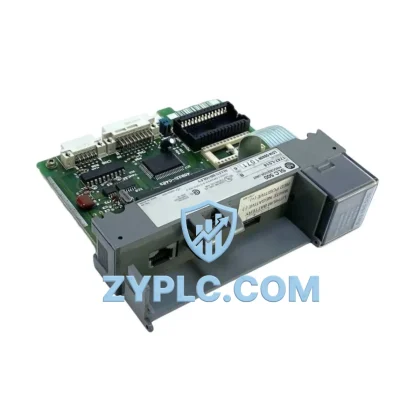
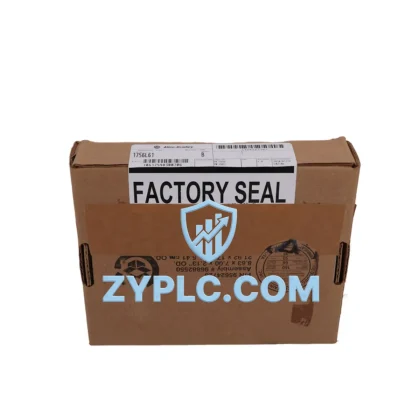
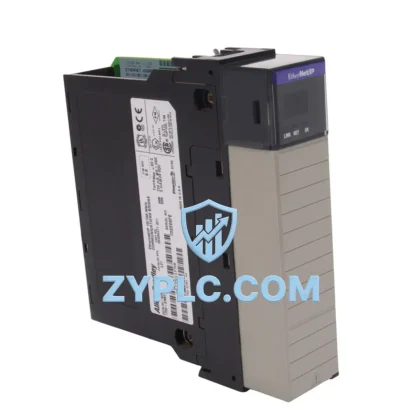
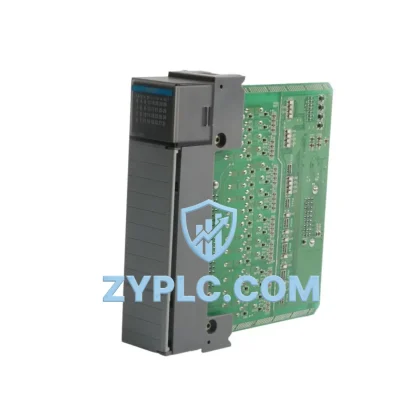
Allen-Bradley 1747-KE System-Ready DH-485 Interface for SLC 500 Control Architecture
The Allen-Bradley 1747-KE is a dedicated DH-485 interface module engineered for seamless integration within the SLC 500 control system architecture. Designed to bridge serial communication between host computers, programming terminals, and the SLC 500 backplane network, this module plays a critical role in maintaining data integrity and communication stability across multi-node industrial automation environments. Rather than functioning as a standalone device, the 1747-KE is most effectively understood as a contextual integration component — one that enables the SLC 500 platform to participate in broader, layered automation architectures spanning control, I/O, network, power, HMI, and execution layers.
In modern industrial control system design, the communication layer is as important as the processing layer. The 1747-KE provides the DH-485 network interface that allows the SLC 500 CPU — such as the 1747-L532 or 1747-L543 — to communicate with upstream SCADA systems, programming workstations running RSLogix 500, and peer controllers on the same network segment. This contextual integration capability ensures that the SLC 500 does not operate in isolation but instead functions as a coordinated node within a plant-wide control hierarchy.
Architecture Specification Table
| Parameter |
Specification |
| System Role |
DH-485 Network Interface Module for SLC 500 Backplane |
| Compatible Platform |
Allen-Bradley SLC 500 Series (1746 Chassis) |
| Communication Protocol |
DH-485 (Data Highway 485), RS-485 Physical Layer |
| Network Nodes Supported |
Up to 32 nodes per DH-485 segment |
| Baud Rate |
1200 / 2400 / 4800 / 9600 / 19200 bps (selectable) |
| Electrical Interface |
RS-232C (DTE) to DH-485 conversion |
| Power Consumption |
Supplied via SLC 500 backplane (1746 chassis) |
| Operating Temperature |
0°C to 60°C (32°F to 140°F) |
| Relative Humidity |
5% to 95% non-condensing |
| Installation Environment |
Panel-mount within 1746 modular chassis |
| Certifications |
UL Listed, CE Marked |
| Warranty |
12-Month Warranty — Tested, verified, and ready to deploy |
Coordinated Control System Design
The 1747-KE achieves its full value when considered within the complete SLC 500 system architecture. At the control layer, the module works in direct coordination with SLC 500 CPUs such as the 1747-L532 and 1747-L543, which execute ladder logic programs and manage I/O scanning cycles. The 1747-KE provides these processors with a reliable DH-485 communication path, enabling real-time data exchange with programming devices and supervisory systems without interrupting the CPU scan cycle.
At the I/O layer, the SLC 500 platform relies on a range of 1746-series I/O modules — including the 1746-IB16 digital input module, 1746-OB16 digital output module, and 1746-NI4 analog input module — all housed within the 1746-A7 or 1746-A13 modular chassis. The 1747-KE ensures that data from these I/O modules can be accessed remotely by SCADA or MES systems via the DH-485 network, supporting real-time monitoring and remote diagnostics without requiring physical access to the control cabinet.
At the network layer, the 1747-KE interfaces with the DH-485 segment, which may also include other SLC 500 nodes, 1747-AIC advanced interface converters, and 1761-NET-AIC network interface converters for MicroLogix integration. This multi-node architecture allows plant engineers to build distributed control topologies where multiple SLC 500 controllers share process data across a common communication backbone, improving system-wide visibility and reducing wiring complexity.
At the power layer, the 1746-P4 power supply module provides stable backplane power to the 1747-KE and all co-installed I/O modules, ensuring consistent electrical performance even under variable load conditions. Proper power architecture is essential for maintaining DH-485 communication stability, particularly in environments with high electromagnetic interference such as motor drive panels or high-voltage switchgear enclosures.
At the HMI layer, the 1747-KE enables connectivity between the SLC 500 CPU and operator interface terminals such as the 2711-T10C8 PanelView 1000 or other DH-485-compatible HMI devices. This allows operators to monitor process variables, acknowledge alarms, and adjust setpoints directly from the control panel, with data flowing reliably through the DH-485 network managed by the 1747-KE interface module.
At the execution layer, variable frequency drives, servo amplifiers, and relay output modules receive commands from the SLC 500 CPU, with the 1747-KE ensuring that upstream supervisory commands are accurately relayed to the controller for execution. This end-to-end signal flow — from SCADA through the DH-485 network, into the SLC 500 CPU, and out to field devices — represents the core value proposition of the 1747-KE in a fully integrated control architecture.
Application in Layered Automation Systems
The Allen-Bradley 1747-KE finds application across a wide range of industrial sectors where the SLC 500 platform remains the backbone of process control. In manufacturing and assembly lines, the module enables centralized monitoring of multiple SLC 500 controllers managing conveyor systems, robotic work cells, and quality inspection stations. Plant engineers can connect a single programming workstation to the DH-485 network and access all connected controllers simultaneously, dramatically reducing commissioning time and ongoing maintenance overhead.
In power distribution and electrical substation applications, the 1747-KE supports integration of SLC 500 controllers with SCADA systems monitoring transformer status, breaker positions, and load balancing parameters. The DH-485 network’s deterministic communication characteristics make it well-suited for time-sensitive data acquisition in electrical infrastructure environments.
In petrochemical and refinery applications, the 1747-KE enables SLC 500 controllers to participate in distributed control architectures where process variables such as flow rate, pressure, and temperature must be continuously monitored and logged. The module’s ability to support up to 32 network nodes allows engineers to build scalable communication topologies that grow with plant expansion requirements.
In water and wastewater treatment facilities, the 1747-KE provides the communication link between SLC 500 controllers managing pump stations, chemical dosing systems, and filtration processes, and the central SCADA platform used by operators to monitor plant-wide performance. The module’s robust RS-485 physical layer ensures reliable communication even over extended cable runs typical of large treatment facilities.
In mining, metallurgy, and heavy industry environments, the 1747-KE supports SLC 500 integration in applications such as conveyor belt control, crusher management, and smelting process monitoring. The module’s industrial-grade design and compatibility with the 1746 chassis system ensures reliable operation in high-vibration, high-temperature environments common in these sectors.
Architecture Engineering FAQ
Q1: Is the 1747-KE compatible with all SLC 500 chassis configurations, and can it coexist with other communication modules in the same rack?
A: Yes. The 1747-KE is designed for installation in any 1746-series modular chassis, including the 1746-A4, 1746-A7, 1746-A10, and 1746-A13. It occupies a single I/O slot and draws power from the backplane, making it compatible with all standard SLC 500 rack configurations. Multiple communication modules, including the 1747-KE and other interface cards, can coexist in the same chassis provided the power supply capacity — typically the 1746-P4 — is sufficient to support the total backplane load. Engineers should verify slot addressing and node ID assignments to avoid network conflicts during commissioning.
Q2: How does the 1747-KE support long-term maintenance and system expandability in aging SLC 500 installations?
A: The 1747-KE is a critical spare component for any facility running SLC 500 architecture, as it provides the primary communication path for remote programming, diagnostics, and SCADA integration. Maintaining a stocked spare of the 1747-KE ensures that communication failures — which can halt remote monitoring and programming access — can be resolved quickly without extended downtime. Our 12-Month Warranty covers the module against defects in materials and workmanship, and each unit is tested prior to shipment to verify DH-485 communication functionality. For facilities planning system expansion, the 1747-KE supports up to 32 nodes per DH-485 segment, providing ample headroom for adding additional SLC 500 controllers or HMI devices as production requirements grow.
Q3: What are the key installation and commissioning considerations when integrating the 1747-KE into an existing DH-485 network?
A: Successful integration of the 1747-KE requires attention to several key parameters. First, the DH-485 network node address must be set correctly using the module’s onboard switches, ensuring no address conflicts with existing nodes. Second, the baud rate must be configured to match the network-wide setting — all devices on a DH-485 segment must operate at the same baud rate. Third, proper cable termination is essential: the DH-485 network requires 120-ohm termination resistors at both ends of the cable run to prevent signal reflections that can cause communication errors. Finally, the RS-232 port on the 1747-KE should be connected to the host device using a properly shielded cable, with the shield grounded at one end only to minimize ground loop interference. Following these commissioning steps ensures stable, long-term DH-485 communication performance in demanding industrial environments.
© 2026 ZYPLC. All rights reserved.
Original Source: https://zyplc.com
Contact: +86 19859288691 | [email protected]