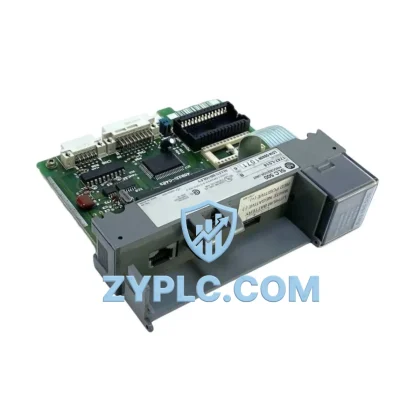
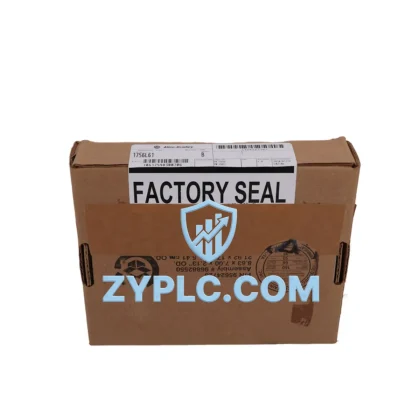
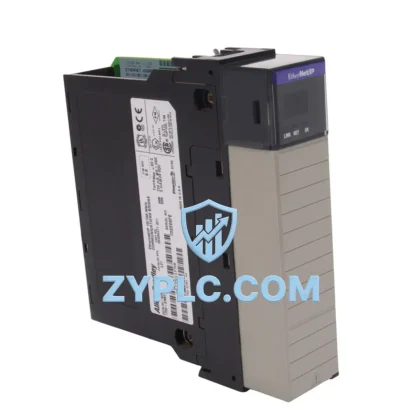
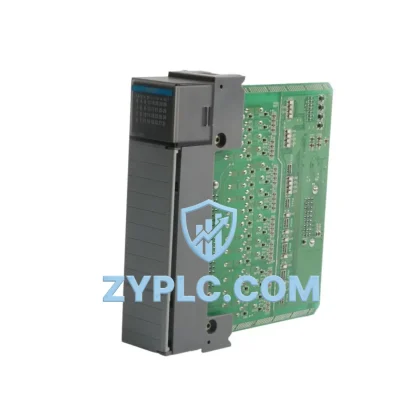
Allen-Bradley 1747-L542 System-Ready Processor for SLC 500 Architecture
The Allen-Bradley 1747-L542 is a high-performance processor module engineered for deployment within the SLC 500 modular control platform — one of Rockwell Automation’s most enduring and widely adopted small-to-mid-range PLC families. Rather than functioning as a standalone unit, the 1747-L542 is designed from the ground up to serve as the computational core of a layered, multi-tier automation architecture. Its role spans from real-time ladder logic execution and I/O data management to coordinated communication across distributed control networks. Understanding the 1747-L542 in the context of the full SLC 500 system architecture — rather than as an isolated component — is essential for engineers responsible for system design, commissioning, long-term maintenance, and capacity expansion.
In a complete SLC 500 control system, the 1747-L542 processor occupies the control layer, where it continuously scans the I/O image table, executes user-defined ladder logic programs, and manages data exchange with peripheral devices. The processor is housed within a 1746 series chassis — typically a 1746-A4, 1746-A7, 1746-A10, or 1746-A13 — which provides the physical backplane for all installed I/O and communication modules. The backplane serves as the high-speed data bus connecting the processor to discrete input modules such as the 1746-IB16, discrete output modules such as the 1746-OB16, analog input modules such as the 1746-NI4, and analog output modules such as the 1746-NO4I. This tight integration between the processor and the I/O layer ensures deterministic scan times and reliable signal processing across all connected field devices.
At the network and communication layer, the 1747-L542 supports DH-485 (Data Highway 485) natively through its built-in communication port, enabling peer-to-peer messaging and programming access via RSLogix 500 software. For broader network connectivity — including integration with EtherNet/IP, ControlNet, or DeviceNet — the system relies on dedicated communication modules such as the 1747-SDN (DeviceNet Scanner), 1747-KE (DH-485 to RS-232 gateway), or 1761-NET-ENI Ethernet interface adapter. These modules extend the processor’s reach into plant-wide SCADA systems, historian platforms, and supervisory HMI layers without requiring processor replacement or architectural redesign.
The human-machine interface layer in SLC 500 architectures typically includes PanelView terminals — such as the PanelView 300, PanelView 550, or PanelView 1000 — connected via DH-485 or RS-232 to the processor. These HMI devices provide operators with real-time process visualization, alarm management, and manual override capability. The 1747-L542 processor’s data table structure — including integer files, binary files, timer and counter files, and control files — maps directly to HMI tag databases, enabling seamless Contextual Integration between the control layer and the operator interface layer.
Power integrity is a foundational requirement for any SLC 500 system. The 1747-L542 processor and all installed I/O modules are powered through a 1746-series power supply module — such as the 1746-P1, 1746-P2, or 1746-P4 — mounted within the same chassis. These power supplies deliver regulated 5 VDC backplane power and 24 VDC field power, ensuring stable operation across the full industrial temperature range. For mission-critical applications requiring continuous uptime, redundant power supply configurations or UPS-backed power distribution panels are recommended to complement the processor’s operational reliability.
At the execution layer, the 1747-L542 coordinates output signals to motor starters, variable frequency drives (VFDs), solenoid valves, and relay output modules. In process control applications, the processor’s PID instruction set enables closed-loop control of temperature, pressure, flow, and level — directly from the ladder logic program without requiring external controllers. This embedded process control capability makes the 1747-L542 particularly well-suited for applications in water treatment, chemical dosing, HVAC control, and continuous manufacturing lines.
Architecture Specification Table
| Parameter |
Specification |
| System Role |
SLC 500 Modular Processor — Control Layer |
| Platform |
Allen-Bradley SLC 500 (1746 Chassis) |
| Memory |
4K Words User Program / 4K Words Data |
| I/O Capacity |
Up to 4096 I/O points (local + expanded) |
| Communication Port |
DH-485 (built-in), RS-232 compatible |
| Programming Software |
RSLogix 500 / APS (Allen-Bradley Programming Software) |
| Scan Time |
Deterministic, ladder-logic based |
| Power Supply |
Via 1746-series chassis power supply (1746-P1/P2/P4) |
| Operating Temperature |
0°C to 60°C (32°F to 140°F) |
| Relative Humidity |
5% to 95% non-condensing |
| Mounting |
1746 modular chassis (slot 0) |
| Certifications |
UL, CE, CSA (typical for SLC 500 series) |
| Origin |
United States |
| Warranty |
12-Month Warranty (ZYPLC) |
Coordinated Control System Design
The 1747-L542 achieves its full potential only when integrated within a properly engineered SLC 500 system architecture. A typical coordinated system begins with chassis selection — the 1746-A7 or 1746-A10 chassis provides sufficient slot capacity for the processor plus a balanced mix of I/O and communication modules. Discrete I/O modules such as the 1746-IB16 (16-point 24 VDC input) and 1746-OB16 (16-point 24 VDC output) handle the majority of field signal connections, while analog modules such as the 1746-NI4 (4-channel analog input) and 1746-NO4I (4-channel analog output) manage process variable measurement and control signal generation.
For applications requiring expanded I/O beyond the local chassis, the 1747-SN Remote I/O Scanner module enables the processor to communicate with remote 1746 I/O chassis over the Remote I/O (RIO) network — extending the system’s physical reach without increasing processor scan time proportionally. Communication gateways such as the 1747-SDN DeviceNet Scanner allow the processor to manage smart field devices including variable frequency drives, smart sensors, and distributed I/O blocks on a DeviceNet network segment. The 1761-NET-ENI adapter provides EtherNet/IP connectivity for integration with plant-level MES and SCADA systems.
Terminal block modules and wiring accessories — including 1492-series terminal blocks and 1492-IFM interface modules — simplify field wiring connections to I/O modules, reduce installation time, and improve long-term maintainability. Relay output modules such as the 1746-OW16 provide isolated contact outputs for controlling high-voltage loads, motor starters, and safety circuits. Together, these components form a cohesive, scalable control architecture centered on the 1747-L542 processor.
Application in Layered Automation Systems
The 1747-L542 processor has demonstrated reliable performance across a broad spectrum of industrial automation applications. In water and wastewater treatment facilities, the processor manages pump sequencing, chemical dosing control, and level regulation across multiple process tanks — with PID loops handling continuous flow and pressure control. In power distribution substations and utility switchgear panels, the SLC 500 platform provides reliable discrete control of circuit breakers, transfer switches, and alarm annunciation systems.
In petrochemical and refinery applications, the 1747-L542 supports batch process control, valve sequencing, and safety interlock logic — often operating in conjunction with dedicated safety relay modules and emergency shutdown (ESD) systems. In mining and mineral processing operations, the processor controls conveyor systems, crusher sequencing, and material handling automation, where robust performance under harsh environmental conditions is essential. In metallurgical and steel mill applications, the SLC 500 platform manages furnace temperature control, rolling mill sequencing, and cooling system automation.
In packaging and discrete manufacturing lines, the 1747-L542 coordinates high-speed discrete I/O for product counting, reject systems, label applicators, and conveyor indexing. Its deterministic scan time and reliable DH-485 communication make it well-suited for synchronized multi-axis applications where timing consistency is critical. Across all these industries, the processor’s proven architecture, wide availability of spare modules, and compatibility with RSLogix 500 programming tools ensure that engineering teams can commission, troubleshoot, and maintain systems efficiently over multi-decade operational lifespans.
Architecture Engineering FAQ
Q1: Is the 1747-L542 compatible with existing SLC 500 chassis and I/O modules already installed in my facility?
Yes. The 1747-L542 is fully compatible with all 1746-series modular chassis (1746-A4, A7, A10, A13) and the complete range of 1746-series I/O modules. It occupies slot 0 of the chassis and communicates with all installed I/O modules via the backplane. Existing field wiring, I/O modules, and power supplies do not require replacement when upgrading or replacing the processor module, making it an efficient solution for system refresh projects.
Q2: Can the 1747-L542 be integrated into a larger plant-wide control network alongside newer ControlLogix or CompactLogix systems?
Yes. Through the use of communication gateway modules such as the 1761-NET-ENI EtherNet/IP adapter or the 1747-KE DH-485 to RS-232 gateway, the 1747-L542 can exchange data with ControlLogix L-series processors, CompactLogix systems, and SCADA platforms via MSG (message) instructions. This Contextual Integration capability allows the SLC 500 system to participate in a unified plant-wide data architecture without requiring full system replacement.
Q3: What does the 12-Month Warranty cover, and what support is available for long-term maintenance?
ZYPLC’s 12-Month Warranty covers the 1747-L542 processor against manufacturing defects and functional failures under normal operating conditions. All units are tested prior to shipment to verify correct operation. For long-term maintenance planning, ZYPLC maintains inventory of SLC 500 processor modules, I/O modules, power supplies, and chassis components to support ongoing spare parts requirements. Technical support for installation, configuration, and system integration is available through our engineering team.
© 2026 ZYPLC. All rights reserved.
Original Source: https://zyplc.com
Contact: +86 19859288691 | [email protected]