Allen-Bradley 1747-L551/C System-Ready Processor for SLC 500 Architecture: Control System Architecture and Upstream-Downstream Coordination
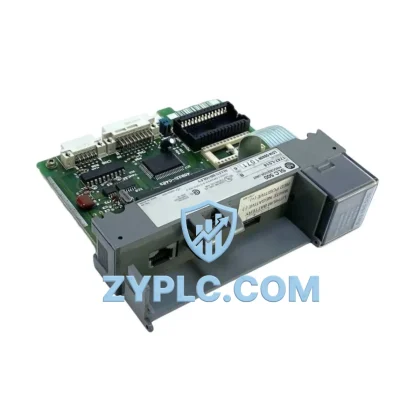
The Allen-Bradley 1747-L551/C is a fixed-chassis SLC 500 series CPU module engineered for deterministic, ladder-logic-based control in demanding industrial environments. As a core processing unit within the SLC 500 platform, this module occupies the central position in a layered automation hierarchy — coordinating signal acquisition from the I/O layer, executing user programs in real time, and maintaining communication integrity across the network layer. Its role is not simply that of a standalone controller; it is the architectural anchor that defines system throughput, scan cycle consistency, and long-term maintainability across the entire control cabinet.
In a fully realized SLC 500 control architecture, the 1747-L551/C operates within a 1746-series fixed chassis, sharing the backplane with discrete and analog I/O modules such as the 1746-IB16 (16-point 24VDC input), 1746-OB16 (16-point transistor output), and 1746-NI4 (4-channel analog input). The processor’s memory capacity and instruction set support complex interlocking logic, PID loops, and sequencer functions — making it suitable for multi-zone process control without requiring a modular ControlLogix or CompactLogix platform. This positions the 1747-L551/C as a cost-effective yet capable solution for retrofit projects, standalone machine control, and distributed control nodes within larger SCADA architectures.
Architecture Specification Table
| Parameter |
Specification |
| System Role |
Central Processing Unit — SLC 500 Fixed Chassis Architecture |
| Series / Platform |
Allen-Bradley SLC 500 (1747 Series) |
| Processor Type |
Fixed Chassis CPU, Ladder Logic / Instruction List |
| Memory |
16K Words User Program Memory (estimated per L55x series) |
| I/O Capacity |
Up to 4096 I/O points (system-level, chassis-dependent) |
| Communication Port |
RS-232 DH-485 / DF1 Protocol (Channel 0) |
| Network Compatibility |
DH-485, DF1 Full/Half Duplex, DeviceNet (via gateway) |
| Scan Time |
Deterministic ladder scan; application-dependent |
| Power Supply Compatibility |
1746-P1 / 1746-P2 / 1746-P4 SLC 500 Power Supply Modules |
| Operating Temperature |
0°C to 60°C (32°F to 140°F) |
| Relative Humidity |
5% to 95% non-condensing |
| Mounting |
Fixed chassis backplane (1746-A4 / 1746-A7 / 1746-A10 / 1746-A13) |
| Programming Software |
RSLogix 500 / RSLogix Micro |
| Electrical Standard |
UL Listed, CE Marked |
| Warranty |
12-Month Warranty — Covered by ZYPLC Quality Assurance Program |
Coordinated Control System Design
The 1747-L551/C achieves its full potential when integrated within a coherent system architecture rather than deployed in isolation. At the power layer, the 1746-P2 or 1746-P4 power supply module provides regulated DC power to the chassis backplane, ensuring stable voltage delivery to the processor and all co-resident I/O modules. Voltage fluctuations at this layer directly impact processor scan integrity, making power supply selection a critical architectural decision.
At the I/O layer, the processor interfaces with 1746-series discrete and analog modules mounted in the same fixed chassis. Modules such as the 1746-OW16 (relay output), 1746-IA16 (120VAC input), and 1746-NIO4I (analog combo module) extend the processor’s reach into the physical process — reading sensor signals, driving actuators, and closing control loops. The 1747-L551/C’s backplane communication ensures deterministic data exchange with these modules at every scan cycle, maintaining signal fidelity across the I/O layer.
At the network layer, the processor’s Channel 0 RS-232 port supports DF1 Full Duplex communication for point-to-point SCADA connectivity, as well as DH-485 multi-drop networking for peer-to-peer data exchange between multiple SLC 500 nodes. For facilities requiring DeviceNet or EtherNet/IP integration, a 1747-SDN DeviceNet Scanner or a 1761-NET-ENI EtherNet/IP interface module can be added to bridge the SLC 500 platform into modern network topologies without replacing the core controller.
At the human-machine interface layer, the 1747-L551/C communicates natively with PanelView 300 and PanelView 550 terminals via DH-485, enabling operators to monitor process variables, acknowledge alarms, and adjust setpoints in real time. For more advanced visualization requirements, a PanelView Plus 600 or 700 connected via EtherNet/IP through a gateway adapter provides a migration path to modern HMI platforms while preserving the existing SLC 500 control logic investment.
At the execution layer, the processor’s output modules drive motor starters, solenoid valves, variable frequency drives (VFDs), and pneumatic actuators. In coordinated motion applications, the 1747-L551/C can interface with PowerFlex 40 or PowerFlex 400 drives via hardwired I/O or DeviceNet, enabling speed reference and run/stop commands to be managed directly from the ladder program. This tight integration between the CPU, I/O modules, and drive systems ensures consistent machine behavior across all operating modes.
Application in Layered Automation Systems
Manufacturing and Discrete Assembly: In automotive component assembly lines and electronics manufacturing facilities, the 1747-L551/C manages conveyor sequencing, part presence detection, and reject gate control. Its deterministic scan cycle ensures that high-speed discrete events — such as part ejection triggers or vision system handshakes — are processed within defined time windows, maintaining line throughput and quality consistency.
Power Distribution and Electrical Utilities: In medium-voltage switchgear panels and substation automation applications, the processor handles protection relay interlocking, breaker status monitoring, and load-shedding logic. The DH-485 network capability allows multiple SLC 500 nodes to share status data across a substation without requiring a full DCS infrastructure, reducing capital expenditure while maintaining operational visibility.
Water and Wastewater Treatment: Municipal water treatment plants deploy the 1747-L551/C for pump station control, chemical dosing sequencing, and level-based alarming. The processor’s analog I/O compatibility — through co-resident 1746-NI4 or 1746-NIO4I modules — enables closed-loop PID control of flow rates and chemical feed pumps, supporting regulatory compliance with minimal operator intervention.
Oil, Gas, and Petrochemical Processing: In wellhead automation and pipeline monitoring applications, the 1747-L551/C provides reliable ladder-based control for valve sequencing, pressure monitoring, and emergency shutdown (ESD) interlocking. Its robust operating temperature range and UL/CE certifications make it suitable for installation in classified electrical enclosures within hazardous area control rooms.
Mining and Mineral Processing: Conveyor drive control, crusher sequencing, and sump pump management in underground and surface mining operations benefit from the 1747-L551/C’s straightforward programming model and field-proven reliability. Maintenance teams familiar with RSLogix 500 can perform online edits and diagnostic monitoring without specialized training, reducing mean time to repair (MTTR) during unplanned stoppages.
Packaging and Material Handling: In high-speed packaging lines, the processor coordinates filling station sequencing, label applicator triggering, and end-of-line palletizer handshaking. Its integration with 1746-series high-speed counter modules enables encoder-based position tracking for indexing conveyors and rotary filling heads, supporting precise product placement at line speeds exceeding 200 units per minute.
Architecture Engineering FAQ
Q1: Is the 1747-L551/C compatible with existing SLC 500 fixed chassis and I/O modules already installed in my control cabinet?
Yes. The 1747-L551/C is fully backplane-compatible with all 1746-series fixed chassis (1746-A4, A7, A10, A13) and the complete range of 1746-series discrete and analog I/O modules. No chassis replacement or I/O rewiring is required when substituting this processor into an existing SLC 500 installation. Program files created in RSLogix 500 for equivalent L55x-series processors can be restored directly to the 1747-L551/C after verifying memory allocation and I/O configuration maps.
Q2: How does the 1747-L551/C support system redundancy and fault tolerance in critical process applications?
The standard 1747-L551/C operates as a simplex (non-redundant) controller. For applications requiring hot-standby redundancy, the SLC 500 platform supports redundancy configurations using the 1747-BSN Backup Scanner Module in conjunction with compatible chassis and I/O configurations. Alternatively, system-level redundancy can be achieved through dual-processor architectures with cross-communication via DH-485, where the secondary processor monitors the primary and assumes control upon fault detection. ZYPLC’s engineering team can advise on redundancy architecture options appropriate to your process criticality and budget constraints.
Q3: What does the 12-Month Warranty cover, and what support is available during the warranty period?
All 1747-L551/C units supplied by ZYPLC are covered by a 12-Month Warranty against manufacturing defects and functional failures under normal operating conditions. The warranty covers processor module replacement or repair at no additional cost. During the warranty period, ZYPLC provides technical support for installation verification, RSLogix 500 connectivity troubleshooting, and firmware compatibility guidance. Units are tested prior to shipment using functional verification procedures that confirm backplane communication, program memory integrity, and communication port operation. For warranty claims or technical inquiries, contact ZYPLC at [email protected] or +86 19859288691.
© 2026 ZYPLC. All rights reserved.
Original Source: https://zyplc.com
Contact: +86 19859288691 | [email protected]