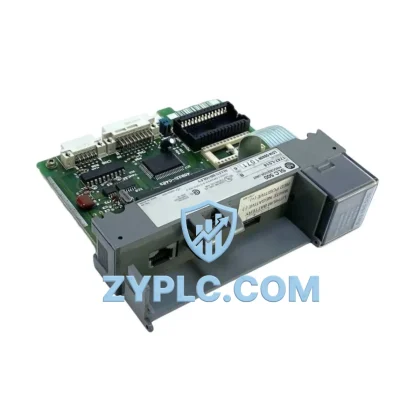
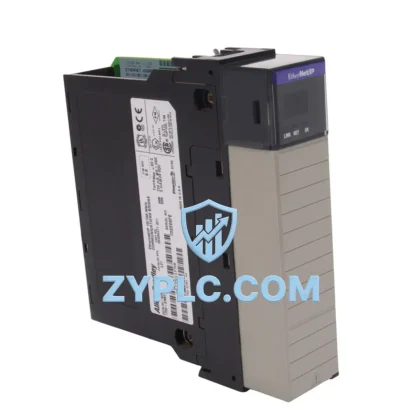
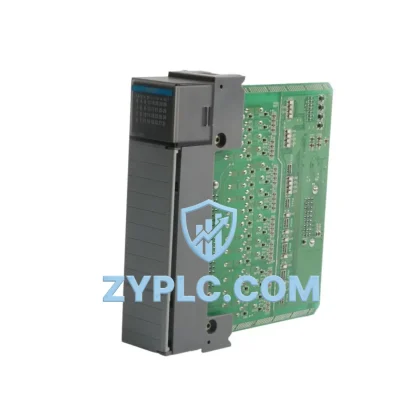
Allen-Bradley 1756-A10 System-Ready Backplane for ControlLogix Architecture
The Allen-Bradley 1756-A10 is a 10-slot ControlLogix chassis backplane engineered to serve as the structural and electrical backbone of Rockwell Automation’s premier control platform. Within a layered industrial automation architecture, the 1756-A10 does not operate in isolation — it is the physical and logical hub through which every module in the control tier communicates, receives power, and exchanges data. Understanding its role demands a system-level perspective that spans the control layer, I/O layer, network layer, power layer, HMI layer, and execution layer simultaneously.
In modern process and discrete manufacturing environments, the backplane is the silent enabler of system coherence. The 1756-A10 accommodates up to 10 ControlLogix modules in a single chassis, allowing engineers to populate slots with a combination of CPU modules, communication adapters, I/O modules, and specialty cards without compromising signal integrity or bus throughput. Its passive backplane design ensures that module-to-module communication occurs at the full ControlLogix backplane bandwidth, supporting deterministic scan cycles that are critical in high-speed packaging lines, power distribution substations, and petrochemical process control systems.
From a control architecture standpoint, the 1756-A10 is typically paired with a 1756-L8x series CPU — such as the 1756-L83E or 1756-L85E — which serves as the primary logic engine. The CPU communicates with all installed modules through the backplane bus, executing ladder logic, function block diagrams, and structured text programs while simultaneously managing tag-based data exchange across the entire system. The backplane’s slot capacity allows engineers to install redundant communication modules, such as the 1756-EN2T EtherNet/IP adapter, alongside the primary CPU, enabling fault-tolerant network topologies without requiring an additional chassis.
Power delivery to the 1756-A10 is handled by a dedicated ControlLogix power supply module — commonly the 1756-PA75 or 1756-PB75 — which mounts directly to the chassis and distributes regulated DC power across all backplane slots. This integrated power architecture eliminates the need for external rail-mounted power supplies for the control tier, simplifying cabinet layout and reducing wiring complexity. In redundant power configurations, dual power supply modules can be installed in separate chassis connected via the 1756-RM2 redundancy module, ensuring uninterrupted operation during power supply maintenance or failure events.
The I/O layer interfaces with the 1756-A10 chassis through locally installed ControlLogix I/O modules — such as the 1756-IB16 digital input module or the 1756-OF8 analog output module — or through distributed I/O adapters connected via EtherNet/IP or ControlNet. In distributed architectures, the 1756-EN2T communication module installed in the 1756-A10 chassis acts as the EtherNet/IP scanner, polling remote I/O racks populated with 1734 POINT I/O or 1769 CompactLogix I/O modules. This architecture allows a single 1756-A10 chassis to serve as the control hub for hundreds of I/O points distributed across a large plant floor, while maintaining sub-millisecond update rates for critical process variables.
At the network layer, the 1756-A10 chassis supports simultaneous installation of multiple communication modules, enabling multi-protocol network architectures. Engineers commonly install both a 1756-EN2T EtherNet/IP module and a 1756-CN2 ControlNet module in the same chassis, allowing the ControlLogix system to participate in both real-time I/O control networks and supervisory SCADA networks concurrently. This multi-network capability is particularly valuable in power generation and water treatment facilities, where legacy ControlNet infrastructure must coexist with modern EtherNet/IP-based SCADA systems during phased modernization projects.
The HMI layer connects to the ControlLogix system hosted in the 1756-A10 chassis via EtherNet/IP, with operator interface terminals such as the 2711P-T12W21D8S PanelView Plus 7 communicating directly with the CPU’s tag database. This direct tag-based communication model eliminates the need for intermediate data mapping, reducing engineering time during commissioning and simplifying long-term maintenance. In large control rooms, multiple HMI terminals can simultaneously access the same ControlLogix tag database, providing operators with consistent, real-time process visibility across all workstations.
For applications requiring high availability, the 1756-A10 chassis supports Rockwell Automation’s ControlLogix redundancy architecture. In a redundant configuration, two 1756-A10 chassis are connected via the 1756-RM2 redundancy module, with one chassis designated as the primary controller and the other as the secondary. The redundancy module continuously synchronizes the program state, I/O data, and communication connections between the two chassis, enabling bumpless switchover in the event of a primary controller failure. This architecture is widely deployed in oil and gas pipeline control systems, pharmaceutical batch processing, and critical infrastructure applications where unplanned downtime carries significant operational and safety consequences.
From a long-term maintenance perspective, the 1756-A10’s modular design provides significant advantages over integrated controller platforms. Individual modules can be replaced without disturbing adjacent slots, and the chassis itself can be swapped during scheduled maintenance windows without requiring rewiring of field devices. ZYPLC maintains in-stock inventory of the 1756-A10 and compatible ControlLogix modules, ensuring rapid delivery to support both planned maintenance and emergency replacement scenarios. All units supplied by ZYPLC are tested, inspected, and covered by a 12-Month Warranty, providing engineering teams with the confidence to specify this chassis in both new installations and system expansions.
Architecture Specification Table
| Parameter |
Specification |
| System Role |
10-Slot ControlLogix Chassis Backplane |
| Platform |
Rockwell Automation ControlLogix 1756 Series |
| Slot Capacity |
10 Slots (accepts all 1756-series modules) |
| Backplane Communication |
ControlLogix High-Speed Backplane Bus |
| Compatible CPUs |
1756-L8x Series (e.g. 1756-L83E, 1756-L85E) |
| Compatible Power Supplies |
1756-PA75, 1756-PB75, 1756-PA72, 1756-PB72 |
| Compatible Comm Modules |
1756-EN2T, 1756-CN2, 1756-DNB, 1756-RIO |
| Redundancy Support |
Yes — via 1756-RM2 Redundancy Module |
| Operating Temperature |
0°C to 60°C (32°F to 140°F) |
| Mounting |
Panel or DIN Rail (with adapter) |
| Dimensions (H × W × D) |
Approx. 290 × 400 × 130 mm (10-slot) |
| Certifications |
UL, CE, cUL |
| Warranty |
12-Month Warranty (ZYPLC) |
| Contextual Integration |
Supported — compatible with EtherNet/IP, ControlNet, DeviceNet architectures |
Coordinated Control System Design
The 1756-A10 chassis is the physical foundation upon which a complete ControlLogix control system is assembled. A typical coordinated system design begins with the selection of a 1756-L85E CPU, which provides the processing power and memory capacity required for large-scale process control applications. The CPU is installed in slot 0 of the 1756-A10, with remaining slots allocated to communication and I/O modules based on the application’s network and signal requirements.
Power is supplied by a 1756-PA75 AC power supply module, which mounts to the left side of the chassis and delivers regulated 1.2V, 3.3V, 5V, and 24V DC rails to all installed modules via the backplane. In applications requiring redundant power, a second 1756-PA75 can be installed in a companion chassis connected via the 1756-RM2 redundancy module, ensuring continuous power delivery even during supply maintenance.
Network connectivity is established through a 1756-EN2T EtherNet/IP communication module installed in an adjacent slot. This module provides dual-port EtherNet/IP connectivity, enabling the ControlLogix system to communicate simultaneously with SCADA servers, remote I/O adapters, variable frequency drives, and HMI terminals on the plant network. For legacy ControlNet installations, a 1756-CN2 ControlNet module can be installed alongside the EtherNet/IP adapter, providing backward compatibility with existing field devices and I/O racks.
Local I/O is accommodated through ControlLogix I/O modules installed in the remaining slots of the 1756-A10 chassis. Common configurations include the 1756-IB16 16-point 24VDC digital input module for discrete signal acquisition, the 1756-OB16E 16-point electronically fused digital output module for actuator control, and the 1756-IF8 8-channel analog input module for process variable measurement. For applications requiring motion control, the 1756-M02AE servo drive interface module can be installed in the chassis, providing direct integration with Kinetix servo drives without requiring a separate motion controller.
Terminal modules and wiring systems connect field devices to the I/O modules through 1492-IFM interface modules or direct screw-terminal wiring, depending on the application’s wiring density and maintenance requirements. In high-density installations, 1492-AIFM analog interface modules provide pre-wired connections between field transmitters and the 1756-IF8 analog input module, significantly reducing panel wiring time and the risk of wiring errors during commissioning.
Application in Layered Automation Systems
The 1756-A10 ControlLogix chassis finds application across a broad spectrum of industrial sectors, each with distinct requirements for control performance, network integration, and system availability.
In automotive manufacturing and high-speed packaging lines, the 1756-A10 serves as the primary control chassis for coordinating robotic welding cells, conveyor systems, and vision inspection stations. The chassis’s high-speed backplane enables sub-millisecond I/O scan times, ensuring precise synchronization between servo drives, pneumatic actuators, and vision systems. The EtherNet/IP network layer connects the ControlLogix system to MES platforms and barcode tracking systems, providing real-time production data for quality management and OEE reporting.
In power generation and electrical substation applications, the 1756-A10 chassis is deployed in protection and control panels where system reliability is paramount. The redundant controller architecture — using paired 1756-A10 chassis connected via the 1756-RM2 module — ensures continuous operation during controller maintenance or failure events. The ControlNet communication module provides deterministic, time-critical communication with protection relays and bay controllers, while the EtherNet/IP module connects to the substation SCADA system for remote monitoring and control.
In petrochemical and oil and gas process plants, the 1756-A10 chassis is integrated into safety instrumented systems and basic process control systems operating in SIL-rated environments. The chassis supports installation of 1756-L8xS Safety CPUs, enabling the ControlLogix platform to execute both standard control logic and IEC 61511-compliant safety logic within a single chassis, reducing panel space requirements and simplifying system integration.
In water and wastewater treatment facilities, the 1756-A10 chassis controls pump stations, chemical dosing systems, and filtration processes distributed across large geographic areas. The EtherNet/IP network layer connects remote pump stations via fiber optic Ethernet links, with the ControlLogix CPU managing distributed I/O racks populated with 1734 POINT I/O modules at each remote site. This architecture provides centralized control and monitoring of the entire water distribution network from a single ControlLogix system.
In mining and metallurgical applications, the 1756-A10 chassis controls conveyor drives, crusher motors, and flotation cell agitators in harsh environments characterized by high vibration, dust, and temperature extremes. The chassis’s robust construction and wide operating temperature range ensure reliable operation in these demanding conditions, while the modular design allows rapid module replacement during scheduled maintenance shutdowns.
Architecture Engineering FAQ
Q1: Is the 1756-A10 compatible with both older 1756-L6x CPUs and the current 1756-L8x series?
Yes. The 1756-A10 backplane is compatible with all generations of ControlLogix CPU modules, including the legacy 1756-L61, 1756-L63, and 1756-L64 processors as well as the current 1756-L81E, 1756-L83E, and 1756-L85E controllers. This backward compatibility protects existing investments in ControlLogix infrastructure and allows engineers to upgrade CPU modules without replacing the chassis or rewiring field devices. ZYPLC can supply both legacy and current-generation CPU modules to support phased system upgrades.
Q2: Can the 1756-A10 be used in a redundant controller architecture, and what additional components are required?
Yes. ControlLogix redundancy requires two identical 1756-A10 chassis, each populated with matching CPU modules (1756-L8xS or standard L8x with redundancy firmware), matching communication modules, and a 1756-RM2 redundancy module installed in a dedicated slot of each chassis. The two redundancy modules are connected via a dedicated fiber optic cable, which carries the continuous state synchronization data between the primary and secondary controllers. ZYPLC maintains stock of all components required for a complete redundant ControlLogix system and can provide application engineering support for redundancy configuration and commissioning.
Q3: What does the 12-Month Warranty cover, and how does ZYPLC support long-term maintenance of the 1756-A10?
ZYPLC’s 12-Month Warranty covers defects in materials and workmanship for all supplied 1756-A10 chassis units. Each unit undergoes functional testing prior to shipment to verify backplane integrity and module slot connectivity. In the event of a warranty claim, ZYPLC provides rapid replacement to minimize system downtime. Beyond the warranty period, ZYPLC supports long-term maintenance through ongoing inventory availability of the 1756-A10 and compatible ControlLogix modules, ensuring that engineering teams can source replacement components for systems with extended service lives. Contact ZYPLC at +86 19859288691 or plc.sales@zyplc.com for availability and lead time information.
© 2026 ZYPLC. All rights reserved.
Original Source: https://zyplc.com
Contact: +86 19859288691 | plc.sales@zyplc.com