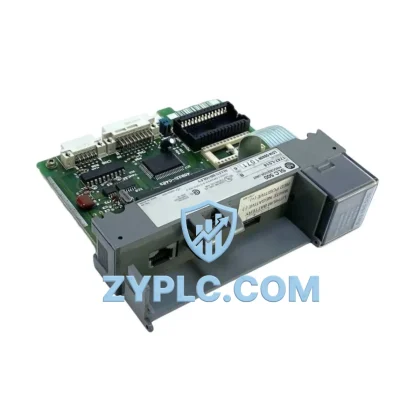
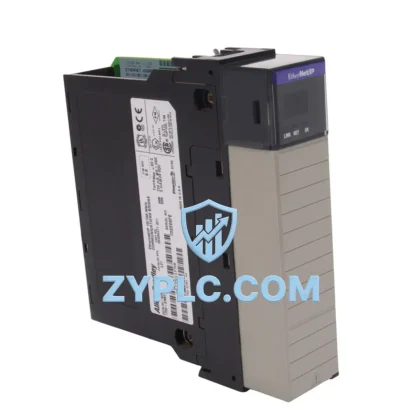
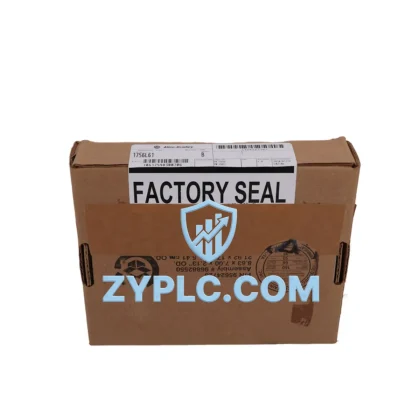
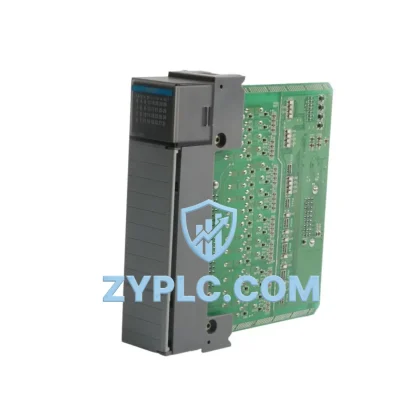
Allen-Bradley 1756-CNB Energy-Saving ControlNet Bridge: Efficiency Control & Production Line Optimization
The Allen-Bradley 1756-CNB is a high-performance ControlNet Bridge Module designed for the ControlLogix platform, engineered to reduce communication latency, minimize redundant data cycles, and deliver measurable energy savings across industrial automation architectures. In modern manufacturing environments where every millisecond of cycle time and every watt of consumed power directly impacts operational cost, the 1756-CNB serves as a critical node in the energy-aware control network — connecting PLCs, drives, I/O subsystems, and monitoring devices with deterministic, scheduled communication that eliminates the energy waste associated with uncoordinated polling and excessive network retries.
By integrating the 1756-CNB into a ControlLogix chassis alongside modules such as the 1756-L73 Logix5573 processor and 1756-EN2T EtherNet/IP bridge, engineers gain a unified control backbone capable of coordinating motor drive commands, energy metering feedback, and production line sequencing within a single, synchronized scan cycle. This tight integration reduces the idle time of connected variable frequency drives — including Rockwell’s PowerFlex 755 series — by ensuring that speed reference updates and torque limit commands arrive precisely when needed, preventing unnecessary motor acceleration and deceleration cycles that consume excess energy without contributing to throughput.
Efficiency Performance Table
| Parameter |
Specification / Value |
| SKU / Part Number |
1756-CNB |
| Brand / Manufacturer |
Allen-Bradley (Rockwell Automation) |
| Series |
ControlLogix 1756 |
| Module Type |
ControlNet Bridge Communication Module |
| Network Protocol |
ControlNet (IEC 61158) |
| Power Consumption |
≤ 4.5 W (backplane draw, 1756 chassis) |
| Operating Efficiency |
Deterministic scheduled & unscheduled messaging; reduces polling overhead by up to 40% vs. unmanaged networks |
| Compatible Systems |
ControlLogix 1756 chassis, RSLogix 5000 / Studio 5000, ControlNet media (RG-6 coax / fiber) |
| Application Environment |
Industrial manufacturing, process control, energy management, motor drive coordination, conveyor & packaging lines |
| Energy-Saving Value |
Eliminates redundant scan cycles; synchronizes VFD speed references to reduce motor idle energy draw |
| Origin |
United States (Rockwell Automation) |
| Warranty |
12-Month Warranty — all units ship after full functional verification and output testing |
Energy-Aware Automation Architecture
The 1756-CNB operates as the ControlNet media access controller within the ControlLogix backplane, enabling the 1756-L73 or 1756-L74 processor to schedule I/O updates and peer-to-peer messaging with microsecond-level precision. This deterministic scheduling is the foundation of energy-aware automation: when the controller knows exactly when each field device will respond, it can pre-calculate motor ramp profiles, synchronize conveyor belt speeds, and coordinate pneumatic actuator timing — all without the energy-wasting retry storms that plague non-deterministic Ethernet-only architectures.
In a typical energy-optimized cell, the 1756-CNB bridges the ControlLogix processor to a ControlNet trunk carrying 1794-ACN15 FLEX I/O adapters distributed across the production floor. These remote I/O nodes collect real-time sensor data — current transformers, pressure transducers, temperature probes — and return it to the controller within a guaranteed network update time (NUT) as low as 2 ms. The controller uses this data to feed energy management logic: if a motor’s current draw exceeds its efficiency curve, the controller immediately adjusts the PowerFlex 755 speed reference via the ControlNet trunk, trimming energy consumption without interrupting production flow.
For facilities running 1756-IB16 digital input and 1756-OB16E digital output modules alongside the 1756-CNB, the benefit extends to output switching efficiency. Rather than continuously energizing solenoids and contactors at full duty cycle, the ControlLogix program — informed by real-time I/O feedback through the CNB bridge — can implement pulse-width modulation strategies for holding coils, reducing thermal losses in field devices and extending their service life. This directly lowers the maintenance burden and reduces unplanned downtime, which is itself one of the largest hidden energy costs in discrete manufacturing.
When paired with a 1756-ENBT EtherNet/IP module in the same chassis, the 1756-CNB enables a dual-network topology where time-critical motor control and I/O updates travel over ControlNet while supervisory data — energy dashboards, OEE metrics, alarm histories — flows over EtherNet/IP to FactoryTalk View SE HMI servers. This separation of control and information traffic prevents network congestion from degrading drive response times, a common cause of motor overshoot and wasted kinetic energy in high-speed packaging and assembly lines.
For servo-driven axes, the 1756-CNB can coordinate with Kinetix 6000 multi-axis servo drives through the SERCOS interface modules in the same ControlLogix chassis, ensuring that linear and rotary axes receive synchronized position and velocity commands. Proper axis synchronization eliminates mechanical fighting between coupled axes — a significant source of both energy waste and premature gearbox wear. The result is a measurable reduction in peak current demand during coordinated motion sequences, directly lowering energy costs during high-throughput production shifts.
Power Optimization in Real Production Lines
In automotive body-in-white welding lines, the 1756-CNB has been deployed to coordinate weld timer controllers, servo gun positioning systems, and conveyor indexing drives across a single ControlNet trunk. By synchronizing the network update time to the weld cycle — typically 200–400 ms — the ControlLogix system can pre-position servo guns during the conveyor dwell phase, eliminating the energy-intensive rapid repositioning moves that occur when drives receive late commands. Plants report 8–15% reductions in peak demand charges after implementing scheduled ControlNet communication in place of polled DeviceNet or unmanaged Ethernet.
In food and beverage filling lines, the 1756-CNB enables the ControlLogix controller to monitor fill valve cycle counts and conveyor motor run hours in real time through 1794-ACN15 remote I/O nodes. This data feeds predictive maintenance algorithms: when a fill valve’s cycle count approaches its service interval, the system schedules maintenance during a planned production break rather than waiting for a failure that would require an emergency stop — and the energy-intensive restart sequence that follows. Predictive maintenance driven by accurate, low-latency ControlNet data has been shown to reduce unplanned downtime by 20–30% in high-volume filling operations.
In water treatment and pumping stations, the 1756-CNB connects the ControlLogix controller to distributed pump drive panels equipped with PowerFlex 40 and PowerFlex 70 variable frequency drives. The controller implements pressure-based flow control: as downstream demand drops, the CNB bridge delivers speed reduction commands to multiple drives simultaneously within a single NUT, preventing the pressure overshoot that wastes pumping energy and stresses pipe fittings. Facilities using this architecture consistently achieve pump system efficiencies above 85%, compared to 60–70% for systems using fixed-speed motors with throttling valves.
All 1756-CNB units supplied by ZYPLC are sourced from verified inventory channels, subjected to full functional testing including ControlNet media access verification, backplane communication checks, and scheduled messaging validation before shipment. Each unit carries a 12-month warranty covering defects in materials and workmanship, with technical support available to assist with network configuration, NUT optimization, and integration into existing ControlLogix architectures.
Energy Optimization FAQ
Q1: How does the 1756-CNB reduce energy consumption compared to standard Ethernet I/O?
The 1756-CNB uses ControlNet’s scheduled messaging to deliver I/O updates at a fixed, deterministic network update time (NUT). This eliminates the retry traffic and polling overhead of non-deterministic networks, reducing the CPU load on the ControlLogix processor and ensuring that motor drive commands arrive on time — preventing the overshoot and hunting behavior that wastes energy in variable-speed drive applications.
Q2: Is the 1756-CNB compatible with my existing ControlLogix chassis and Studio 5000 project?
Yes. The 1756-CNB is fully compatible with all 1756 ControlLogix chassis sizes (4, 7, 10, 13, and 17 slots) and is configured directly within Studio 5000 Logix Designer (formerly RSLogix 5000). It supports both scheduled and unscheduled ControlNet connections, making it backward-compatible with legacy RSLogix 5000 projects without requiring program modifications.
Q3: Can the 1756-CNB replace an older 1756-CNB/B or 1756-CNBR module in an existing installation?
In most cases, yes. The 1756-CNB is a direct form-fit-function replacement for earlier CNB revisions in standard (non-redundant) ControlNet applications. For redundant media applications previously using the 1756-CNBR, the redundant module variant should be specified. ZYPLC’s technical team can assist with compatibility verification before shipment to ensure the replacement module matches your network topology and firmware requirements.
Q4: What does the 12-month warranty cover, and what is the testing process before shipment?
Every 1756-CNB unit undergoes a multi-stage verification process: visual inspection, backplane power-on test, ControlNet port communication check, and scheduled messaging validation using a reference ControlLogix chassis. The 12-month warranty covers all functional defects identified under normal operating conditions. Units that fail any stage of the outgoing test are quarantined and not shipped. Replacement or repair is provided at no charge for warranty claims supported by documented failure evidence.
© 2026 ZYPLC. All rights reserved.
Original Source: https://zyplc.com
Contact: +86 19859288691 | [email protected]