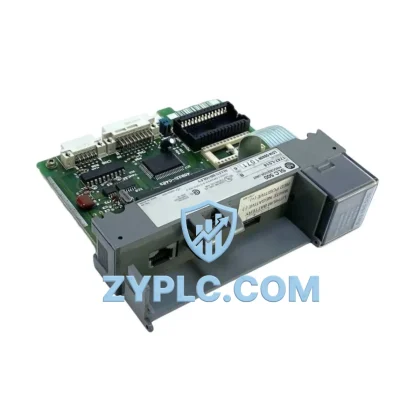
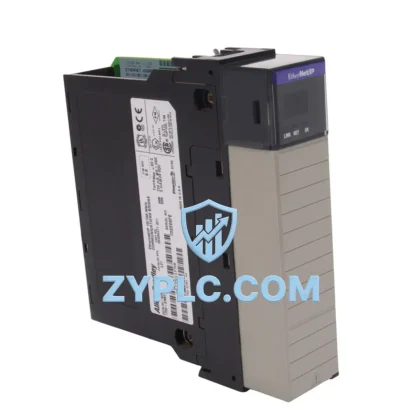
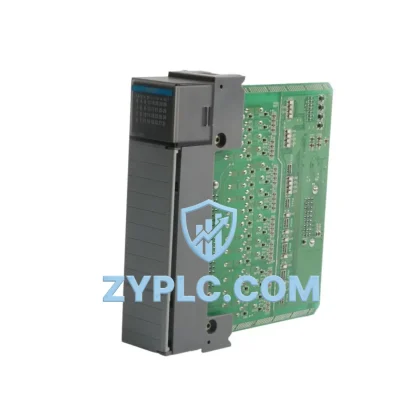
Allen-Bradley 1756-CNBR/E System-Ready ControlNet Bridge for ControlLogix Architecture
The Allen-Bradley 1756-CNBR/E is a deterministic ControlNet bridge module engineered for deployment within the Rockwell Automation ControlLogix platform. Rather than functioning as a standalone communication device, the 1756-CNBR/E occupies a critical position within a layered industrial control architecture — bridging the ControlNet network layer to the ControlLogix backplane and enabling synchronized, real-time data exchange across control, I/O, and peer-to-peer network segments. In complex automation environments where system consistency, redundancy, and long-term maintainability are non-negotiable, the 1756-CNBR/E delivers the structural communication backbone that keeps every layer of the control hierarchy aligned.
Designed for integration into the 1756 chassis ecosystem, this module supports both scheduled and unscheduled messaging across ControlNet, making it suitable for applications that demand deterministic I/O scanning alongside flexible peer messaging. Its dual-port ControlNet interface enables media redundancy configurations, ensuring that a single cable fault does not interrupt production. For engineers designing systems in power generation, petrochemical processing, water treatment, or advanced discrete manufacturing, the 1756-CNBR/E provides the communication reliability that mission-critical architectures require.
ZYPLC maintains verified stock of the 1756-CNBR/E with a 12-Month Warranty and global logistics support, ensuring that procurement, replacement, and system expansion timelines are met without compromise.
Architecture Specification Table
| System Role |
ControlNet Bridge Module — ControlLogix Backplane to ControlNet Network |
| Module SKU |
1756-CNBR/E |
| Brand / Platform |
Allen-Bradley / Rockwell Automation ControlLogix |
| Series |
1756 ControlLogix |
| Network Protocol |
ControlNet (IEC 61158 / ODVA) |
| Network Ports |
Dual BNC (coaxial) — supports media redundancy |
| Messaging Types |
Scheduled (I/O) and Unscheduled (explicit messaging) |
| Backplane Communication |
ControlLogix 1756 backplane — high-speed parallel bus |
| Node Capacity |
Up to 99 ControlNet nodes per network segment |
| Operating Voltage |
Backplane-powered via 1756 chassis (no external power required) |
| Operating Temperature |
0°C to 60°C (32°F to 140°F) |
| Mounting |
1756 chassis slot — any slot position |
| Certifications |
UL, CE, C-Tick |
| Contextual Integration |
Compatible with RSNetWorx for ControlNet, Studio 5000 Logix Designer |
| Warranty |
12-Month Warranty — ZYPLC Verified Stock |
Coordinated Control System Design
The 1756-CNBR/E does not operate in isolation — its value is realized through its role as the communication spine connecting multiple system layers within a ControlLogix architecture. At the control layer, a 1756-L73 or 1756-L75 ControlLogix CPU executes the control program and relies on the 1756-CNBR/E to extend its I/O reach across the ControlNet segment to remote chassis or distributed I/O racks. The CPU communicates with the bridge module via the high-speed 1756 backplane, ensuring that scan cycle integrity is maintained even under high I/O load.
At the power layer, a 1756-PA75 or 1756-PB75 power supply provides stable backplane voltage to the chassis, supporting the 1756-CNBR/E and co-resident modules without voltage sag during peak communication bursts. For redundant power architectures, dual power supplies with a 1756-PSCA2 power supply chassis adapter can be deployed to eliminate single points of failure at the power layer.
On the I/O layer, remote 1756-IB16 digital input modules and 1756-OB16E digital output modules installed in remote 1756 chassis communicate back to the primary controller via the ControlNet segment managed by the 1756-CNBR/E. For analog process signals, 1756-IF16 analog input modules provide 16-channel current/voltage acquisition, with data transported deterministically across the ControlNet bridge to the CPU scan table.
At the network layer, a 1756-ENBT or 1756-EN2T EtherNet/IP communication module co-exists in the same chassis, providing the upper-level EtherNet/IP path for SCADA integration, historian connectivity, and remote programming access via Studio 5000 Logix Designer — while the 1756-CNBR/E handles the deterministic ControlNet I/O network independently. This dual-network architecture separates real-time control traffic from information-layer traffic, improving both performance and cybersecurity posture.
For human-machine interface connectivity, a PanelView Plus 7 HMI terminal connected via EtherNet/IP reads tag data from the ControlLogix CPU, providing operators with real-time process visualization without interfering with the ControlNet I/O scan managed by the 1756-CNBR/E. At the execution layer, variable frequency drives and servo controllers connected through 1756-DNB DeviceNet bridge modules or direct ControlNet nodes receive setpoints and status commands routed through the bridge module’s scheduled messaging framework.
This coordinated architecture — spanning CPU, power supply, I/O modules, dual communication bridges, HMI, and field devices — demonstrates how the 1756-CNBR/E functions as a structural enabler of system consistency, not merely a peripheral communication card.
Application in Layered Automation Systems
Power Generation & Utilities: In turbine control and substation automation systems, the 1756-CNBR/E enables deterministic ControlNet I/O scanning across geographically distributed control panels, ensuring that protection relay status, breaker feedback, and analog process values are delivered to the ControlLogix CPU within defined scan windows. Media redundancy via dual coaxial ports ensures that a single cable fault does not trigger a protection system trip.
Petrochemical & Refinery Process Control: In continuous process environments where SIL-rated control loops and DCS-integrated PLC architectures coexist, the 1756-CNBR/E provides the ControlNet backbone for remote I/O racks installed in hazardous area junction boxes. Its deterministic scheduling ensures that flow, pressure, and temperature signals are scanned at consistent intervals regardless of unscheduled messaging traffic on the same network segment.
Water & Wastewater Treatment: Municipal water treatment facilities deploying ControlLogix-based SCADA architectures use the 1756-CNBR/E to connect remote pump station I/O panels to the central control room PLC chassis. The module’s ability to support up to 99 ControlNet nodes per segment allows a single bridge to serve multiple remote I/O drops across a large facility footprint.
Mining & Metals Processing: In conveyor control, crusher automation, and smelter process control systems, the 1756-CNBR/E supports high-availability architectures where ControlNet media redundancy is combined with ControlLogix controller redundancy (using 1756-RM2 redundancy modules) to achieve system uptime targets exceeding 99.9%.
Packaging & Discrete Manufacturing: High-speed packaging lines with distributed servo drives, vision systems, and reject mechanisms benefit from the 1756-CNBR/E’s scheduled ControlNet messaging, which guarantees that I/O updates arrive at the CPU within the machine’s motion control scan cycle, preventing timing-related rejects or line stoppages.
Architecture Engineering FAQ
Q1: Is the 1756-CNBR/E compatible with both ControlLogix and GuardLogix controller platforms?
The 1756-CNBR/E is designed for the 1756 ControlLogix chassis and is compatible with ControlLogix L6x and L7x series CPUs. GuardLogix safety controllers (1756-L6xS, 1756-L7xS) installed in the same chassis can also utilize the ControlNet bridge for standard (non-safety) I/O communication. Safety I/O on GuardLogix systems typically uses a dedicated safety network such as EtherNet/IP with CIP Safety; the 1756-CNBR/E handles the standard ControlNet I/O segment in parallel. Contextual Integration with RSNetWorx for ControlNet is required for network scheduling configuration.
Q2: Can the 1756-CNBR/E be used in a controller redundancy architecture, and what are the configuration requirements?
Yes. In a ControlLogix redundancy system using the 1756-RM2 redundancy module, the 1756-CNBR/E must be installed in matching slot positions in both the primary and secondary chassis. RSNetWorx for ControlNet must be used to configure the ControlNet schedule, and the network must be re-scheduled after any topology change. During a controller switchover, the ControlNet bridge in the new primary chassis assumes network ownership within the configured switchover window, maintaining I/O continuity for connected remote racks. The 12-Month Warranty covers both primary and redundant module deployments.
Q3: What is the recommended maintenance and replacement strategy for the 1756-CNBR/E in a long-term production environment?
Rockwell Automation recommends maintaining at least one spare 1756-CNBR/E per ControlNet segment in critical production environments. ZYPLC supports this strategy by maintaining verified stock with a 12-Month Warranty, enabling rapid replacement without extended lead times. During planned maintenance windows, the module can be replaced hot (with the chassis powered) if the chassis supports hot-swap for communication modules — verify chassis revision compatibility before performing hot-swap operations. After replacement, the ControlNet network schedule stored in RSNetWorx must be re-downloaded to the new module to restore deterministic I/O scanning. ZYPLC’s technical team can provide pre-shipment configuration verification upon request.
© 2026 ZYPLC. All rights reserved.
Original Source: https://zyplc.com
Contact: +86 19859288691 | [email protected]